
If you need a verified after-hours drug test right now, your realistic options are a walk-in occupational clinic with extended hours, a mobile collector who can meet you on-site, or an urgent-care network, though not all of these support DOT-compliant chain-of-custody collection. When timing is tied to a workplace incident or federal regulation, contact a dedicated occupational provider or request mobile dispatch so the collection holds up under audit.
TL;DR:
- Mobile and walk-in occupational clinics with experience in DOT testing offer the most reliable after-hours results, often with same-day turnaround and audit-ready paperwork.
- Confirm whether providers handle DOT Part 40 collections, work with a Consortium or MRO, and can dispatch mobile collectors to meet urgent needs.
- Urine tests are the most common for both DOT and non-DOT employers, but positive results always require lab confirmation before employment action.
- Collection procedures, including specimen sealing and documentation, are consistent regardless of the time or location, emphasizing the importance of proper protocol to avoid compliance issues.
- Having an established relationship with a licensed occupational testing provider ensures faster, compliant results during emergencies while preserving critical documentation.
Table of Contents
- Where to find after-hours testing: walk-ins, urgent care, and mobile collectors
- Which specimen type you need after hours: urine, oral fluid, hair, or breath
- What happens during an after-hours collection, from check-in to confirmation
- How employers should arrange after-hours testing and document the decision
- Quick checklist for people needing an after-hours drug test
- Why a dedicated occupational testing provider makes after-hours testing easier
- Prioritizing safety and documentation when time is limited
- How Total Tox can help with urgent and after-hours testing
- Sources
- FAQ
Where to find after-hours testing: walk-ins, urgent care, and mobile collectors
Three types of providers handle testing outside standard business hours, and they are not interchangeable when compliance is on the line.
Walk-in occupational clinics built around workplace testing tend to keep extended hours specifically because employers need fast turnaround for pre-employment, random, or reasonable-suspicion screens. These clinics are usually set up to issue DOT paperwork, coordinate with a Medical Review Officer (MRO, the licensed physician who reviews lab results before they go to an employer), and hand you a copy of your chain-of-custody form on the spot.
Urgent-care centers are often the most visible option in the evenings or on weekends, but many of them are not equipped for regulated testing. They may run a quick urine screen for a private employer’s non-DOT policy, but they frequently lack a relationship with a Consortium/Third-Party Administrator (C/TPA) or MRO, which FMCSA guidance notes is a common gap at retail pharmacy and urgent-care locations. If your test needs to satisfy DOT, USCIS, or a court order, confirm this before you walk in, not after.
Mobile or on-site collectors solve a different problem: they come to you. That matters most after a workplace accident, at a remote job site, or any time a delay would put a DOT post-accident window at risk. A trained collector arrives with the same chain-of-custody materials a clinic would use, which keeps the specimen legally defensible even though the collection happened in a parking lot or a site trailer instead of a lab.
Before you commit to any provider, a few quick questions save hours of rework:
- Ask whether they work with a C/TPA and an MRO, not just a lab.
- Confirm which specimen types they collect on-site: urine, oral fluid, hair, or breath.
- Ask directly whether they handle DOT Part 40 collections or only non-regulated screens.
- If you cannot travel, ask whether they can dispatch a mobile collector the same day.
Aggregator sites that list “drug test near me” results can be a fast way to scan local options, though listings such as SolvHealth’s show that hours, pricing, and test types vary widely by location, so a phone call to verify DOT capability is still worth the two minutes it takes.
Which specimen type you need after hours: urine, oral fluid, hair, or breath
The right test depends on what you are trying to prove and how much time has passed since potential use.
Urine testing remains the most common choice for both DOT and non-DOT employers because it is fast to collect and widely accepted. A negative result typically clears someone quickly, but a positive screen is never final on its own. It has to go to a lab for confirmation using gas chromatography-mass spectrometry (GC/MS) or liquid chromatography-tandem mass spectrometry (LC-MS/MS) before an employer can act on it.
Oral fluid, or saliva testing, is well suited to recent use and travels well with mobile collectors because the collection itself is observed by design, which removes some of the tampering concerns that come with unobserved urine collection. It is a practical choice for post-incident testing when a mobile unit is already on-site.
Hair follicle testing shows drug use over a longer window, generally several months, but it is a poor fit for an urgent same-day request. Collection usually requires scheduling and a short wait for results, making it better suited to pre-employment screening than to post-accident response.
Breath or Breath Alcohol Testing (BAT) is the standard for alcohol, and timing is unforgiving. DOT employer guidance calls for breath alcohol testing within 2 hours of a qualifying accident when it is safe to do so, and documents the reasoning if that window is missed.
Home and instant test kits give only a preliminary result. Any presumptive positive from an over-the-counter kit must be confirmed in a lab before it can justify an employment decision, according to FDA guidance on home-use drug tests. A kit purchased at a pharmacy is a screening tool, not a verdict.
- Urine: fast, broad acceptance, positives require lab confirmation.
- Oral fluid: detects recent use, works well for mobile collectors or observed collections.
- Hair: detects a longer history, needs scheduling rather than same-day turnaround.
- Breath: alcohol-specific, governed by a strict post-accident time window.
What happens during an after-hours collection, from check-in to confirmation
A compliant collection follows the same sequence whether it happens in a clinic at midnight or in a mobile unit in a warehouse parking lot.
- The collector verifies photo ID and reviews the consent and chain-of-custody form with you.
- For urine collections, most are unobserved unless there is a specific reason (such as a prior attempt to substitute a specimen) requiring an observed collection.
- The specimen is sealed in front of you, and you both sign the chain-of-custody form confirming the seal is intact.
- The sample is packaged for courier transport to a certified laboratory, or for a rapid on-site screen, read immediately.
- A non-negative rapid screen is sent for laboratory confirmation; a confirmed result goes to the MRO for review before it reaches the employer.
Turnaround depends on which stage you are asking about. A rapid on-site screen can produce a preliminary result in minutes. Laboratory confirmation of a non-negative screen typically takes another 24 to 72 hours, depending on the lab’s volume and courier schedule.
DOT and United States Coast Guard rules build in specific windows for post-accident testing. DOT employer guidance lays out collection timeframes by specimen type and stresses that a supervisor’s good-faith decision to test, made and documented promptly, matters more than hitting an impossible deadline that would compromise safety. If a window closes before collection happens, write down why: the safety situation, the time the decision was made, and the time collection was attempted.
Pro Tip: Keep a folder, physical or digital, with the chain-of-custody form, the supervisor’s decision notes and timestamp, and the final MRO report together. Auditors ask for all four, and scrambling to find one after the fact is the most common compliance gap.
Four things to keep after any after-hours collection:
- The signed chain-of-custody form.
- Written notes on who made the testing decision and when.
- The exact collection timestamp.
- The final MRO-reviewed report.
How employers should arrange after-hours testing and document the decision
A workplace incident at 9 PM does not wait for business hours, and the steps an employer takes in the first hour often matter as much as the test result itself.
- Confirm everyone is safe and address any medical needs before anything else.
- Make and document the decision to test, including who made it and exactly when.
- Contact a provider that can collect immediately, whether that means directing the employee to a walk-in clinic or dispatching a mobile collector.
- Preserve the employee’s access to personal effects as little as possible between the decision and the collection to limit tampering risk.
- File the chain-of-custody form, decision notes, and MRO report together once results come back.
Not every provider that answers the phone at night can actually deliver a defensible result. A short checklist before you call helps:
- Confirm DOT Part 40 capability if the role is safety-sensitive.
- Ask whether results come back MRO-reviewed, not just lab-reviewed.
- Check whether the provider’s staff is proficient in chain-of-custody paperwork, not just specimen collection.
- Ask about mobile or on-site dispatch for remote sites or after-hours incidents.
- Get a straight answer on turnaround time for both the screen and the lab confirmation.
- Request a sample of their audit-ready documentation before you need it in an emergency.
Supervisors play a direct role in specimen integrity. Simple steps, like escorting the employee to the collection site rather than letting them travel alone, or limiting access to bags and personal items until after collection, reduce the chance of a tampered or diluted sample. DOT’s Part 40 Q&A covers the conditions under which alcohol testing applies and the return-to-duty process, which is worth reviewing before an incident happens rather than during one.
The strongest position an employer can be in is having an after-hours workflow already arranged with a provider, so nobody is searching for an open clinic while a compliance clock is running. Fleet managers facing DOT random testing requirements in particular benefit from a standing relationship rather than a one-time emergency call.

Quick checklist for people needing an after-hours drug test
If you are the one being tested rather than arranging the test, a little preparation keeps the appointment short and the result accurate.
- Bring photo ID and any paperwork or order number your employer gave you.
- Have a list of current prescriptions and over-the-counter medications ready, since some can affect screening results.
- Ask ahead of time whether the collection will be observed or unobserved.
- Confirm whether a non-negative screen will go to lab confirmation and how long that typically takes.
- If the test is for DOT compliance or an immigration exam, confirm the provider issues MRO-reviewed, DOT-compliant results before you go.
- If the nearest clinic is closed, ask whether a mobile collector can come to you instead.
None of this takes more than a few minutes on the phone, and it avoids the worst outcome: showing up somewhere that cannot actually produce a result your employer or the government will accept.
Why a dedicated occupational testing provider makes after-hours testing easier
Speed only helps if the paperwork behind it holds up, which is the gap between a clinic that happens to be open late and one built around workplace and compliance testing.
Total Tox has operated in the occupational testing space for over 10 years, running walk-in collections typically completed in under 15 minutes with results often back within 24 hours. Every result is MRO-reviewed, and the paperwork is built to be audit-ready, which matters most in exactly the after-hours scenarios this article covers: a post-accident collection at night, a pre-employment screen before a shift starts, or a DOT physical scheduled around someone’s actual work hours.
Fast turnaround matters most when downtime is expensive. A driver who cannot be dispatched, or a construction crew that cannot start a shift, costs an employer money for every hour a result is pending, and a same-day walk-in with next-day results closes that gap.
- MRO-reviewed results reduce the chance of a false positive driving an employment decision.
- Audit-ready documentation means the chain-of-custody form, collection record, and MRO report are organized and ready if a regulator asks.
- Same-day, walk-in scheduling removes the need to book days in advance for routine or urgent testing.
Total Tox operates primarily locally, and mobile service availability for after-hours or on-site collection depends on location, so it is worth calling ahead to confirm coverage and scheduling for your specific situation.
Prioritizing safety and documentation when time is limited
Testing decisions made under time pressure go wrong in one of two ways: either safety gets rushed to hit a deadline, or paperwork gets skipped to save a few minutes. Neither is worth it. Safety comes first, always, and documentation comes immediately after, because a missed window explained in writing holds up far better than a rushed collection that raises questions later. The employers who handle after-hours testing best are the ones who already know who to call before they need to.
— Total Tox
How Total Tox can help with urgent and after-hours testing
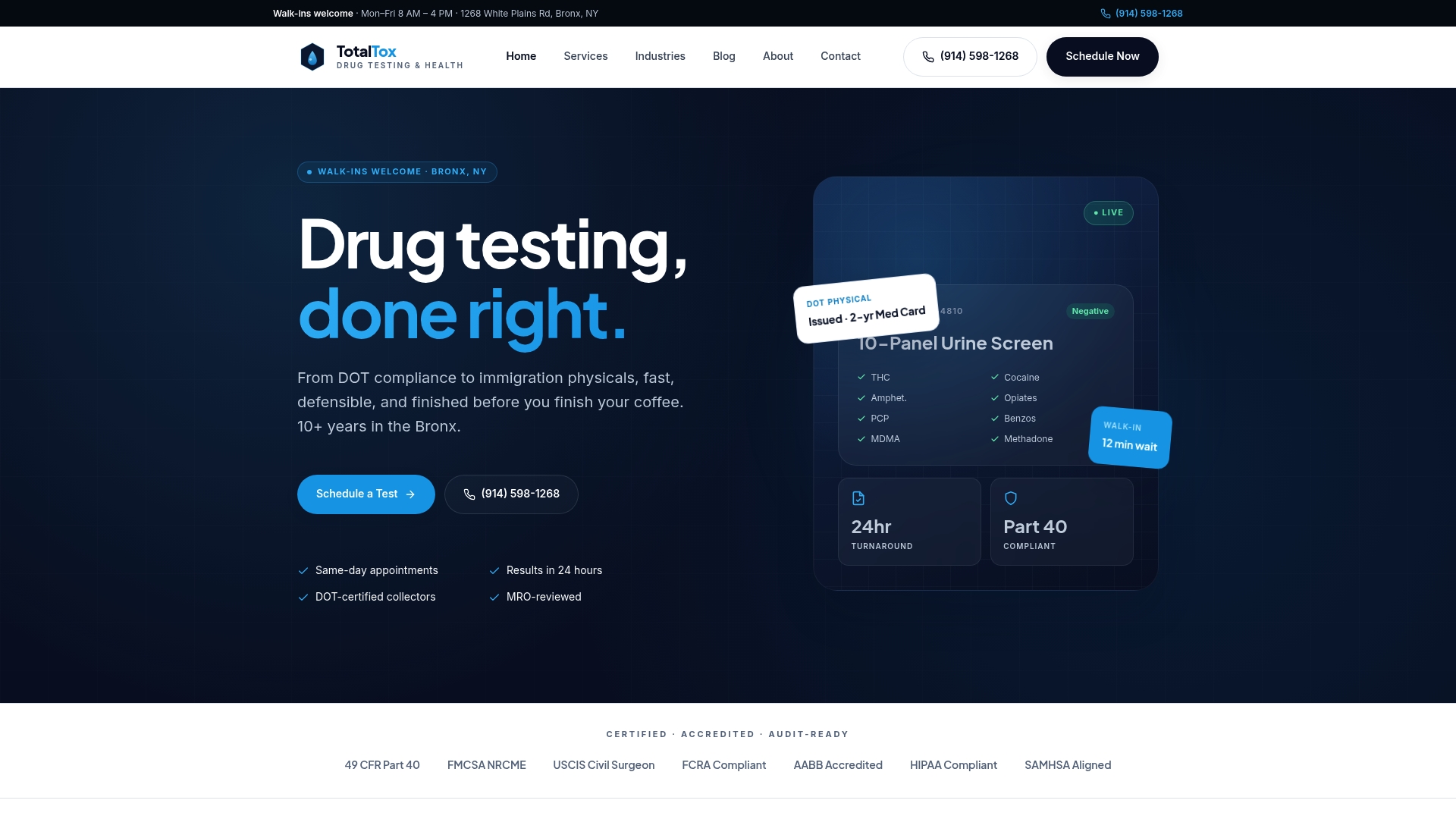
Total Tox offers walk-in collections for urine, oral fluid, and hair testing, along with DOT and employee physicals, immigration medical exams, and MRO-reviewed reporting, all designed to get you a result fast without sacrificing the documentation a compliance program needs.
- Walk-in, same-day collections with results typically back within a short turnaround time.
- DOT Drug & Alcohol Testing with audit-ready chain-of-custody paperwork.
- MRO-reviewed results for both DOT and non-DOT employers.
To schedule a test or ask about mobile collection availability, contact Total Tox directly. Bring photo ID and any employer paperwork, and call ahead if you are outside the Bronx service area to confirm whether mobile collection can reach you.
Sources
- Drugs of Abuse Home Use Test | FDA
- What Employers Need To Know About DOT Drug and Alcohol Testing (ODAPC)
FAQ
Does CVS do a drug screening?
Retail pharmacies like CVS generally sell over-the-counter home-use test kits rather than performing on-site DOT-compliant drug screening collections. For employment, DOT, or immigration testing, you need a provider with chain-of-custody procedures and MRO review, which FMCSA notes most retail pharmacy locations are not set up to provide.
Can I pass a drug test after 48 hours?
Detection windows vary by substance, frequency of use, and specimen type, so there is no single timeframe that applies to everyone. Oral fluid and urine tend to detect more recent use, while hair testing can reflect use from months earlier, and any presumptive result still requires lab confirmation before it affects an employment decision.
Does Walgreens do walk-in drug tests?
Walgreens primarily sells home-use drug test kits rather than offering regulated, on-site collection with chain-of-custody documentation. For DOT, workplace, or immigration testing, an occupational clinic or mobile collector that works with a C/TPA and MRO is the appropriate choice.
Can urgent care detect fake pee?
Collection protocols, such as temperature strip checks on the specimen and limiting access to personal items, are designed to catch substituted or tampered samples, and many urgent-care sites follow similar steps to occupational clinics. Whether a given urgent-care location has these safeguards in place for a regulated test should be confirmed directly, since not all of them perform DOT-compliant collections.