
A standard U.S. background check typically runs from a low tens to around a hundred dollars per candidate, while multi-jurisdiction or executive-level packages can cost significantly more. The biggest swings in price come from scope (how many counties, states, or countries you need searched), pass-through fees charged by courts and state agencies, and how fast you need results. Even the federal government charges a fee for records: the FBI’s Identity History Summary costs $18 on its own.
TL;DR:
- For low risk, high volume roles, an instant database search plus one county search typically costs $30 to $60, but database records can be incomplete.
- Roles involving safety risks often require multiple county searches, driving records, and fingerprinting, bringing budgets to $75 to $150 per candidate.
- Court and agency fees may be billed separately, so request a sample invoice and full fee list before comparing vendors’ quoted package prices.
- County searches can take days to two weeks, while FBI checks through an approved channeler take 24 to 72 hours; rush processing adds fees.
- Employers using reports from outside screening companies must budget for disclosure, consent, dispute handling, and adverse action steps under the Fair Credit Reporting Act.
Table of Contents
- Cost by check type: what you actually get for the price
- Why your invoice has extra fees: pass-through and court charges
- How fast you need results changes what you pay
- Budgeting for screening: matching spend to role risk
- Fast, audit-ready testing that fits your hiring timeline
- Balancing cost, speed, and legal defensibility
- Get walk-in testing and fingerprinting without the wait
- FAQ
- Sources
Cost by check type: what you actually get for the price
Not all background checks search the same records, and the price tag tells you a lot about what’s included. An instant database search is cheap because it pulls from aggregated, pre-existing data rather than contacting a courthouse in real time. A county-level criminal search costs more because someone, or some automated system, is querying an actual court record repository.
Here’s how the major check types typically compare:
| Check type | Typical price range | What it covers |
|---|---|---|
| Instant national database search | low tens of dollars | Aggregated criminal data from multiple sources, fast but can miss or misreport records |
| County criminal search | $5 to $25 per record | Direct courthouse record pull, the gold standard for accuracy |
| Statewide criminal search | low tens of dollars per state | State repository data, coverage varies by state law |
| Motor vehicle record (MVR) | $5 to $25 | Driving history, required for roles involving a company vehicle |
| FBI Identity History Summary | $18 flat | Federal fingerprint-based record, limited employment use on its own |
| Employment/education verification | low tens of dollars per verification | Confirms past jobs, degrees, or licenses |
| Fingerprint-based (Live Scan) check | around a hundred dollars | Required for licensing, healthcare, education, and government roles |
A few patterns matter for budgeting:
- County checks add up fast because candidates with multiple past addresses often need two or three counties searched, not one.
- Statewide and MVR checks are useful add-ons for roles tied to driving or state licensing, not substitutes for a full criminal history review.
- The FBI Identity History Summary fee of $18 covers only the federal fingerprint-based record and doesn’t replace a commercial employment screen, since it may not include every state’s repository data.
- Fingerprint-based checks (Live Scan) often cost more upfront but are mandatory for many licensed professions, including healthcare and education, where state law requires them regardless of price.
If you’re comparing vendors, ask exactly which of these components are bundled into a quoted “package price” and which are billed separately. A $29 quote that excludes county fees looks very different once those charges land on the final invoice.
Why your invoice has extra fees: pass-through and court charges
The quoted price for a background check rarely includes everything you’ll actually pay. Courts, state agencies, and county clerks charge their own fees to release records, and vendors pass those costs directly to you rather than absorbing them into a flat rate.
Common pass-through charges include:
- County clerk record fees, often $5 to $25 per record depending on the jurisdiction.
- State repository access fees for statewide criminal or sex offender registry searches.
- MVR state charges, which vary because each state’s Department of Motor Vehicles sets its own fee schedule.
- Alias searches and Social Security number traces, usually small add-ons but billed separately from the base check.
- Manual courthouse pulls, required when a county has no electronic record access, which cost more because a human has to physically retrieve the file.
- International record requests, which can add weeks and significantly higher fees due to translation and foreign registry access.
Vendors bill these costs in one of two ways: itemized line items on the invoice, or bundled into a single per-check price that assumes an average candidate history. Bundled pricing is simpler to budget but can hide the fact that a candidate with five past addresses costs more to screen than one who has lived in the same county for a decade.
Pro Tip: Ask any vendor for a sample invoice and a full pass-through fee list before you sign a contract, so you know exactly what a complex candidate history will cost versus a simple one.

How fast you need results changes what you pay
Speed and price move together in background screening. An instant database search returns results in minutes because it’s querying pre-aggregated data, but a county courthouse pull can take days to weeks depending on how that jurisdiction processes requests.
- Instant database checks: typically minutes, lowest cost, lowest completeness.
- County criminal checks: typically a few days to two weeks, cost rises with manual courthouse involvement.
- FBI channeler-routed checks: often 24 to 72 hours when submitted through an approved channeler, compared with longer processing for a standard mailed applicant request.
- International background checks: often several weeks to a few months due to foreign registry access and translation needs.
- Lab-based drug testing: results often return within 24 to 48 hours for standard panels, with rapid point-of-collection options available at a different price point than send-out lab testing.
Rush requests, whether a courthouse expedite fee or a request to prioritize processing, typically add a surcharge on top of the base price. For high-volume, low-risk hiring, standard turnaround is usually the better value. For a safety-sensitive role you need to fill this week, paying for expedited processing can be worth the premium.
Budgeting for screening: matching spend to role risk
The right screening budget depends on what’s at stake if the check misses something. A rule of thumb many HR teams use: spend less per hire on high-volume, low-risk roles and more on safety-sensitive or executive positions where a bad hire carries real liability.
- Low-risk, high-volume roles (retail, warehouse, seasonal): an instant database check plus one county search often covers the basics for $30 to $60 per candidate.
- Safety-sensitive roles (transportation, healthcare, childcare): budget for multi-county checks, MVR, and fingerprint-based screening, often $75 to $150 per candidate.
- Executive or high-trust roles: comprehensive, multi-jurisdiction checks with education and employment verification can run $150 to $500 or more.
To build a realistic per-hire estimate, add up the base criminal check, any pass-through county fees, fingerprinting if the role requires it, drug testing, and a line for administrative time spent on adjudication and recordkeeping. That last item is easy to overlook, but it’s real.
FTC guidance confirms that employers using third-party background reports must follow specific disclosure, consent, and adverse-action procedures under the Fair Credit Reporting Act, which means dispute-handling and adverse-action workflows are part of your true cost even though they don’t appear on the vendor’s price sheet.
Before signing with any vendor, ask:
- What’s included in the base price, and what’s billed as a pass-through?
- What’s your average turnaround time for county criminal checks in my hiring states?
- Can you provide a sample invoice showing a typical candidate’s full charges?
- How do you handle FCRA-required disputes and adverse-action notices?
SHRM’s guidance on budgeting for reliable background checks notes that comprehensive checks involving county-level validation cost more than instant database-only services, and recommends budgeting for defensibility rather than defaulting to the cheapest option.
Fast, audit-ready testing that fits your hiring timeline
Background checks are only part of a compliant hiring process, and for many employers, drug and alcohol testing is the piece that actually determines whether an offer can be finalized. We run walk-in urine, saliva, and hair follicle drug testing with results typically delivered within 24 hours and reviewed by a Medical Review Officer before delivery.
- Walk-in collections for urine, saliva, and hair follicle drug testing, with no appointment required for most tests.
- Live Scan fingerprinting and background-check support for roles that require fingerprint-based screening are available.
- We provide results reviewed by a Medical Review Officer to give you a medically verified outcome, not just raw lab data.
- We provide documentation designed to support compliance reviews such as DOT, OSHA, and USCIS.
Faster, cleanly documented testing shortens time-to-hire and cuts down on the administrative back-and-forth that happens when paperwork is incomplete or results are delayed. For roles where drug testing and fingerprinting are part of the compliance chain, consolidating that work with a single walk-in clinic reduces the number of handoffs between your HR team and separate labs.
Balancing cost, speed, and legal defensibility
The cheapest check isn’t always the right check. For high-volume, low-risk roles, an instant database search plus speed is a reasonable trade, since the cost of a screening miss is low and the hiring pace matters more. For safety-sensitive or high-trust roles, the calculus flips: a county-validated, fingerprint-backed check costs more up front, but SHRM’s own guidance is clear that validating database hits against actual court records reduces legal risk, which matters far more than the per-check savings when a bad hire in a safety-sensitive role can cost a company far more than any screening budget. Weigh what a hiring mistake actually costs you before you shop by price alone.
— Total Tox
Get walk-in testing and fingerprinting without the wait
Pricing transparency matters as much as speed when you’re budgeting for compliance testing. We keep our process simple: walk in, get tested, and receive MRO-reviewed results within 24 hours, backed by audit-ready documentation your compliance team can hand over without a second look.
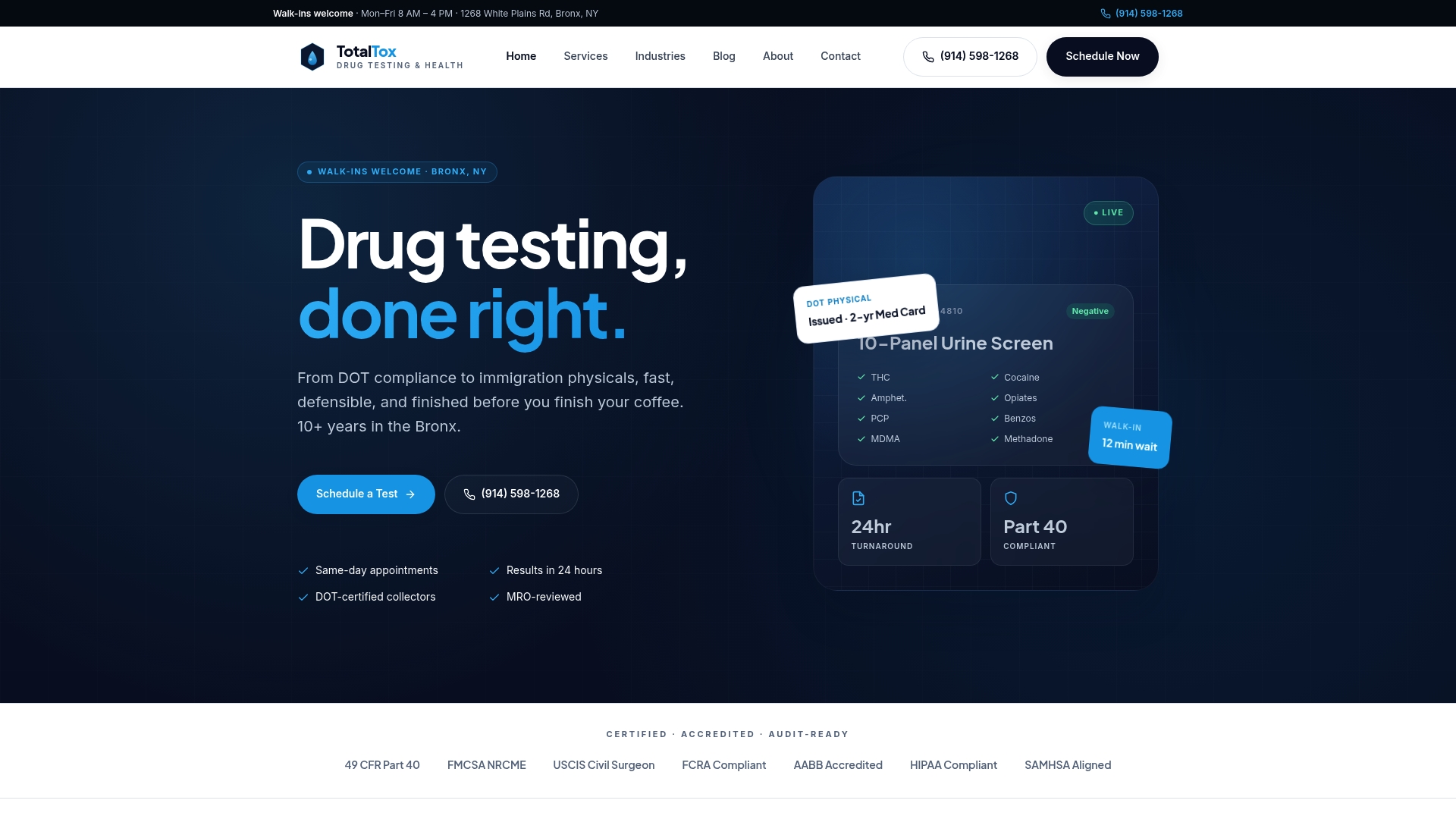
- We offer walk-in urine, saliva, and hair follicle drug testing without the need for long wait times for appointments.
- Live Scan fingerprinting and background-check services are offered alongside drug and alcohol testing.
- DOT and employee physicals, plus immigration medical exams, are available at the clinic.
- A sample pricing packet is available, allowing comparison of costs before commitment.
Healthcare employers in particular face tight hiring windows, and sector-specific hiring platforms report significant background-check bottlenecks for nursing roles, which makes fast, reliable testing even more valuable when a credentialed hire is waiting to start. If you need rapid, compliant testing for an open role, visit our services page to check pricing and same-day availability.
FAQ
How long does a Canadian criminal background check take?
This guide focuses on U.S. background check pricing and processes, so Canadian timelines fall outside what we cover here. For U.S. hires, county criminal checks typically take a few days to two weeks, while FBI channeler-routed checks often return in 24 to 72 hours.
Is a background check business profitable?
Profitability for a screening business depends on volume, pricing model, and how much is spent on pass-through fees versus margin, factors that vary widely by vendor and region. We don’t have published data specific to that question, so we’d rather not guess at a number.
What’s the difference between a background check and a federal background check?
A standard background check usually combines county or statewide criminal searches with database screening, while a federal background check, such as the FBI’s Identity History Summary, searches federal fingerprint-based records for a flat $18 fee. The federal summary alone typically isn’t sufficient for employment screening since it may not include state-level repository data.
What is the fastest way to get a FBI background check?
Submitting your request through an FBI-approved channeler instead of mailing an applicant request directly to the FBI often cuts processing to 24 to 72 hours instead of a longer standard mail turnaround. Channelers charge an additional routing fee on top of the FBI’s $18 Identity History Summary fee.
Sources
- Identity History Summary Checks FAQs — FBI
- Background checks: What employers need to know — Federal Trade Commission
- How much should a reliable background check cost? — SHRM