
Most pre-employment background checks finish in 1 to 5 business days, with many components returning results in 24 to 72 hours. That estimate assumes the candidate signed consent right away, the provider pulls from an API-connected state repository instead of mailing a request, and nothing crosses an international border. Miss any of those assumptions and the timeline stretches fast.
Here’s the range you’re actually working with:
-
Database-only criminal check: same day to 24 hours
-
Full standard package (criminal, employment, education): 1 to 5 business days
-
FBI fingerprint check via LiveScan: 3 to 7 business days
-
County courthouse or international records: 1 to 4 weeks
Roughly 80% of standard checks return within five business days.
Key Takeaways
Background check speed depends less on luck than on data accuracy, provider technology, and which components run in parallel rather than in sequence.
| Point | Details |
|---|---|
| Standard timeline | Most full pre-employment checks finish in 1 to 5 business days, with 80% done inside five days. |
| Fingerprint checks are slower | FBI LiveScan runs 3 to 7 business days; mailed fingerprint cards can take 8 to 12 weeks. |
| Biggest controllable factor | Complete address and alias history from the candidate prevents the most common delay. |
| Escalate on silence, not slowness | A missing action log or unexplained deadline miss is a red flag; a manual courthouse pull is not. |
| Drug testing can be same-day | Total Tox offers walk-in collection under 15 minutes with MRO-reviewed results within 24 hours. |
Table of Contents
Background Check Turnaround Time by Type of Search
Every screening package is a bundle of separate searches running on their own clocks, and the slowest component sets your finish line. Knowing each piece’s typical range lets you build a realistic timeline instead of guessing.
Criminal record checks split into two speeds. A national database search, which cross-references millions of records instantly, often comes back the same day. A county-level courthouse search, which sometimes requires a human clerk to physically pull a file, commonly adds 2 to 5 business days and can stretch to two weeks in rural jurisdictions with limited staff.
Employment and education verification depend on who’s on the other end of the phone. Automated systems like The Work Number can confirm a job in minutes. A small business without HR software might take a week to call back. Education verification through clearinghouses like the National Student Clearinghouse typically runs 3 to 7 business days, longer during summer break when registrar offices are short staffed.
MVR (motor vehicle record) checks are usually the fastest line item. Many states offer real-time or same-day access, while a handful still require 1 to 3 business days for manual processing.
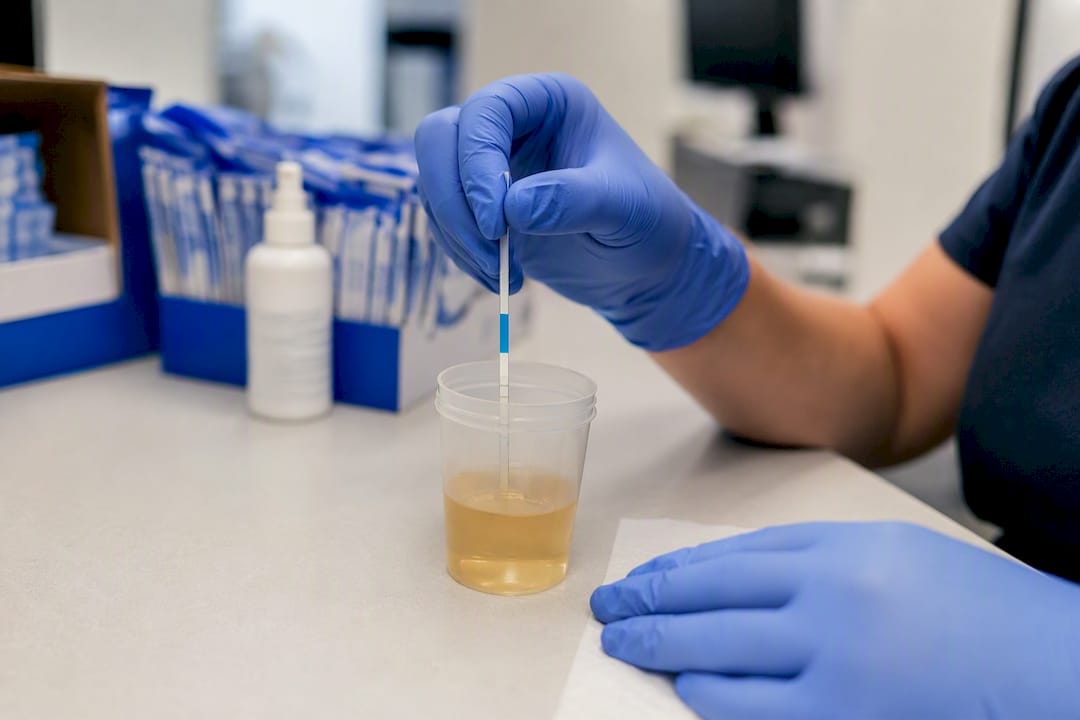
Drug testing has its own split. Onsite rapid testing can produce a preliminary result in under 15 minutes, though a positive screen still requires lab confirmation and a Medical Review Officer’s sign-off, which typically adds a day or two.
Here’s how the pieces typically stack:
| Check Type | Typical Range | Slow-Case Upper Bound |
|---|---|---|
| Instant criminal database | Same day | 24 hours |
| County courthouse search | 2 to 5 business days | 2 weeks |
| Employment verification | 1 to 3 business days | 1 to 2 weeks (small employers) |
| Education verification | 3 to 7 business days | 3 weeks (summer months) |
| MVR/driving record | Same day to 1 business day | 3 business days |
| FBI fingerprint (LiveScan) | 3 to 7 business days | 2 weeks |
| International records | 1 to 2 weeks | 4+ weeks |
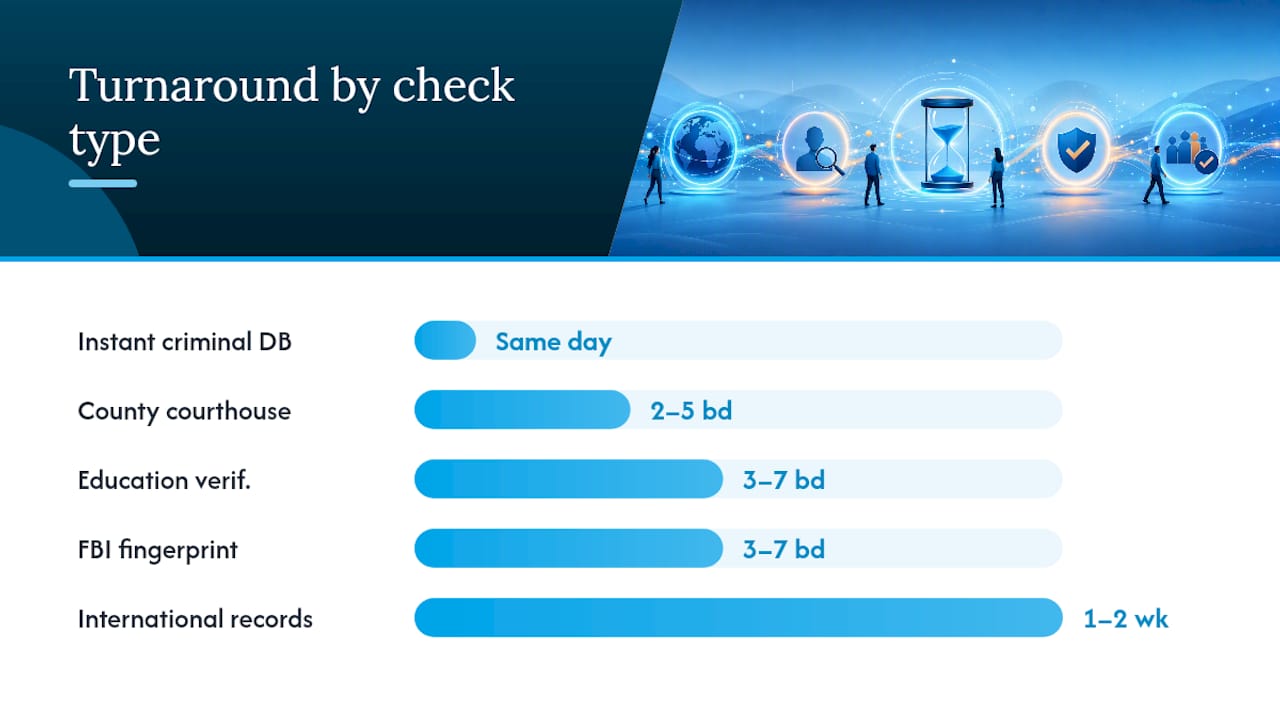
A basic fast package (database criminal, MVR, one employer verified through an automated source) often finishes in 24 to 48 hours. A thorough package with international education records or a courthouse search in a slow county can easily run 2 to 3 weeks.
Why Do Some Background Checks Take So Much Longer?
The gap between a same-day result and a three-week wait almost never comes down to luck. It comes down to four things: where the data lives, how clean the candidate’s information is, who has to respond, and when you asked.
Jurisdictional access is the biggest lever. States with digitized, API-connected repositories let providers query records electronically in seconds. Counties still running on paper files require someone to physically retrieve a document, and that person has a lunch break, a backlog, and a holiday schedule.

Candidate history adds up quickly. Someone who’s lived in one state for ten years is a simple search. Someone who’s moved through five states, used a maiden name, or worked abroad multiplies the number of separate queries a provider has to run, and each one runs on its own clock.
Third parties are frequently the real holdup. A former employer that’s since closed, merged, or outsourced its HR function to a system nobody monitors can sit on a verification request for a week or more. Licensing boards move at their own pace too.
Common delay triggers, ranked by how often they actually happen:
-
Inaccurate or incomplete address/alias history from the candidate
-
Manual courthouse pulls in jurisdictions without electronic access
-
Unresponsive former employers or defunct companies
-
Requests submitted right before a weekend or federal holiday
-
International record requests requiring translation or embassy involvement
Pro Tip: Ask your candidate for every address and legal name used in the past seven years upfront. A single missed alias is the single most common reason a “fast” check turns into a two-week wait.
How Can You Speed Up a Background Check?
Most of the delay in a slow background check is avoidable, and the fix usually costs nothing but a little upfront organization.
For candidates:
-
Sign the consent form the moment it arrives. Nothing legally starts until you do.
-
List every address, legal name, and employer from the past 7 years, including short stints and name changes from marriage or divorce.
-
If a past employer has closed or is known to be slow, have W-2s or pay stubs ready to provide as backup verification.
-
Respond to any verifier contact (email, text, portal alert) the same day if possible.
For employers and HR teams:
-
Choose a provider connected via API to state repositories rather than one relying on manual or mailed requests.
-
Run instant database searches first, then layer in the slower manual searches, instead of waiting to start everything sequentially.
-
Run components concurrently, not one after another. There’s no reason MVR and education verification can’t happen at the same time.
-
Prefill known candidate data into the intake form to eliminate a data-entry round trip.
-
Order expedited processing for safety-sensitive or urgent-start roles. It typically costs more per check but can cut days off a courthouse or FBI fingerprint search.
Pro Tip: Draft one standard email template requesting employment verification with a clear deadline and a direct callback number. Generic requests get buried; specific ones with a due date get answered.
When Is a Delay Normal, and When Should You Escalate?
A background check that’s taking longer than expected isn’t automatically a problem. The question is whether the delay has a visible cause.
Normal, explainable delays include a manual courthouse pull in a county without electronic records, an international request awaiting embassy processing, or a former employer that’s genuinely gone out of business. These take time regardless of who your provider is.
Red flags look different. If your provider can’t tell you which specific jurisdiction is still pending, hasn’t logged any action on the file in days, or has blown past its own stated service window without explanation, something’s wrong on their end, not the data’s end.
Before you escalate, ask your provider these three things:
-
Which exact jurisdictions or verifications are still open?
-
Has a manual pull actually been initiated, and when?
-
Can you provide an action log or timeline showing what’s been done so far?
Transparency about pending jurisdictions and a visible action log is one of the clearest signs of a provider doing its job well. If you can’t get a straight answer to any of the three questions above, that’s your cue to ask for a supervisor or set a hard deadline for resolution.
How Expedited Drug Testing Cuts Days Off Hiring
Drug testing is one leg of the screening process employers can control almost entirely, and it’s often the one that unnecessarily drags out a start date.
Total Tox runs walk-in collection with no appointment required, typically completing the onsite portion of a test in under 15 minutes. Lab-confirmed results, when needed, are paired with review by a Medical Review Officer and generally delivered within 24 hours.
An MRO review isn’t a formality. It’s the step that verifies a positive result against legitimate prescriptions and confirms the collection followed chain-of-custody rules, which is what makes the report defensible in a DOT audit or legal dispute.
That combination matters most for safety-sensitive hiring:
-
DOT-regulated roles (transportation, CDL drivers) where the test is legally required before someone can start work
-
Urgent-start positions in construction or healthcare where a delayed test means a delayed first day
-
Employers who need audit-ready documentation on file, not just a pass/fail text message
Expedited testing with MRO review removes one of the few bottlenecks employers can actually control, rather than waiting on it like a courthouse pull.
What Actually Matters Most Here
The advice most articles give on background check speed treats every delay as equally fixable. It isn’t. You have real control over candidate data quality, provider technology, and drug-test logistics. You have almost no control over a rural courthouse clerk’s workload or an embassy’s processing queue.
That distinction should drive where you spend your energy. Chasing a faster county court pull is mostly wasted effort. Fixing incomplete address history before submission, choosing an API-connected provider, and picking expedited drug testing for urgent starts are levers you can actually pull, and they compound. Get those three right and you’ve eliminated most of the delay that was ever within your control to begin with.
The conventional wisdom oversells “choose the right vendor” as the single fix. Vendor choice matters, but a candidate who forgets a maiden name from eight years ago will slow down even the best provider in the industry.
Ready to Remove the Drug-Testing Bottleneck?
If you’re staring down a hiring deadline and the drug test is the one piece standing between an offer and a start date, that’s the part you can actually fix today. Total Tox runs walk-in collection in the Bronx with no appointment necessary, onsite processing typically under 15 minutes, and MRO-reviewed results back within 24 hours, so the drug-screen leg of your hire stops being the bottleneck.
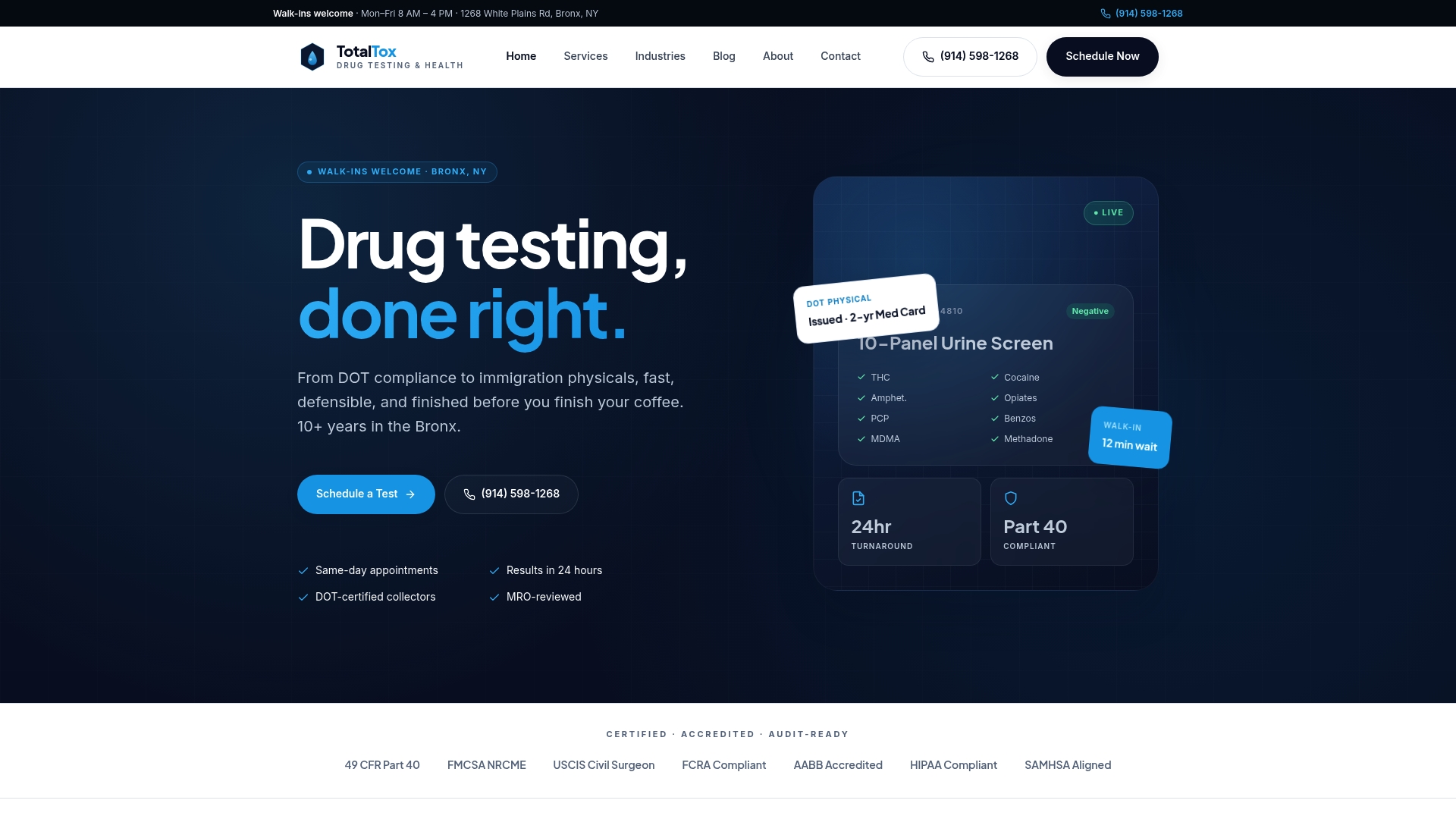
Book a DOT drug test, an expedited lab screen, or LiveScan fingerprinting through the full service list, or head straight to scheduling and contact details to lock in a same-day slot for an urgent start.
Frequently Asked Questions
How long does a typical background check take? Most standard employment background checks complete in 1 to 5 business days, with database-only components often finishing the same day.
How fast can an FBI background check come back?FBI fingerprint checks submitted through LiveScan typically take 3 to 7 business days. Mailed fingerprint cards can take 8 to 12 weeks, so LiveScan is worth requesting whenever it’s available.
Why is my background check taking longer than a week? The most common causes are a manual courthouse search in a county without electronic records, an unresponsive or closed former employer, or missing address and alias history that forced the provider to run extra queries.
Can I dispute a background check result if it’s wrong? Yes. The FTC outlines specific consumer rights and dispute procedures for background check errors, including the right to see the report and challenge inaccurate information.
Does drug testing slow down the overall hiring timeline? It doesn’t have to. Walk-in rapid testing with same-day collection and MRO review within 24 hours, offered through Total Tox’s services, removes one of the few screening components employers can fully control for speed.
Are international background checks always slower? Generally yes. International record requests commonly take 2 to 4 weeks or longer due to translation requirements, embassy processes, and inconsistent record digitization abroad.