
A construction drug testing policy needs five working parts to hold up: defined testing types tied to specific triggering events (pre-employment, random, reasonable suspicion, post-accident, return-to-duty), a Medical Review Officer to verify results, a clear path to a Substance Abuse Professional for anyone returning to work, written confidentiality protections, and an Employee Assistance Program referral option. Federal guidance from SAMHSA and DOT rules under 49 CFR Part 40 set the floor for covered employers. Total Tox works with construction firms every week that discover their existing policy is missing at least one of these pieces. Audit yours against the checklist below before your next hire, not after your next incident.
TL;DR:
- Construction drug policies must include defined testing types, clear trigger events, and a Medical Review Officer review process to be legally compliant.
- Employers with federal contracts exceeding $100,000 are required to publish policies, inform employees of convictions, and take corrective actions under the Drug-Free Workplace Act.
- Testing should use urine for DOT roles, oral fluid for on-site or post-accident, and hair follicle for extended detection, with random testing at around 25% annually.
- All non-negative results must go through MRO verification, and a Substance Abuse Professional must evaluate confirmed violations for return-to-duty testing.
- Records must be kept securely and separately, with signed consent forms, to safeguard confidentiality and comply with federal and state regulations.
Table of Contents
- Why Construction Needs a Tailored Drug Testing Policy
- Core Components Every Construction Drug Testing Policy Must Include
- Regulatory Anchors: DOT, SAMHSA, and Federal Contractor Clauses
- How to Design Testing Logistics for Construction Sites
- Responding to Non-Negative or Positive Tests: MRO, SAP, and Return-to-Duty
- Recordkeeping, Confidentiality, and State-Law Considerations
- Practical Implementation Checklist and Sample Policy Clauses
- Practitioner Perspective and Common Pitfalls
- Total Tox’s Viewpoint: Partnering to Operationalize Policy
- How Total Tox Can Help Put Your Policy Into Practice
- Authoritative Regulator and Toolkit Links to Bookmark
- Sources
- FAQ
Why Construction Needs a Tailored Drug Testing Policy
Construction sites carry a different risk profile than an office or a warehouse. Crane operators, scaffold crews, and equipment operators work at height, around moving machinery, and often on tight deadlines that push people to skip a break they need. A generic HR drug policy written for desk workers doesn’t address any of that.
The financial and safety stakes compound quickly on a job site where one impaired worker can put a whole crew at risk. The DOL’s Recovery-Ready Workplace toolkit frames substance use as a health condition employers can manage proactively rather than just punish after the fact, and that framing matters for how you write consequences into your policy.
Federal contract obligations change things further. If your company holds a federal contract or grant of $100,000 or more, the Drug-Free Workplace Act requires you to:
- Publish a formal drug-free workplace policy and distribute it to every employee
- Run an ongoing awareness program covering the dangers of substance use in the workplace
- Notify the contracting agency of any employee conviction related to workplace drug activity within five days
- Take corrective action against employees convicted of a workplace drug violation
Skip any of these and you risk losing the contract, not just facing a compliance headache.
Core Components Every Construction Drug Testing Policy Must Include
A policy that survives a legal challenge or a Department of Labor audit covers the same ground every time, whether you’re a 15-person subcontractor or a general contractor running multiple sites. Here’s the checklist we walk clients through:
- Scope and definitions. Name which roles are “safety-sensitive” (equipment operators, crane crews, anyone working at height), list prohibited substances, and spell out how prescription medications get handled without automatically triggering discipline.
- Testing types and triggers. Define pre-employment, random, reasonable suspicion, post-accident, and return-to-duty/follow-up testing, and describe exactly what event triggers each one.
- Collection and chain of custody. Detail specimen collection procedures, who performs them, how chain of custody is documented, and the employee’s right to a split-specimen test if they dispute a result.
- MRO review process. Every non-negative lab result gets reviewed by a Medical Review Officer before it becomes an employment action.
- Confidentiality and notifications. State who sees test results, how records are stored, and what gets reported to a Clearinghouse or management information system if your company is DOT-covered.
- Discipline and rehabilitation pathways. Distinguish consequences for a first non-negative result from repeat violations, and build in an EAP or SAP referral rather than automatic termination for every case.
- Supervisor training requirements. Require documented training on recognizing reasonable-suspicion indicators before any supervisor can order a test on that basis.
Pro Tip: Write your reasonable-suspicion section with specific, observable behaviors (slurred speech, odor, erratic movement on a ladder) rather than vague language like “appears impaired.” Vague standards are what get challenged in arbitration.
Regulatory Anchors: DOT, SAMHSA, and Federal Contractor Clauses
Not every construction employer answers to the same rulebook, and knowing which one applies to you determines half your policy language.
DOT-covered employers, meaning any company with commercial driver’s license holders operating certain vehicles, must follow DWI and your commercial driver’s license in NH guidance to understand the legal implications and comply with 49 CFR Part 40 to the letter. That means urine-only specimens for DOT drug tests, HHS-certified laboratories, breath alcohol technicians using approved devices, and a fixed schedule of testing events including pre-employment, random, reasonable suspicion, post-accident, return-to-duty, and follow-up.
SAMHSA’s Mandatory Guidelines set the technical backbone behind those DOT rules: which labs qualify, which analytes get screened, and what cutoffs trigger a confirmatory test. The MRO Guidance Manual spells out exactly what a Medical Review Officer must verify before reporting a result to an employer, including a confidential interview with the donor about any legitimate medical explanation.
Federal contractors face an additional layer. The DFARS 252.226-7003 clause and the equivalent NASA NFS 1852.223-74 clause require contractors performing on covered federal contracts to run a drug-free workforce program with testing for employees in sensitive positions, covering the same core testing events as DOT programs.
Where things get complicated: state cannabis laws, local ordinances, and collective bargaining agreements can all pull in different directions from federal rules. When state law conflicts with a DOT or federal contract requirement, the federal rule wins for covered employees. For everyone else, you have more room to write policy that reflects your state’s legal landscape.

How to Design Testing Logistics for Construction Sites
The specimen type you choose determines what you can actually detect and how fast.
- Urine testing remains the standard for DOT-covered roles and most pre-employment screens, with a detection window of roughly one to three days for most substances.
- Oral fluid testing works well for observed, on-site collection and picks up very recent use, making it useful for post-accident and reasonable-suspicion situations.
- Hair follicle testing extends the detection window to around 90 days, which makes it better suited to pre-employment screening than to catching same-day impairment. Our breakdown of hair follicle versus urine testing covers the tradeoffs in more depth.
For random testing, the selection process has to be genuinely random and documented that way, not a supervisor picking names they suspect. A construction-industry partnership in western Pennsylvania_1.pdf) sets 25% annual random testing as a benchmark deterrent rate, and that figure is a reasonable starting point for firms building their own program from scratch.
Post-accident testing has a narrow window too. Collect as close to the incident as safety and medical care allow, and document exactly why any delay happened, since a test drawn many hours later carries less evidentiary weight.
When choosing a testing vendor, confirm they use an HHS-certified lab, give you MRO access, and commit to a specific turnaround time in writing. A rapid point-of-collection screen is useful for triage, but a non-negative result there always needs lab confirmation before you act on it.
Responding to Non-Negative or Positive Tests: MRO, SAP, and Return-to-Duty
A non-negative lab result is not the same thing as a confirmed positive, and treating it that way is one of the most common mistakes employers make.
- MRO verification comes first. The Medical Review Officer contacts the employee directly, reviews any legitimate medical explanation (a valid prescription, for example), and only then reports a verified result to the employer.
- The employee can request a split-specimen retest if they dispute the confirmed result, using the reserved portion of their original sample at a different certified lab.
- For DOT-covered employees with a confirmed violation, you must provide a list of qualified Substance Abuse Professionals. The DOT/ODAPC employer FAQs walk through this obligation in detail.
- The SAP evaluates and, if needed, refers treatment, then determines when the employee is eligible for return-to-duty testing.
- Return-to-duty testing is observed and must be negative before the employee resumes safety-sensitive duties, followed by a minimum of six unannounced follow-up tests over the next 12 months.
Write your discipline language to distinguish a first confirmed violation, which should route toward SAP evaluation and a return-to-duty path, from repeat violations or refusal to test, which more often lead to termination.
Recordkeeping, Confidentiality, and State-Law Considerations
Records need a home, a retention schedule, and strict access limits, or your policy is a liability waiting to surface in a lawsuit.
- Keep DOT-required records (test results, chain-of-custody forms, MRO reports) for the periods 49 CFR Part 40 specifies, and set a separate internal retention schedule for non-DOT records.
- Store all results separately from general personnel files, accessible only to people with a direct need to know.
- Handle valid prescriptions carefully. An employee taking a legally prescribed medication that shows up on a screen deserves an MRO review, not an automatic write-up, and mishandling this is a common source of ADA and EEOC complaints.
- If you operate in a state with legal recreational or medical cannabis, write policy language that focuses on impairment and safety-sensitive roles rather than off-duty use where your state restricts that basis for discipline.
Pro Tip: Keep a signed consent form on file for every test administered, even non-DOT ones. It’s the single document most likely to matter if a former employee later challenges the test in a wrongful-termination claim.
Practical Implementation Checklist and Sample Policy Clauses
Before your policy goes live, run through this sequence:
- Finalize which roles count as safety-sensitive and confirm testing triggers for each.
- Select a vendor with HHS-certified lab access, MRO service, and a written turnaround-time commitment.
- Set your random testing rate, using the 25% annual benchmark as a reference point, and document the random-selection method.
- Train supervisors on reasonable-suspicion documentation before the policy takes effect.
- Build your post-accident collection workflow, including who authorizes testing and how quickly.
- Distribute the written policy to every employee and collect signed acknowledgment.
| Policy Element | What to Include |
|---|---|
| Scope clause | Names safety-sensitive roles and prohibited substances |
| Testing triggers | Pre-employment, random, reasonable suspicion, post-accident, return-to-duty |
| MRO/SAP clause | Requires MRO verification before action; provides SAP referral list |
| Confidentiality clause | Restricts result access to a defined list of roles |
| Random testing method | States annual percentage target and selection process |
Practitioner Perspective and Common Pitfalls
Turnaround time isn’t a convenience feature. A crew sidelined for three days waiting on lab results costs a project real money, and MRO-reviewed, audit-ready paperwork is what protects you if that test result ever gets challenged.
The mistakes we see most often on construction accounts:
- Supervisors trained once, years ago, with no refresher on reasonable-suspicion documentation
- Employers treating a rapid point-of-collection screen as final instead of sending non-negatives to lab confirmation
- No written rule on how fast post-accident testing must happen, leading to disputes over delayed collection
Firms that lock in a clear service-level agreement with their testing partner, covering turnaround time and walk-in availability, consistently report fewer scheduling delays and cleaner audit trails when a state labor investigator or federal contract auditor comes asking.
Total Tox’s Viewpoint: Partnering to Operationalize Policy

A written policy only works if the testing behind it actually happens on schedule. Some testing providers handle urine, oral fluid, and hair follicle collections for DOT and non-DOT construction employers, with MRO-reviewed results and audit-ready documentation built into every test.
Our operational advice to clients: lock in a service-level agreement with your collection provider covering turnaround time and emergency post-accident scheduling before you need it, not during an incident. Walk-in availability matters more than most policies account for, since a random-selection notification often means someone needs to test within hours, not days.
— Total Tox
How Total Tox Can Help Put Your Policy Into Practice
Some clinics offer walk-in service options that avoid scheduling around a lab’s calendar. Many construction employers need same-day collections when a random-selection list is pulled or an incident occurs mid-shift, and waiting days for an appointment may not fit a job site’s pace. These clinics may complete collections rapidly and deliver MRO-reviewed results within 24 hours, with audit-ready paperwork designed for DOT, OSHA, and USCIS review.
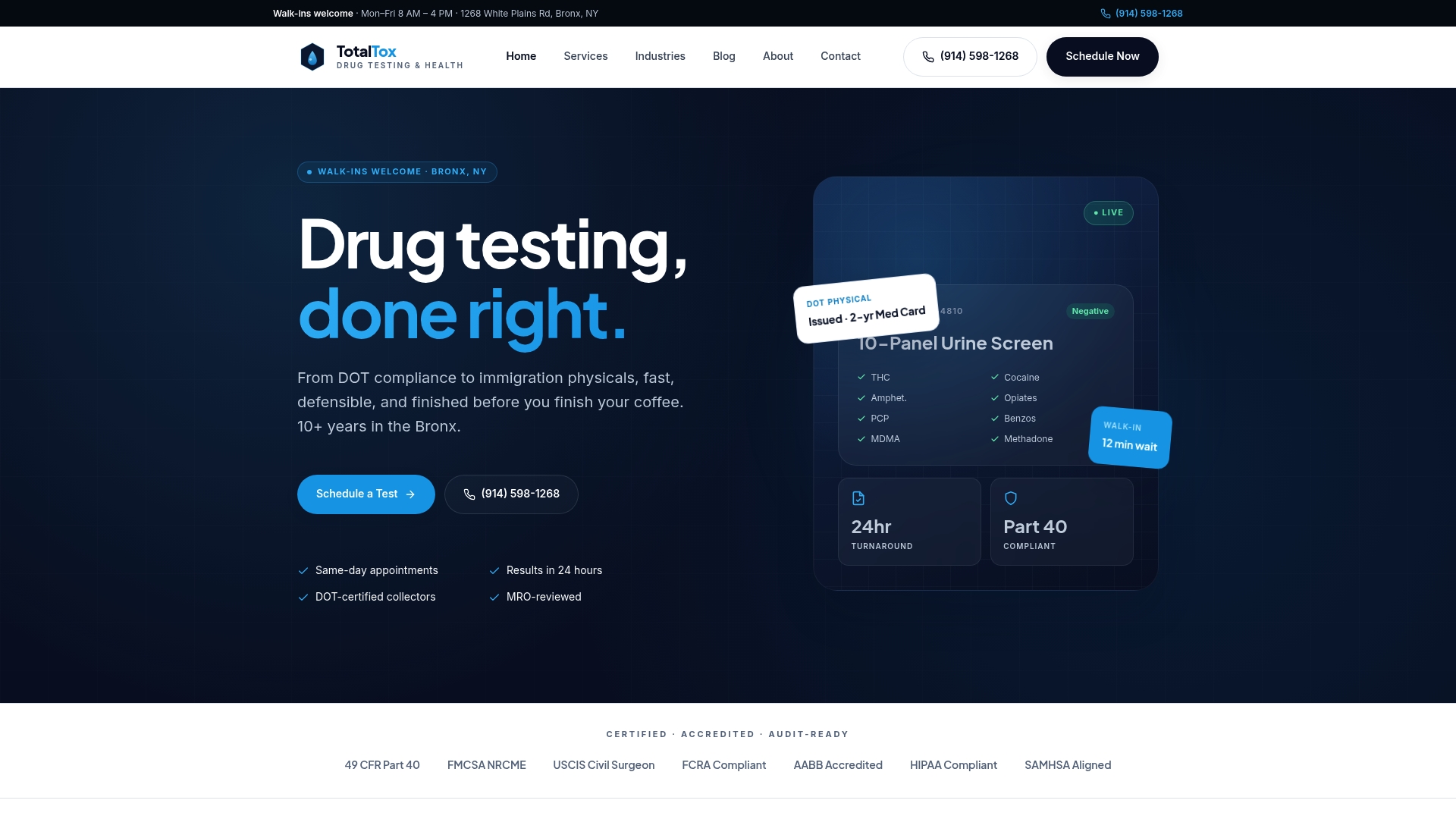
Whether your policy calls for urine, oral fluid, or hair follicle testing, our services page covers the full range along with DOT physicals and background checks for new hires. If you’re building out a random testing program or need a same-day post-accident collection, contact our Bronx clinic to set up an employer account and get your first test scheduled.
Authoritative Regulator and Toolkit Links to Bookmark
- SAMHSA Drug-Free Workplace resources — certified-lab lists and program setup support.
- DOT/ODAPC employer FAQs — plain-language answers on testing events and employee rights.
- 49 CFR Part 40 full text — the binding legal text for DOT-covered testing.
- DOL Recovery-Ready Workplace toolkit — guidance on EAP and return-to-work design.
Sources
- SAMHSA — Drug-Free Workplace Contractor & Grantee Resources
- U.S. DOT — Procedures for Transportation Workplace Drug and Alcohol Testing Programs (49 CFR Part 40)
FAQ
Do Construction Workers Have to Take a Drug Test?
Most construction employers require pre-employment testing, and many add random, post-accident, and reasonable-suspicion testing for safety-sensitive roles. Whether a specific worker must test depends on the employer’s written policy and whether the role is DOT-covered under 49 CFR Part 40.
What Are the Mandatory Guidelines for Workplace Drug Testing?
SAMHSA’s Mandatory Guidelines set the technical standards federal workplace programs follow, including which labs can perform testing and how Medical Review Officers verify results. Federal contractors and grantees receiving $100,000 or more must also meet the Drug-Free Workplace Act requirements around policy publication and employee notification.
What Drug Test Do Most Construction Companies Use?
Urine testing remains the most common method, particularly for DOT-covered roles where it’s required, while some employers add oral fluid or hair follicle testing for pre-employment or reasonable-suspicion situations. Total Tox offers all three specimen types with MRO-reviewed results for construction employers.
Can a Company Still Hire You if You Fail a Drug Test?
That depends entirely on the employer’s written policy and whether the role is DOT-covered, since some companies allow a documented waiting period before reapplying while others have a strict no-hire rule after a confirmed positive. A Medical Review Officer reviews every non-negative result before it’s reported, so a legitimate prescription explanation can change the outcome before it ever becomes a hiring decision.