
A standard DOT urine drug test typically costs $50 to $125 per visit at most U.S. clinics, and the employer almost always foots the bill. That price usually covers the collection, lab analysis at a SAMHSA-certified facility, and review by a Medical Review Officer. Add breath alcohol testing, consortium fees, or a Clearinghouse query, and the total employer spend climbs well past the sticker price on any single test.
TL;DR:
- The typical DOT 5-panel urine test costs between $50 and $125, including collection, lab analysis, and MRO review, with prices varying based on volume and location.
- Combining drug testing with breath alcohol testing or physical exams can raise the total visit cost to $100–$175, depending on region and provider.
- Ongoing costs, such as consortium membership, Clearinghouse queries, and MRO fees, significantly increase the total annual expense beyond per-test prices.
- Return-to-duty testing after a positive result can total between $1,000 and $5,000 or more, due to evaluations, treatment, and multiple follow-up tests.
- Employers should request itemized quotes covering all fees and verify pricing details before booking to avoid unexpected expenses.
Table of Contents
- How Much Does a DOT Drug Test Cost by Test Type?
- Why Do DOT Drug Test Prices Vary So Much?
- What Are the Ongoing Program Costs for DOT Compliance?
- How Much Does Return-to-Duty Testing Cost After a Positive Result?
- How Much Does Location Affect DOT Drug Test Pricing?
- What Total Tox’s Track Record Shows About Fast, Compliant Testing
- Does Insurance Cover DOT Drug Testing?
- Does Random Testing Cost More Than Scheduled Testing?
- What the Cost Data Actually Tells Employers and Drivers
- Get Fast, Compliant DOT Testing Without the Wait
- Where to Verify DOT Testing Rules
- Sources
- FAQ
How Much Does a DOT Drug Test Cost by Test Type?
The panel type and collection method drive most of the price swing you’ll see between vendors. Here’s how the common options break down:
- DOT 5-panel urine test: Runs $50 to $125 per test, and that range typically bundles the collection visit, lab processing, and MRO review. Some vendor materials list DOT testing starting around $72, which lands squarely inside that band once MRO review is added.
- DOT oral fluid testing: Priced similarly to urine in most markets, though the collection itself is faster and doesn’t require a bathroom facility, which matters for employers running mobile or on-site programs.
- Breath alcohol testing (EBT): When performed alongside a drug screen in the same visit, expect to pay roughly $40 to $95 extra, with combined urine-plus-breath visits commonly totaling $100 to $175 depending on the facility and region.
- Hair-follicle testing: Not a standard DOT-mandated method, but some employers use it for extended-window screening outside federal requirements. Pricing tends to run higher than urine testing because of the longer lab turnaround and specialized processing. A closer look at hair follicle versus urine testing shows why the cost gap exists.
Combined visits are common in trucking and construction, where a driver needs both a pre-employment drug screen and a physical exam on the same day. Booking both at once usually beats scheduling separate appointments, saving both time and total cost.
Why Do DOT Drug Test Prices Vary So Much?
Two employers in the same city can pay noticeably different rates for what looks like the identical test. Volume is the biggest lever: fleets that test dozens or hundreds of drivers a month typically negotiate a lower per-test rate through a corporate account, while a single walk-in visit pays closer to retail price.
Collection method matters just as much. A walk-in clinic charges its posted rate, but an on-site mobile collection, where a technician comes to your facility, usually carries a flat fee that covers the visit regardless of how many drivers get tested. After-hours or weekend collections often add a surcharge on top of that.
A few line items catch employers off guard:
- Observed collection (required after certain violations) adds a fee beyond standard testing.
- Adulteration or validity panels, run when a specimen looks tampered with, cost extra.
- Split-sample handling and specimen shipping to the lab are sometimes itemized separately.
- Rural clinics and small independent providers often charge more per test simply because they lack the volume to negotiate lab discounts.
Pro Tip: Ask every vendor for a per-test quote that separately lists collection, lab fee, MRO review, and shipping. A single bundled number hides which line item changes when your volume grows.
What Are the Ongoing Program Costs for DOT Compliance?
The per-test price is only part of what a DOT-regulated employer budgets for each year. Running a compliant program means covering several recurring costs that exist independent of how many tests you actually run.
Consortium membership is the most common of these. Owner-operators and small fleets typically join a consortium to handle random selection and reporting, and annual membership fees vary by provider and driver count. Small-fleet owners tend to prefer this bundled approach because it stabilizes per-driver costs even though the annual fee is a fixed expense regardless of test volume.
Clearinghouse queries add another layer. The FMCSA Drug and Alcohol Clearinghouse requires employers to run pre-employment queries on every new hire and annual queries on current drivers, and each check carries a per-query cost that adds up across a large workforce.
MRO administrative fees typically apply per test, separate from the lab processing charge, and cover the physician’s review of any non-negative result. Recurring costs to plan for include:
- Consortium membership fees, billed annually per driver
- Clearinghouse query fees, charged per pre-employment and annual check
- MRO review fees, added per test regardless of result
- Third-party administrator fees, if you outsource random selection and reporting
Bundled programs that combine all four often cost more upfront but reduce the administrative burden of tracking separate vendors, which matters most for fleets running a random testing program across dozens of drivers.
How Much Does Return-to-Duty Testing Cost After a Positive Result?
A positive result triggers a return-to-duty process that costs far more than the original test, and both employers and drivers should understand the full timeline before assuming a driver is back on the road quickly.
- SAP evaluation. A Substance Abuse Professional evaluates the driver and recommends a treatment or education program; this initial evaluation is the first cost in the process.
- Treatment or education program. Costs vary widely depending on whether the SAP recommends brief education or an intensive outpatient program.
- Follow-up testing. FMCSA rules require a minimum of six directly observed tests over the first year back on duty, and each of those tests carries its own per-test cost on top of the standard testing fee.
- Final SAP clearance and return-to-duty test. The driver needs a documented negative result before returning to safety-sensitive duty.
Total return-to-duty costs commonly range from $1,000 to $5,000 or more, depending on the treatment level required and how many follow-up tests get scheduled that first year. Employers and drivers should both check whether an Employee Assistance Program or health insurer covers any portion of the SAP evaluation or treatment, since coverage varies significantly by plan.
How Much Does Location Affect DOT Drug Test Pricing?
State averages for a 5-panel DOT test show real variance. BlueHive’s state-level pricing data puts New York’s average around $75 while Texas averages closer to $50, a gap driven mostly by provider density and local labor costs rather than anything about the test itself.
Before booking with any vendor, run through a short checklist to get an apples-to-apples quote:
- Does the quoted price include MRO review, or is that billed separately?
- Is Clearinghouse reporting included, or does it carry its own per-query fee?
- Which lab processes the specimen, and is it SAMHSA-certified?
- Are there flat fees for on-site collection, or surcharges for after-hours appointments?
Watch for red flags too. A vendor asking for payment on a prepaid card, or quoting “testing included” without specifying which panel or whether MRO review is part of the price, is worth a second phone call before you book. Clear, itemized quotes are the norm among established providers, and vague pricing is usually a sign to look elsewhere.
What Total Tox’s Track Record Shows About Fast, Compliant Testing
A local provider offers walk-in DOT testing in the area, processing many tests yearly with most collections completed quickly. Results typically return within about 24 hours, which matters when a driver is waiting to get back on the road or a new hire can’t start without a cleared test.
Every result goes through MRO review before it reaches the employer, and documentation is built to be audit-ready from the start. That matters more than it sounds: an FMCSA audit or Clearinghouse discrepancy is far less stressful when your paperwork already matches Part 40 requirements instead of needing to be reconstructed after the fact. For fleets and staffing agencies juggling multiple hires a week, that speed and documentation combination is often the difference between a smooth compliance record and a scramble.
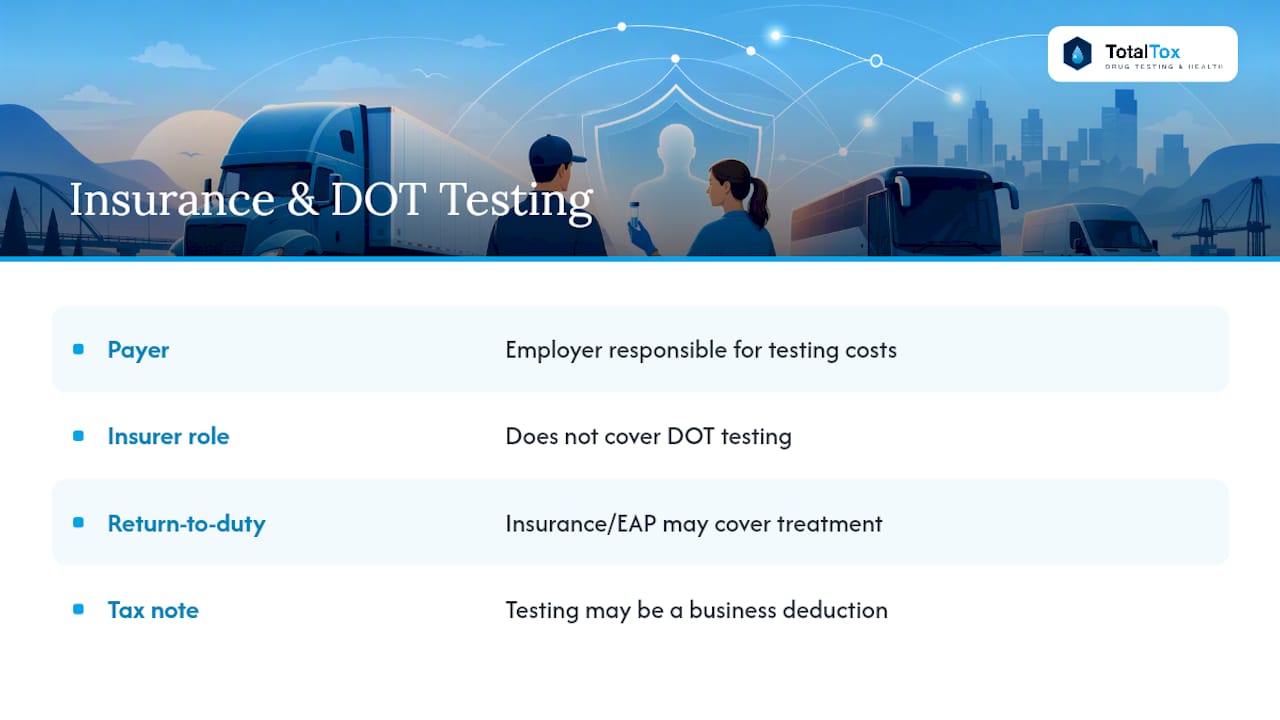
Does Insurance Cover DOT Drug Testing?
Standard health insurance generally does not cover DOT-mandated drug and alcohol testing, because these tests exist to satisfy a federal employment requirement rather than to diagnose or treat a medical condition. Employers, not insurers, are responsible for the cost of pre-employment, random, and return-to-duty testing under FMCSA rules.
Where insurance sometimes enters the picture is on the treatment side of a return-to-duty case. Health insurance or an Employee Assistance Program may cover part of the substance abuse evaluation or treatment program a SAP recommends, even though it won’t cover the testing itself. Coverage varies by plan, so drivers going through the SAP process should check their specific policy or EAP benefits before assuming out-of-pocket costs.
Some employers also treat testing costs as a deductible business expense, which doesn’t reduce the upfront price but can offset the annual budget impact. For self-employed owner-operators, testing costs paid through a consortium membership may qualify as a business expense as well, though that’s a tax question worth confirming with an accountant rather than a testing provider.
The bottom line: budget for DOT testing as a direct employer cost, not something a health plan will absorb, and treat any insurance involvement as limited to the treatment phase of a return-to-duty case rather than the testing itself.
Does Random Testing Cost More Than Scheduled Testing?
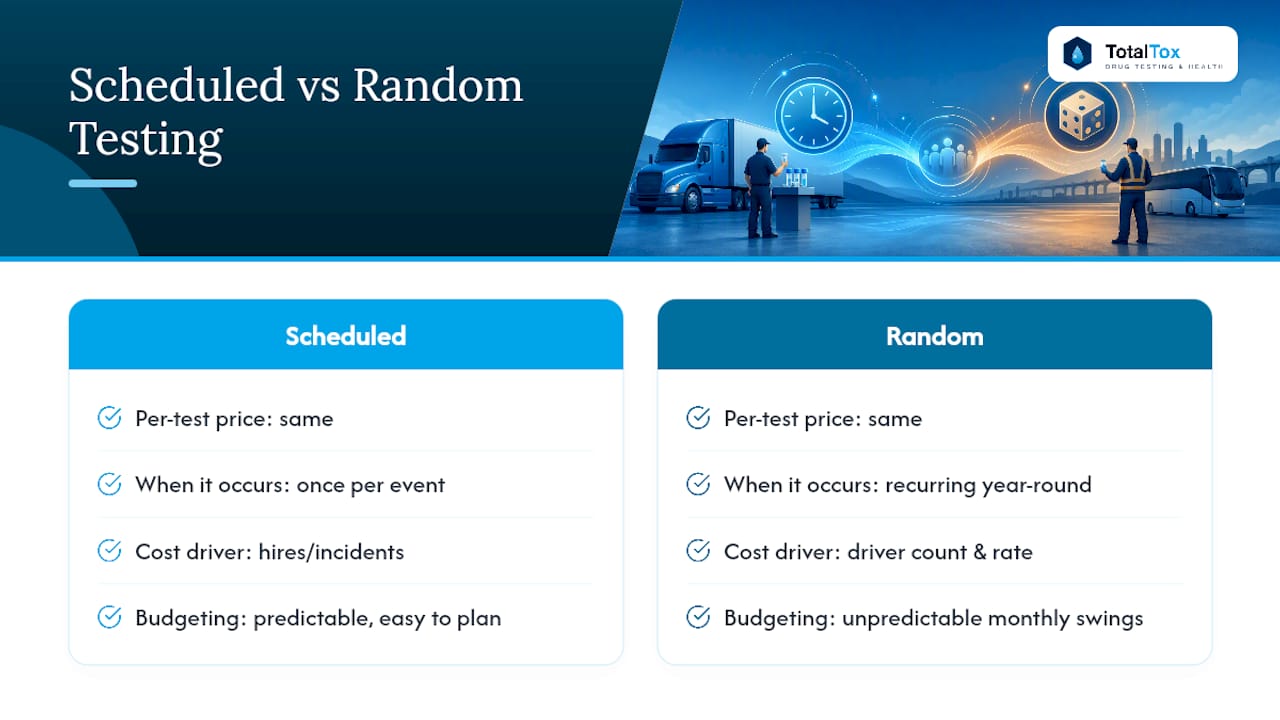
Random testing and scheduled pre-employment testing carry the same per-test price, but random programs cost more over a year because of how frequently they run. FMCSA requires minimum annual random testing rates for drug and alcohol testing among safety-sensitive employees, which means a fleet’s total annual testing spend depends heavily on driver count and the applicable random rate, not just how many people get hired.
Scheduled tests, like pre-employment and return-to-duty screens, happen once per event and are easier to budget for since they tie directly to a hiring or incident timeline. Random testing is a recurring, unpredictable draw throughout the year, so the total cost scales with your workforce size rather than your hiring pace.
This is where consortium membership earns its annual fee. Bundling random selection, notification, and reporting into one program smooths out what would otherwise be an unpredictable monthly cost, especially for small fleets where a single random draw might otherwise mean an unplanned trip to a clinic. Larger fleets running frequent random draws often see the per-test cost drop through volume pricing, even as the total annual spend rises simply because more tests are happening.
The practical takeaway: don’t budget DOT testing as a flat annual number. Separate your one-time scheduled testing costs from your recurring random testing costs, since the second category is the one that grows or shrinks with your driver count year over year.
What the Cost Data Actually Tells Employers and Drivers
The conventional advice on DOT testing costs treats the per-test sticker price as the whole story, and that’s the biggest gap in most guidance available online. The real budget number for any DOT-regulated employer is the sum of testing fees, consortium membership, Clearinghouse queries, and MRO surcharges, and that combined figure is what actually determines whether a small fleet’s compliance program is affordable.
Drivers face a parallel blind spot. A positive result isn’t a $75 problem, it’s a $1,000 to $5,000 problem once SAP evaluation, treatment, and a year of observed follow-up testing enter the picture. That gap between the test price and the return-to-duty price is where most people underestimate what a single mistake actually costs.
If there’s one priority worth acting on first, it’s this: get an itemized quote before you commit to any provider, not just a per-test number. The employers who avoid surprise bills are the ones who ask what’s included before they need the answer, not after.
— Total Tox
Get Fast, Compliant DOT Testing Without the Wait
Some providers run walk-in DOT drug testing, breath alcohol testing, and DOT physicals with most visits completed quickly and MRO-reviewed results back within about 24 hours, helping balance compliance and scheduling needs.
Tests may come with audit-ready documentation designed to meet FMCSA review standards, reducing the need to reconstruct records. Providers often serve employers across various industries locally, maintaining consistent turnaround times whether testing individual hires or managing ongoing random testing programs. Review the full range of drug testing and occupational health services offered, or schedule a walk-in appointment or set up an employer account to get your next test done today.
Where to Verify DOT Testing Rules
For the official rules behind everything covered here, see FMCSA’s overview of drug and alcohol testing rules, the Part 40 procedures, and the FMCSA Clearinghouse.
Sources
- Overview of drug and alcohol testing rules | FMCSA
- Part 40 — Procedures for transportation workplace drug and alcohol testing programs | U.S. DOT
- How Much Is a DOT Drug Test? Prices and Who Pays - LegalClarity
- Department of Transportation (DOT) Drug Tests | Checkr
FAQ
What Are the DOT Drug Test Rates for 2026?
A standard DOT urine test typically costs $50 to $125, and annual minimum random testing rates are set by FMCSA and can change year to year, so employers should confirm current rates directly with FMCSA before setting a random testing program.
How Much Does a Drug Test Typically Cost in the US?
Non-DOT workplace drug tests are often cheaper than DOT-mandated tests because they don’t require SAMHSA-certified lab processing or MRO review, while a DOT test’s $50 to $125 price reflects those added regulatory steps.
Is a DOT Drug Test the Same as a Regular Drug Test?
No. DOT tests follow strict Part 40 procedures, use SAMHSA-certified labs, and require MRO review, while non-DOT tests can use different cutoffs and processes set entirely by the employer.
How Much Urine Is Needed for a DOT Drug Test?
DOT collection procedures under Part 40 specify a minimum urine specimen volume the donor must provide to ensure the lab has enough sample for primary testing and, if needed, a split-sample retest.
Does this provider offer Same-Day DOT Drug Testing?
Yes, some providers offer walk-in DOT testing with most collections completed quickly and results typically returned within about 24 hours, backed by MRO review and audit-ready documentation.