
Renew your DOT medical card by scheduling a DOT physical with a medical examiner listed on the FMCSA National Registry and getting a new Medical Examiner’s Certificate (MCSA-5876). Most certificates run up to 24 months, though drivers with certain monitored conditions get shorter windows. Once you pass, confirm the examiner filed the paperwork and that your state’s CDL record actually shows the new date.
TL;DR:
- Most drivers should book their exam at least a month before expiry, especially if their certificate is valid for only three months due to monitored conditions.
- Only clinicians listed on the FMCSA National Registry, including MDs, DOs, PAs, NPs, and some chiropractors, can legally issue valid DOT medical certificates.
- Electronic submission of results usually occurs within a couple of weeks, but drivers must verify their state’s record and self-certification category to avoid roadside violations.
- If a certificate expires before renewal, drivers must complete a new exam, ensure electronic filing, and check their state record before resuming driving.
- Walk-in clinics like Total Tox offer same-day physicals and documentation, which is essential when renewal deadlines are imminent and scheduling lead time is short.
Table of Contents
- How long does DOT medical card renewal last, and when should you schedule it?
- How do you complete the DOT medical exam and get your MEC?
- Who can perform your DOT physical, and how do you verify them?
- What happens with state filing and self-certification after your exam?
- What happens if your DOT medical card expires before you renew?
- What usually delays a DOT medical card renewal?
- How Total Tox helps drivers renew without losing a workday
- Get your DOT physical done today, not next week
- Sources
How long does DOT medical card renewal last, and when should you schedule it?
A DOT medical card is valid for up to two years for drivers with no flagged health issues. That’s the ceiling, not the default for everyone. If an examiner is watching something like high blood pressure, diabetes, or sleep apnea, they can issue a certificate valid for just 3, 6, or 12 months instead, so your card stays under closer review.
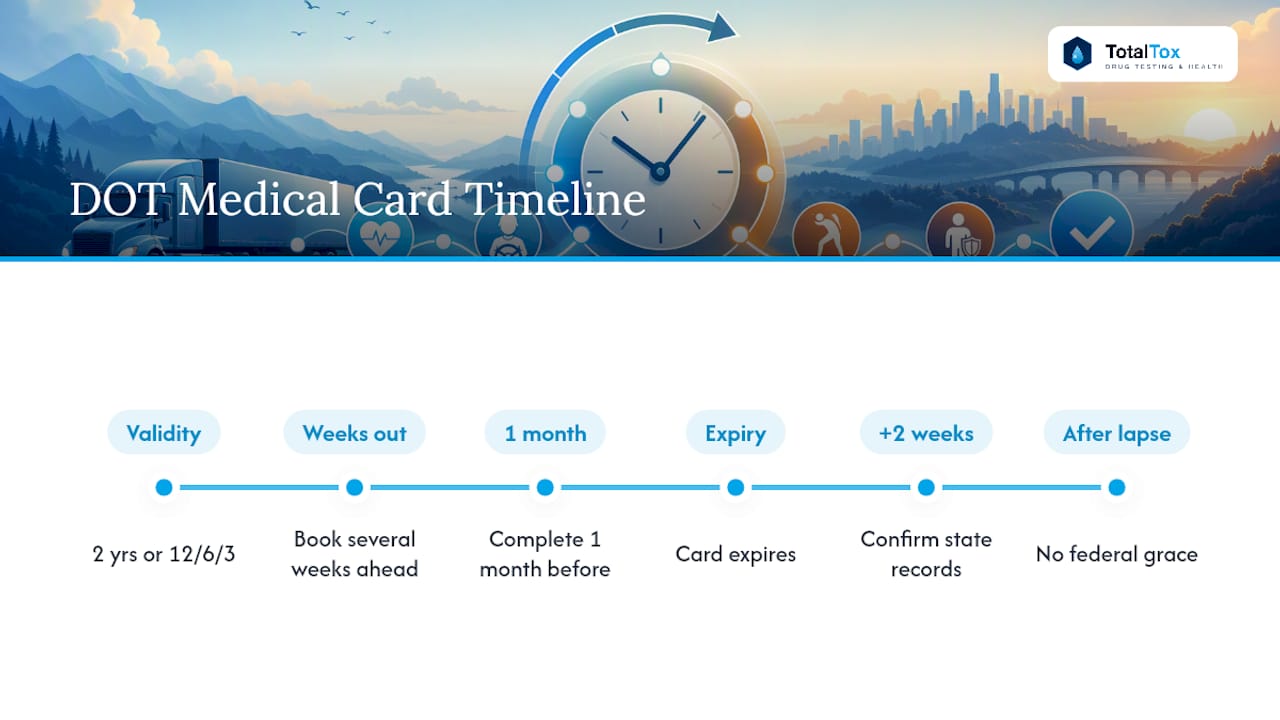
There’s no federal grace period once that certificate lapses. None. The 30 to 60 day scheduling window you’ll see recommended everywhere isn’t a legal cushion. It’s a practical buffer that gives you time to redo a blood pressure check, track down a specialist letter, or wait out a records mix-up without missing your deadline.
A rough timeline that works for most drivers involves booking your exam several weeks ahead, completing the physical about a month before expiration, and then confirming state record updates within a couple of weeks after.
If you’re on a monitored schedule already, push your booking window earlier. A 3-month certificate leaves almost no room for delay.
How do you complete the DOT medical exam and get your MEC?
The process runs in a predictable order, and most drivers finish it in a single visit.
- Find a certified examiner. Search the National Registry directly, or confirm with the clinic that your examiner is currently listed and will submit results electronically.
- Complete the intake paperwork. You’ll fill out the Medical Examination Report, form MCSA-5875, covering your health history before the physical exam starts.
- Go through the exam. Expect a vision screening, blood pressure check, urinalysis, and a general physical exam covering hearing, mobility, and reflexes.
- Receive your certificate. If you pass, the examiner issues your Medical Examiner’s Certificate, form MCSA-5876, on the spot.
- Verify the filing. Ask whether the result was submitted electronically to FMCSA and, if so, when it should appear on your state record.
What to bring matters more than most drivers realize:
- Your current MEC and CDL, so the examiner can check continuity.
- A full medication list, including dosages.
- Blood pressure logs if you’re being monitored for hypertension.
- Recent A1c results if you have diabetes.
- CPAP compliance data if you use one for sleep apnea.
- Any specialist letters tied to a condition under review.
Pro Tip: Print your CPAP compliance report or blood pressure log the morning of your appointment. Examiners can issue a longer certificate on the spot when they see documented control, instead of sending you back out for a follow-up visit.
Who can perform your DOT physical, and how do you verify them?
Only clinicians listed on the FMCSA National Registry can legally issue a valid Medical Examiner’s Certificate. That includes:
- Medical doctors (MD)
- Doctors of osteopathy (DO)
- Physician assistants (PA)
- Nurse practitioners (NP)
- Doctors of chiropractic (DC), for specific exam components
An exam from someone off that list doesn’t count, no matter how thorough the physical was. You can search the National Registry by name or location before you book, and most clinics that regularly handle DOT work will confirm their registration status without you having to ask twice. If a clinic hesitates to answer that question directly, that’s worth noticing.
What happens with state filing and self-certification after your exam?
Examiners typically submit your results electronically to FMCSA and to your state driver licensing agency, but don’t assume the paperwork landed just because the exam went fine. State posting can lag.
- Check your CDL record with your state’s licensing agency about one to two weeks after your exam.
- Confirm your self-certification category is current. You’re filed under one of four types: interstate non-excepted, interstate excepted, intrastate non-excepted, or intrastate excepted, and each carries different medical requirements.
- If your record doesn’t reflect the new certificate, contact your SDLA with a copy of your MCSA-5876 in hand.
Getting this step wrong is one of the most common reasons drivers get flagged during a roadside inspection despite having a valid physical on file.
What happens if your DOT medical card expires before you renew?
Once your Medical Examiner’s Certificate expires, you’re not legally permitted to operate a commercial motor vehicle. Many states automatically downgrade CDL privileges when that happens, sometimes without much warning to the driver.
Reinstating is straightforward but not instant:
- Complete a new DOT physical and receive a fresh MCSA-5876.
- Confirm the examiner submitted it electronically.
- Verify your state record reflects the update before you get back behind the wheel.
- Keep a physical copy of your new certificate on hand until you see it posted, in case an employer or inspector asks.
Processing delays happen. Carrying proof of your exam date can bridge the gap while records catch up.
What usually delays a DOT medical card renewal?
Most holdups trace back to a handful of avoidable issues, not surprise medical findings.
- Missing specialist letters for a monitored condition like sleep apnea or cardiac history.
- State records that haven’t synced with the examiner’s electronic submission yet.
- Incorrect self-certification category on file, which can trigger a rejection at the DMV counter.
- Forgetting monitoring records like BP logs or A1c results, which forces a shorter certificate or a repeat visit.
A quick pre-exam checklist covers most of this: current MEC, medication list, monitoring data, specialist documentation, and your CDL. Bring copies, not originals you can’t leave behind.
Pro Tip: If you’re managing a chronic condition, ask your specialist for a signed compliance letter dated within 90 days of your exam. A stale letter is treated the same as no letter at all.
How Total Tox helps drivers renew without losing a workday
Total Tox runs walk-in DOT physicals designed for drivers who can’t afford a two-week wait for an appointment slot. Same-day exams, MRO-reviewed documentation, and audit-ready paperwork mean you leave with a certificate that holds up to employer and enforcement scrutiny, not just a signature on a form.
Scheduling weeks ahead works fine for planned renewals. But when your certificate is expiring in days, not months, a walk-in clinic built around fast turnaround is often the more practical route than sitting in a waiting room for a standard appointment. Total Tox has handled this kind of time-sensitive renewal across the Bronx transportation sector for over a decade.
— Total Tox
Get your DOT physical done today, not next week
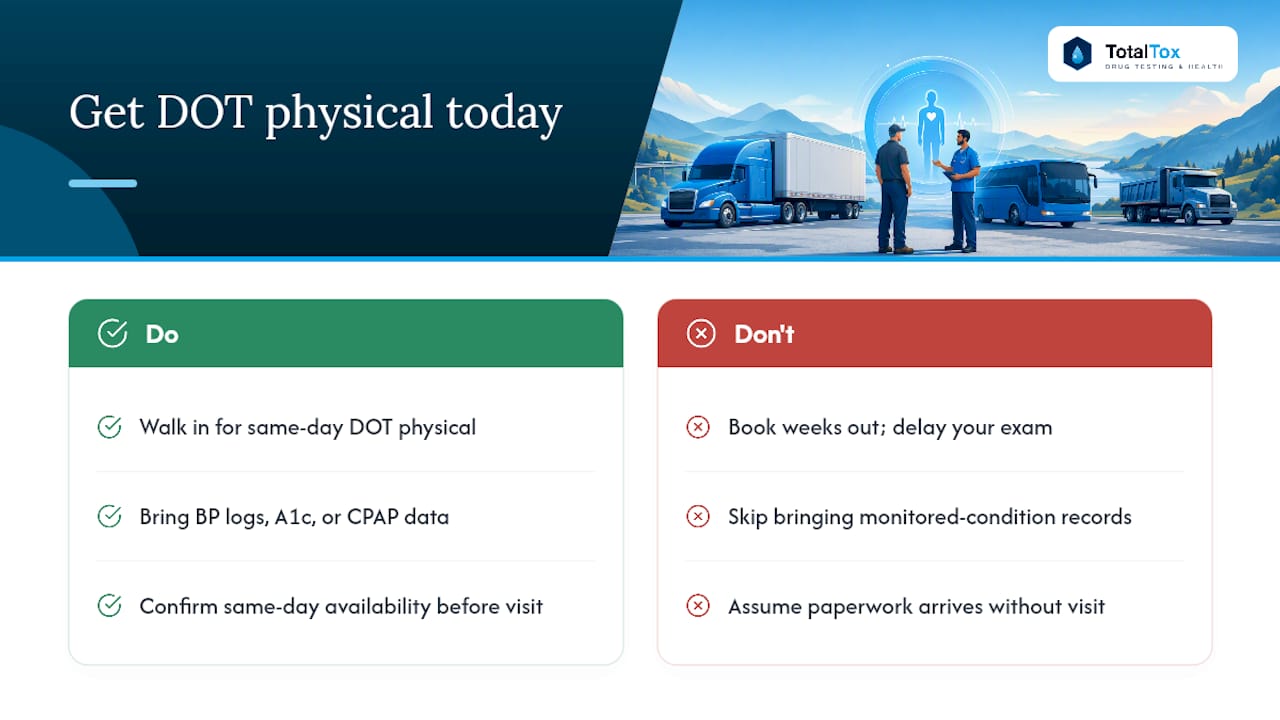
Total Tox is the practical alternative to booking weeks out for a standard clinic appointment: walk in, get your DOT physical completed in one visit, and leave with MRO-reviewed, audit-ready documentation instead of a follow-up call three days later.
Total Tox handles walk-in DOT physicals, DOT drug testing, and the paperwork that comes with both, including the forms your state SDLA expects on file. If you’re managing a monitored condition, bring your blood pressure logs, A1c results, or CPAP compliance data so the examiner can issue the longest certificate you qualify for on your first visit. That single step is what usually separates a one-visit renewal from a two-visit one.
Check current DOT physical services and hours, or contact Total Tox directly to confirm same-day availability before your certificate expires.
This article is general information, not a substitute for advice from a qualified doctor. Consult a qualified healthcare professional about your own circumstances before acting on anything here.
Sources
- DOT Medical Exam and Commercial Motor Vehicle Certification | FMCSA
- DOT physical: What to expect | Cleveland Clinic
- CDL medical certification | Florida Highway Safety and Motor Vehicles