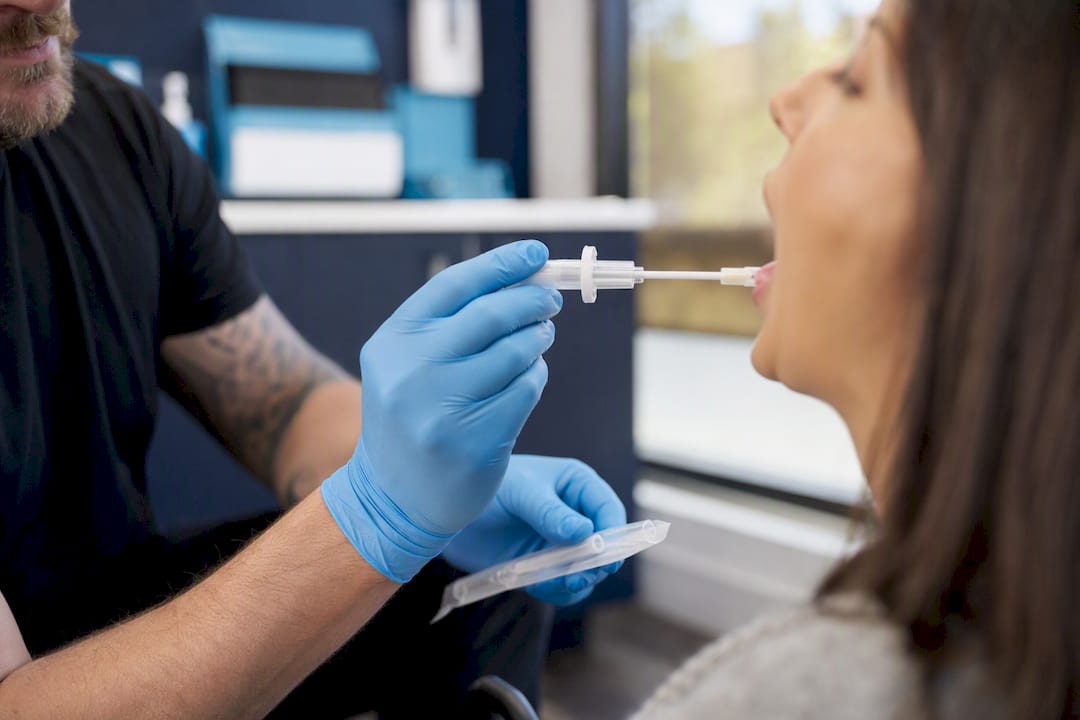
Oral fluid testing is not yet available for DOT-regulated drug testing. DOT authorized it as an alternate specimen type back in 2023, but implementation requires two HHS-certified oral fluid laboratories, and none exist as of this writing. Employers and CDL drivers must continue using DOT urine testing procedures until that certification threshold is met and DOT publishes the trigger in the Federal Register.
TL;DR:
- Oral fluid testing for DOT drug screening is not yet available because no HHS-certified labs currently exist to process it.
- Employers should maintain their urine testing protocols, prepare collection site agreements, and train collectors on oral devices in anticipation of certification.
- DOT’s direct observation rules extend to oral fluid, which offers privacy advantages and simplifies collection for transgender and nonbinary drivers.
- Certification of two labs will trigger an 18-month grace period, but preparedness through training and contracts is advisable now.
- Ongoing compliance with existing urine testing procedures remains essential to avoid enforcement actions until oral fluid testing officially becomes operational.
Table of Contents
- Is DOT Oral Fluid Testing Currently Available?
- What Should Employers Do Before Oral Fluid Testing Is Available?
- How Does Direct Observation Work Under Part 40?
- What Should Fleet Safety Managers Check Right Now?
- What Triggers Full Oral Fluid Implementation?
- Total Tox’s Take on Getting Ready for Oral Fluid Collections
- How Does Oral Fluid Testing Affect Driver Privacy?
- What Goes Wrong During Oral Fluid Collections?
- What Should CDL Drivers Expect During Oral Fluid Testing?
- What Happens If Employers Don’t Comply?
- Where to Track Official Oral Fluid Testing Updates
- Why This Rollout Rewards Preparation Over Speed
- Get Audit-Ready Testing Support From Total Tox
- Sources
Is DOT Oral Fluid Testing Currently Available?
No. That’s the short answer, and it surprises a lot of safety managers who read about the 2023 rule change and assumed the switch had already flipped. It hasn’t.
The Department of Transportation’s final rule added oral fluid as an alternate specimen type under 49 CFR Part 40, effective June 1, 2023. However, the rule built in a gatekeeper: employers can’t actually use oral fluid until the Department of Health and Human Services certifies at least two laboratories to process it.
Why two, and not one? Split-specimen testing requires a second, independent lab to confirm a positive result if a driver challenges it. A single certified lab can’t do both jobs. As of the DOT’s HHS-certified lab list, no labs currently hold that certification for oral fluid.
A few things to keep straight about the regulatory posture right now:
- Oral fluid is authorized in law but not operational in practice.
- DOT treats oral fluid as an alternate method, not a replacement for urine testing. Employers get to choose which specimen type they use once oral fluid becomes available.
- The May 2026 Federal Register notice reinforces that directly observed urine collection remains the interim requirement in scenarios where oral fluid would otherwise be used but isn’t yet available.
- DOT will publish the certification trigger and the start of a grace period after HHS certifies a second lab.
Nothing about your DOT-regulated urine testing program changes today. The rule exists; the plumbing behind it doesn’t.
What Should Employers Do Before Oral Fluid Testing Is Available?
Waiting for HHS certification doesn’t mean waiting to prepare. Smart safety teams are treating this like a known regulatory event with an unknown date, not an emergency to react to later.
- Keep your urine-based collection network intact. Don’t let contracts lapse or collection-site relationships go stale assuming a quick pivot to oral fluid.
- Update your DER standing orders. Specify explicitly whether your organization intends to use oral fluid once it’s available, and give collectors clear direction on which specimen type to request.
- Review your agreements with collection sites, labs, and C/TPAs. Confirm they cover oral fluid collection, and remember split-specimen testing requires a second, separate HHS-certified lab distinct from your primary lab.
- Get collectors trained on oral fluid devices now. Training ahead of the trigger date means you’re not scrambling to find certified collectors when the grace period clock starts.
- Tighten your recordkeeping habits today. Custody and control form (CCF) accuracy, device expiration checks, and audit-ready documentation matter for urine collections right now and will matter identically for oral fluid later.
Pro Tip: Run a mock collection with your chosen oral fluid device and collection site before you’re required to, even informally. Catching a training gap during a practice run costs nothing. Catching it during a real post-accident test costs a compliance violation.
Your DER contacts and standing orders should already reflect this dual-track thinking, since random testing programs face the same specimen-type decision once oral fluid clears certification.
How Does Direct Observation Work Under Part 40?
Direct observation is the part of Part 40 that generates the most questions, and for good reason. It’s invasive by design, reserved for specific circumstances: return-to-duty and follow-up testing, and situations where a specimen shows signs of tampering.
Under §40.67, DOT amended the direct observation rules to require oral fluid collection, once available, for certain scenarios, including collections involving transgender or nonbinary individuals where a same-sex observer requirement would otherwise create a conflict. Oral fluid sidesteps the same-sex observer issue entirely because saliva collection doesn’t require the same physical observation as a urine void.
Until oral fluid labs are certified, though, DOT’s interim solution is directly observed urine collection in those same trigger scenarios.
What “fatal flaw” means for oral fluid devices: DOT and SAMHSA’s oral fluid collection handbook require collectors to check device expiration before every collection. An expired device isn’t a minor paperwork issue. It’s classified as a fatal flaw, meaning the test result can’t be used and the donor needs a new collection with a valid device.
Collectors have specific duties baked into the process:
- Confirm the device is FDA-cleared and within its expiration date, and show that expiration date to the donor.
- Collect the minimum undiluted specimen volume the device requires, and package it using tamper-evident materials.
- Enter the device information and expiration correctly on the CCF.
- Know when to reject a device outright rather than proceed with a flawed collection.
Dry mouth is the oral fluid equivalent of a shy bladder. Devices generally include saliva stimulants to help, and collectors follow specific wait-time protocols before treating a collection attempt as insufficient.
What Should Fleet Safety Managers Check Right Now?
A short audit now beats a scramble later. Run through this list with your DER and any contracted C/TPA:
- Lab agreements. Confirm your primary lab contract and any split-specimen lab agreement name two genuinely separate HHS-certified entities, not the same lab wearing two hats.
- Collector proficiency records. Verify documentation exists showing collectors are trained on both urine and, where relevant, oral fluid devices.
- Standing order language. Make sure it states your organization’s specimen-type intentions clearly enough that a collector or DER reading it cold understands what to do.
- Collection-site device stock and expiration tracking. If you’re piloting oral fluid devices, someone needs to own the expiration-check calendar.
- C/TPA notification protocols. Confirm your third-party administrator knows your specimen-type plans and communicates changes to collection sites promptly.
- MRO coordination. Confirm your Medical Review Officer’s process accommodates oral fluid result review once it’s operational.
- Employee communication. Draft (don’t send yet) a driver-facing explainer so you’re ready to roll it out the moment the trigger publishes.
Assign each item to a named owner, whether that’s your DER, safety manager, or C/TPA contact, with a near-term deadline like 30 or 60 days. Retain training logs, signed lab contracts, and sample CCFs as your audit trail.
What Triggers Full Oral Fluid Implementation?
The mechanism is straightforward even if the timing isn’t. HHS certifies a second oral fluid laboratory, DOT publishes a Federal Register notice confirming it, and that notice starts an 18-month grace period.
A few practical notes for planning purposes:
- Employers who are already prepared, trained collectors, updated contracts, working devices, can begin using oral fluid as soon as the trigger publishes.
- Employers who aren’t ready get the 18-month window to catch up, not an indefinite runway.
- Random, post-accident, and return-to-duty testing programs all fall under the same trigger. There’s no separate timeline for different test reasons.
- Labs will need to report DOT test data by specimen type on their semi-annual reports, which gives DOT visibility into adoption rates once the switch flips.
Watch the DOT’s certified lab list directly rather than relying on secondhand summaries. It’s the single fastest way to know the moment status changes.
Total Tox’s Take on Getting Ready for Oral Fluid Collections
Fast, accurate collection isn’t specific to one specimen type. Total Tox runs walk-in DOT urine collections completed in under 15 minutes, with MRO-reviewed results back within 24 hours and documentation built to survive an audit. That same operational discipline, correct CCF entries, verified device status, tight chain of custody, is exactly what oral fluid collections will demand once they’re operational.
A few habits worth building into your process now, regardless of specimen type:
- Check that any device or lab you’re considering actually holds current FDA clearance and HHS certification. Don’t take a vendor’s word for it.
- Verify expiration dates on collection devices before every single use, and show that date to the donor as part of the process.
- Enter device information accurately in Step 4 of the CCF. This is the single most common paperwork error we see, and it’s an avoidable one.
- Stage a dry run with your collection site before you’re required to use a new device or procedure for real.
Preparation now means a smoother transition later, whenever the trigger date lands. Total Tox’s full range of testing services reflects a decade of exactly this kind of procedural discipline.
How Does Oral Fluid Testing Affect Driver Privacy?
Privacy is actually the strongest argument in favor of oral fluid testing, not against it. A saliva swab happens in the open, observed by the collector as a matter of course, without the bathroom-stall setup that urine collection requires.
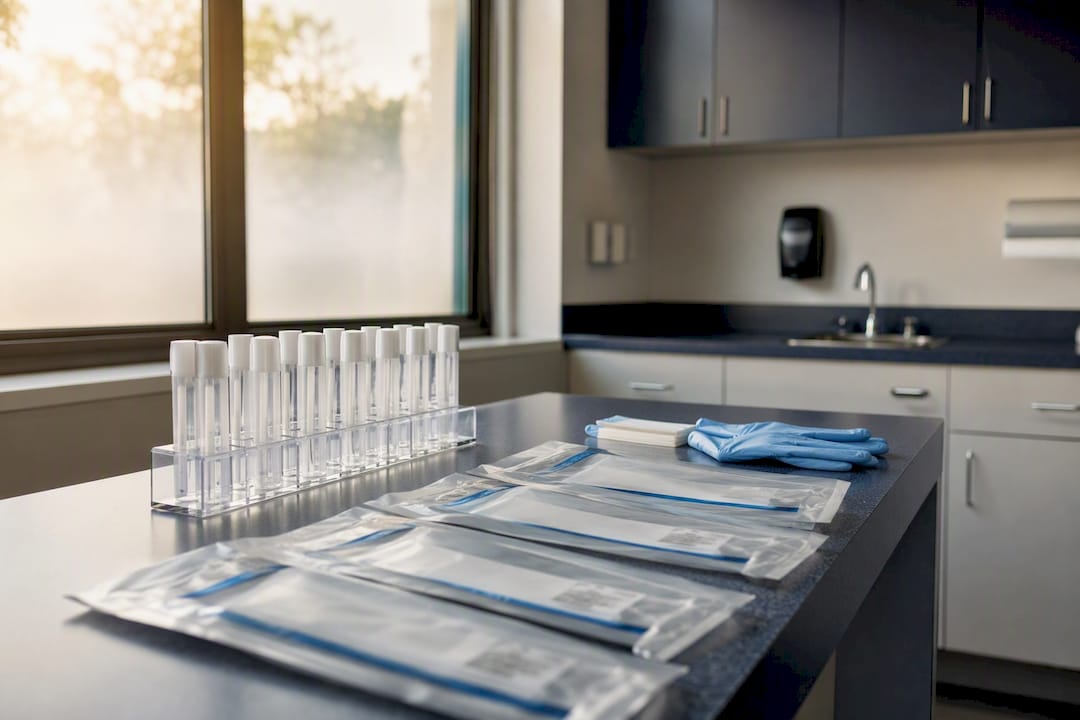
That matters most in direct observation scenarios. Directly observed urine collection means a same-sex observer watches the donor urinate into the collection cup, a process that’s understandably uncomfortable and, for transgender and nonbinary drivers, can create genuine conflict over which observer is appropriate. Oral fluid collection removes that specific friction because the observation itself is inherent to the swab process rather than an added invasive step.
That said, oral fluid isn’t privacy-neutral in every respect. It’s harder to adulterate than urine, but that same directness means less physical distance between collector and donor during the swab itself. Some drivers find that uncomfortable in its own way, even though it’s brief.
Legally, oral fluid results carry the same weight as urine results under Part 40 once the specimen type is operational: positive results go to the MRO for review, drivers retain the right to request split-specimen testing (from a separate certified lab), and the same due-process protections apply. Employers should treat oral fluid collections with the same confidentiality standards they already apply to urine results, meaning results go to designated personnel only, and CCF paperwork gets stored under the same access controls.
Drivers concerned about oral fluid testing’s legal standing should know it isn’t a lesser or informal test. It carries identical regulatory weight once certified labs exist to process it.
What Goes Wrong During Oral Fluid Collections?
Every new collection method has a break-in period, and oral fluid will be no exception once labs are certified. A few predictable failure points show up consistently in DOT guidance and collector training material.
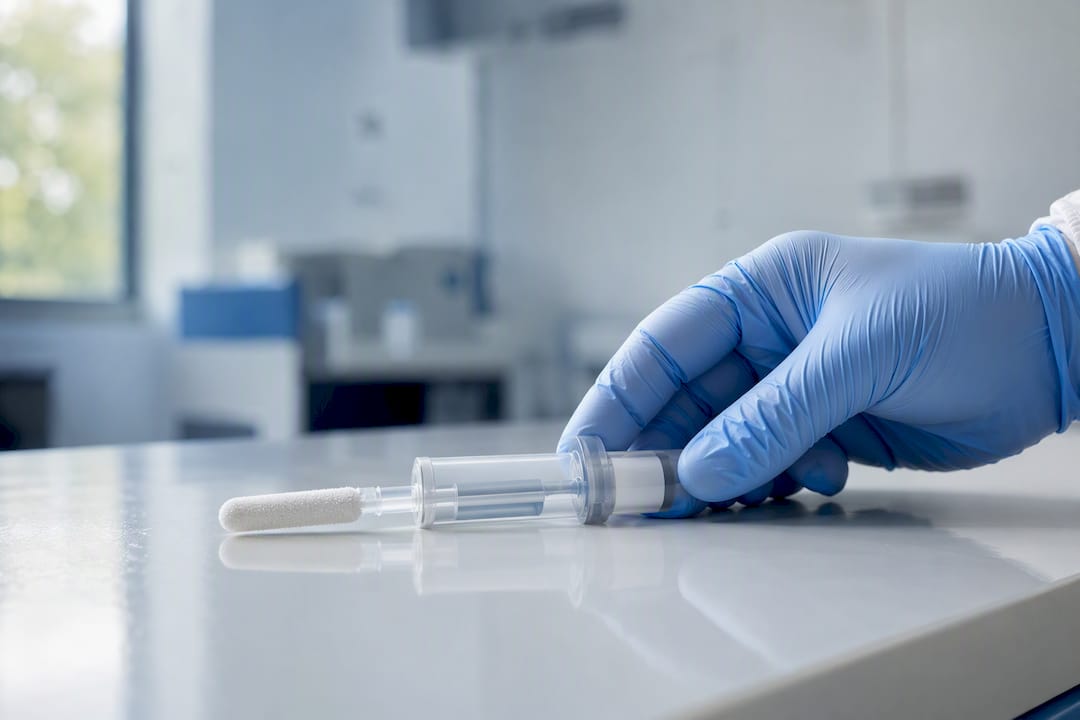
Insufficient saliva volume tops the list. Dry mouth from nerves, medication, or simple dehydration can make it hard for a donor to produce the minimum undiluted volume a device requires. Devices typically include a stimulant component to help, and collectors follow a defined wait period before treating an attempt as a failure to provide a specimen.
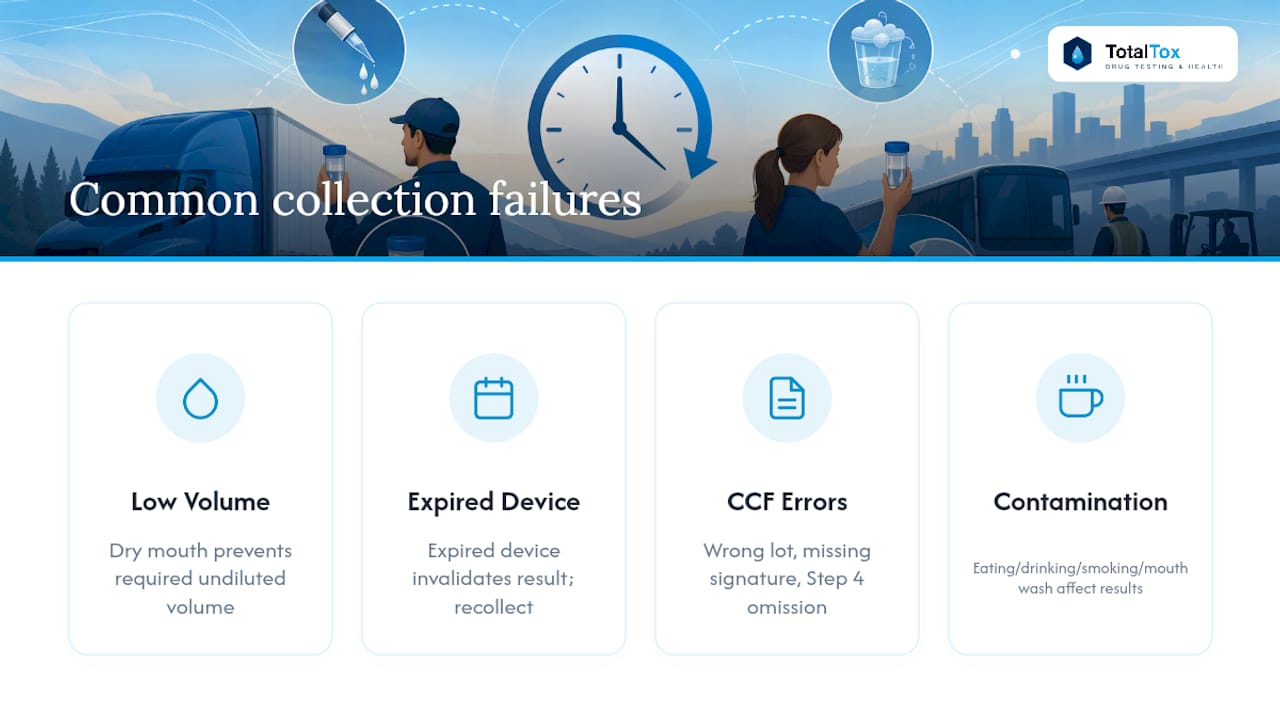
Device expiration errors are the second major issue, and arguably the most avoidable. An expired collection device is a fatal flaw under DOT rules; the result can’t stand, and the donor needs to be recollected with a valid device. Collectors who develop the habit of checking expiration before every single collection, not just when something looks off, eliminate this problem almost entirely.
CCF documentation mistakes round out the common failures. Entering the wrong device lot number, missing a required signature, or failing to note device expiration in Step 4 can invalidate an otherwise clean collection.
Contamination concerns matter differently for oral fluid than urine. Eating, drinking, smoking, or using mouthwash shortly before collection can affect results, so collectors typically ask donors to avoid these for a defined window before testing, and observe an oral cavity check as part of the procedure.
None of these are exotic problems. They’re the same category of human error that shows up in any collection procedure, urine included, and they’re solvable with consistent training and device-first habits.
What Should CDL Drivers Expect During Oral Fluid Testing?
Once oral fluid testing becomes operational, the process for drivers will be noticeably faster and less clinical than urine collection. A trained collector places an absorbent pad or swab against the inside of the cheek or under the tongue, depending on the device, and holds it there for a specified time, often a few minutes, until enough saliva has been absorbed.
There’s no bathroom stall, no privacy partition, and no waiting for a natural urge. The entire collection happens in the room with the collector present the whole time, which is precisely why it sidesteps the same-sex observer complications that arise with directly observed urine testing.
Drivers should expect the same chain-of-custody rigor as urine testing: the collector will show the device’s expiration date, seal the specimen in tamper-evident packaging in front of the donor, and have the driver initial or sign the CCF confirming the specimen is theirs. Every step mirrors the accountability built into urine collection procedures.
One practical heads-up: avoid eating, drinking anything other than water, smoking, or using mouthwash for roughly 10 to 15 minutes before a scheduled test if possible. These can interfere with either the sample volume or the test itself.
Refusal to test, tampering, or substitution carries the same consequences under oral fluid testing as under urine testing; there’s no reduced-stakes version of DOT drug testing based on specimen type. A verified positive or a refusal triggers the same immediate removal from safety-sensitive duties and the same return-to-duty process regardless of which specimen was collected.
What Happens If Employers Don’t Comply?
Right now, non-compliance risk sits in a different place than most employers expect. You’re not at risk for failing to adopt oral fluid testing, since it isn’t available yet. You’re at risk for assuming it’s already an option and improperly skipping or substituting urine collection procedures.
DOT enforcement continues under the existing urine-testing framework without interruption. FMCSA can flag violations during audits, and a compliance review that finds gaps in collection procedures, CCF errors, or missed random testing rates can result in civil penalties, and in serious cases, downgrades to a carrier’s safety rating.
Once HHS certifies the second lab and DOT publishes the Federal Register trigger, the compliance clock changes shape. Employers already using oral fluid, or ready to switch immediately, can proceed. Employers who aren’t ready get the 18-month grace period, but that period has a hard end date once it starts running. There’s real risk in treating that window as indefinite; it isn’t.
The safest posture between now and the trigger date is straightforward: run your current urine-testing program exactly as required, document everything as if you’ll be audited tomorrow, and use any prep time available to get collector training and lab contracts oral-fluid-ready before you’re forced to move fast. Employers who’ve done that legwork early will have a real head start when the grace period clock finally starts.
Where to Track Official Oral Fluid Testing Updates
Bookmark the DOT’s HHS-certified lab list, which updates the moment certification status changes, and Part 40 itself for rule text and Q&A guidance. Check the Federal Register for the eventual grace-period notice, and keep SAMHSA’s collection handbook on hand for device specifics. A quarterly check of the lab list is enough until certification news breaks.
Why This Rollout Rewards Preparation Over Speed
The conventional advice floating around fleet compliance circles treats oral fluid testing like a light switch: wait for the announcement, then flip it. That’s backwards. The employers who come out ahead here are the ones treating the current gap, no certified labs, no trigger date, as prep time rather than dead time.
What’s overrated is trying to predict exactly when HHS will certify a second lab. Nobody can, and burning energy on speculation distracts from work that pays off regardless of timing: training collectors on oral fluid devices, auditing lab and C/TPA contracts for split-specimen language, and tightening CCF discipline on your existing urine program. Every one of those tasks makes you better at compliance today and ready for the switch tomorrow.
What the research actually supports is a dual-track mindset. Keep urine testing airtight because that’s still the law. Build oral fluid readiness in parallel because the trigger, when it comes, won’t give you 18 months to start from zero, it’ll give 18 months to finish what you should have already started. Employers waiting for a press release to begin planning are the ones who’ll be scrambling when the grace period clock starts ticking.
— Total Tox
Get Audit-Ready Testing Support From Total Tox
Whether you’re running DOT urine collections today or preparing your program for oral fluid testing down the line, the fundamentals stay the same: fast turnaround, accurate documentation, and zero guesswork on compliance details. Total Tox handles walk-in DOT testing with collections completed in under 15 minutes and MRO-reviewed results back within 24 hours, so your drivers stay compliant without sitting in a waiting room half the day.
That speed matters more than most safety managers realize until they’re facing a random testing deadline or a post-accident window with no appointment slots open. Total Tox serves employers across the Bronx, Manhattan, Westchester, and Queens with the same audit-ready CCF documentation and device-handling discipline that oral fluid collections will eventually require. If your standing orders, lab agreements, or collector training need a review before the next compliance audit, schedule a visit or reach out to discuss your program and get your testing setup squared away now.
This article is general information, not a substitute for advice from a qualified lawyer. Consult a qualified legal professional about your own circumstances before acting on anything here.
Sources
- Procedures for Transportation Workplace Drug and Alcohol Testing Programs; Federal Register (May 11, 2026)
- Oral Fluid Specimen Collection Handbook | SAMHSA