
A standard U.S. DOT physical typically costs about $80 to $150 out of pocket, though the exact number depends on the clinic and whatever add-ons get tacked on. Drug testing, paperwork processing, and follow-up screenings can push the total higher. There is no federal rule requiring employers to cover this cost, so drivers should confirm who pays before booking.
TL;DR:
- Most clinics charge between $80 and $150 for a DOT physical, with costs varying based on provider type, location, and added services like drug testing.
- Fleet accounts or clinics with high-volume agreements typically offer lower per-exam prices by spreading administrative overhead across many drivers.
- Employers are not legally required to pay for the exam, but in the case of a positive drug test retest, they must cover costs if the driver requests a split-sample test within 72 hours.
- Additional costs may include drug testing panels, ECGs, pulmonary tests, and paperwork fees, which vary depending on driver health history and clinic policies.
- Choosing a provider that offers same-day results, bundled services, and transparent pricing can significantly reduce downtime and administrative hassle.
Table of Contents
- What Drivers and Employers Typically Pay for a DOT Physical
- What Changes the Price: Add-Ons, Location, and Timing
- Who Pays for a DOT Physical and How Employer Policies Vary
- Practical Tactics to Cut Cost or Downtime Without Losing Compliance
- How Total Tox’s Walk-In Model Affects Cost and Downtime
- Impact of Insurance Coverage on DOT Physical Cost
- Factors Influencing Price Negotiation or Discounts
- Cost Comparison Between Initial and Follow-Up DOT Physicals
- Prioritizing Price, Speed, or Employer-Account Benefits
- Total Tox: Services and How to Schedule
- Sources
- FAQ
What Drivers and Employers Typically Pay for a DOT Physical
Most clinics that perform DOT physicals fall into a fairly predictable price band. Retail and walk-in clinics tend to sit at the lower end, occupational medicine centers land in the middle, and urgent care chains or hospital-affiliated clinics often charge more, especially when extra testing gets bundled in. None of these prices are set or regulated by the government. The National Registry’s ME certification guidance confirms that medical examiners and the organizations that employ them set their own fees, since neither FMCSA nor the National Registry establishes pricing.
A few real-world scenarios show how this plays out:
- An independent owner-operator booking a single exam at a walk-in clinic typically lands at the lower to middle end of the range, paying out of pocket with no employer to split the cost.
- A small employer scheduling one driver for a physical often pays a similar per-exam rate, unless the clinic charges extra for same-day scheduling or expedited paperwork.
- A fleet account with a standing relationship at an occupational health provider usually negotiates a lower per-exam rate, since the clinic is guaranteed repeat volume.
The gap between these scenarios comes down to volume and relationship, not the exam itself. A basic DOT physical involves the same vision, hearing, blood pressure, and urinalysis screening no matter who is paying. What changes is the overhead the clinic bakes into its fee, and whether that clinic has enough incoming exams to spread its administrative costs across many patients instead of just one.
Retail clinics inside pharmacies or grocery stores often keep prices predictable because the exam is one of several standardized services they offer, like those available at PromptMed Urgent Care, which provide walk-in DOT physicals with transparent pricing. Urgent care centers, by contrast, may treat the DOT physical as a smaller part of their business and price it closer to a general physical exam. Occupational medicine clinics that specialize in employer compliance work usually build in the paperwork handling and any required drug testing as part of a package price, which can make the total look higher but actually save a separate trip.
What Changes the Price: Add-Ons, Location, and Timing
The base exam fee is only part of the picture. Several add-ons and circumstances shift the final number, and understanding them lets you control what you pay.
- DOT drug testing. A 5-panel test, which is the federally required panel for safety-sensitive transportation roles, typically costs less than a broader 10-panel screen that some employers request for internal policy reasons.
- Electrocardiogram (ECG). Drivers with a history of heart conditions may need an ECG as part of the certification process, which adds a separate line-item fee.
- Pulmonary function testing (PFT). This is not standard for every driver but may be required if the examiner has concerns about breathing capacity, and it carries its own charge.
- Paperwork and MRO review fees. Medical Review Officer oversight of drug test results and processing of the Medical Examiner’s Certificate can appear as a separate administrative fee at some clinics.
- Convenience premiums. Same-day appointments, after-hours slots, and clinics located far from a driver’s route can all carry a slightly higher price or an indirect cost in lost driving time.
Volume changes the math significantly. FMCSA’s implementation guidelines for drug and alcohol testing explain that testing providers set their own fees, and that overhead tends to make per-test pricing higher for low-volume buyers while consortia and high-volume purchasers typically get lower rates. A single owner-operator walking in for one exam pays the sticker price. A fleet with a consortium membership or a standing contract spreads its administrative costs across dozens or hundreds of exams a year, which brings the per-exam price down.
Pro Tip: Ask upfront whether the quoted price includes the drug test panel and paperwork processing, or whether those are billed separately: bundled pricing is often cheaper than the sum of its parts.
Who Pays for a DOT Physical and How Employer Policies Vary
There is no federal law that puts the cost of a DOT medical exam on the employer. According to FMCSA’s own guidance, the Federal Motor Carrier Safety Regulations do not require employers to pay for the exam, so the answer depends entirely on company policy. Many carriers choose to cover it as a hiring or retention cost, but nothing forces them to.
The one clear exception involves split-specimen testing after a positive drug result. FMCSA states that if a driver requests a split-specimen test within 72 hours of a positive result and cannot pay for it, the employer must cover that cost so the retest happens without delay, under 49 CFR §40.173. Outside that specific scenario, payment responsibility is a matter of employer choice, not federal mandate.
Before booking an exam, drivers should confirm a few things directly with their employer:
- Reimbursement policy: will the company pay upfront, reimburse after the fact, or not cover the cost at all.
- Required testing: does the role require only the standard physical, or also a 5-panel or 10-panel drug screen.
- MRO handling: who reviews drug test results and how quickly certification paperwork gets processed.
- Timeline: how soon the exam needs to happen relative to a start date or recertification deadline.
Getting these answers before scheduling avoids the frustrating scenario of paying out of pocket for something the employer would have covered, or booking a clinic that does not offer the specific testing the job requires.
Practical Tactics to Cut Cost or Downtime Without Losing Compliance
Lowering the cost of a DOT physical usually comes down to asking the right questions before you book, not shopping for the absolute cheapest clinic. A few tactics make a real difference.
Start by comparing provider types directly. Call ahead and ask whether the quoted price includes drug testing, whether an MRO reviews results in-house or through a third party, and whether paperwork is processed same-day or takes longer. Retail clinics and walk-in providers are often the most transparent about pricing since the exam is a standardized offering rather than a custom service.
Employers and fleet managers should look into consortium membership or fleet accounts. FMCSA’s guidance notes that high-volume purchasers and consortia benefit from lower per-exam pricing because fixed administrative costs get diluted across many tests, which makes this one of the more reliable ways for a small carrier to bring costs down over time.
A statistic worth remembering: industry pricing for DOT physicals commonly falls within a moderate price range nationally (https://www.fmcsa.dot.gov/regulations/drug-alcohol-testing/implementation-guidelines-alcohol-and-drug-regulations-chapter-10), though this reflects general market pricing patterns rather than a government-set fee schedule, since providers set their own rates.
Before booking anywhere, confirm these details:
- Forms: does the clinic use the current Medical Examiner’s Certificate and have it ready to issue on-site.
- Drug testing: is DOT-compliant drug testing performed at the same location or does it require a separate trip.
- MRO review: is a Medical Review Officer available to review results without added delay.
- Total fees: does the quoted price include paperwork, or will that show up as a separate charge at checkout.
How Total Tox’s Walk-In Model Affects Cost and Downtime
Speed and paperwork quality carry a real cost even when they do not show up as a separate line item. A driver who loses half a day waiting for an appointment, or an employer whose paperwork gets rejected for missing documentation, pays for that delay in lost hours and repeat visits.
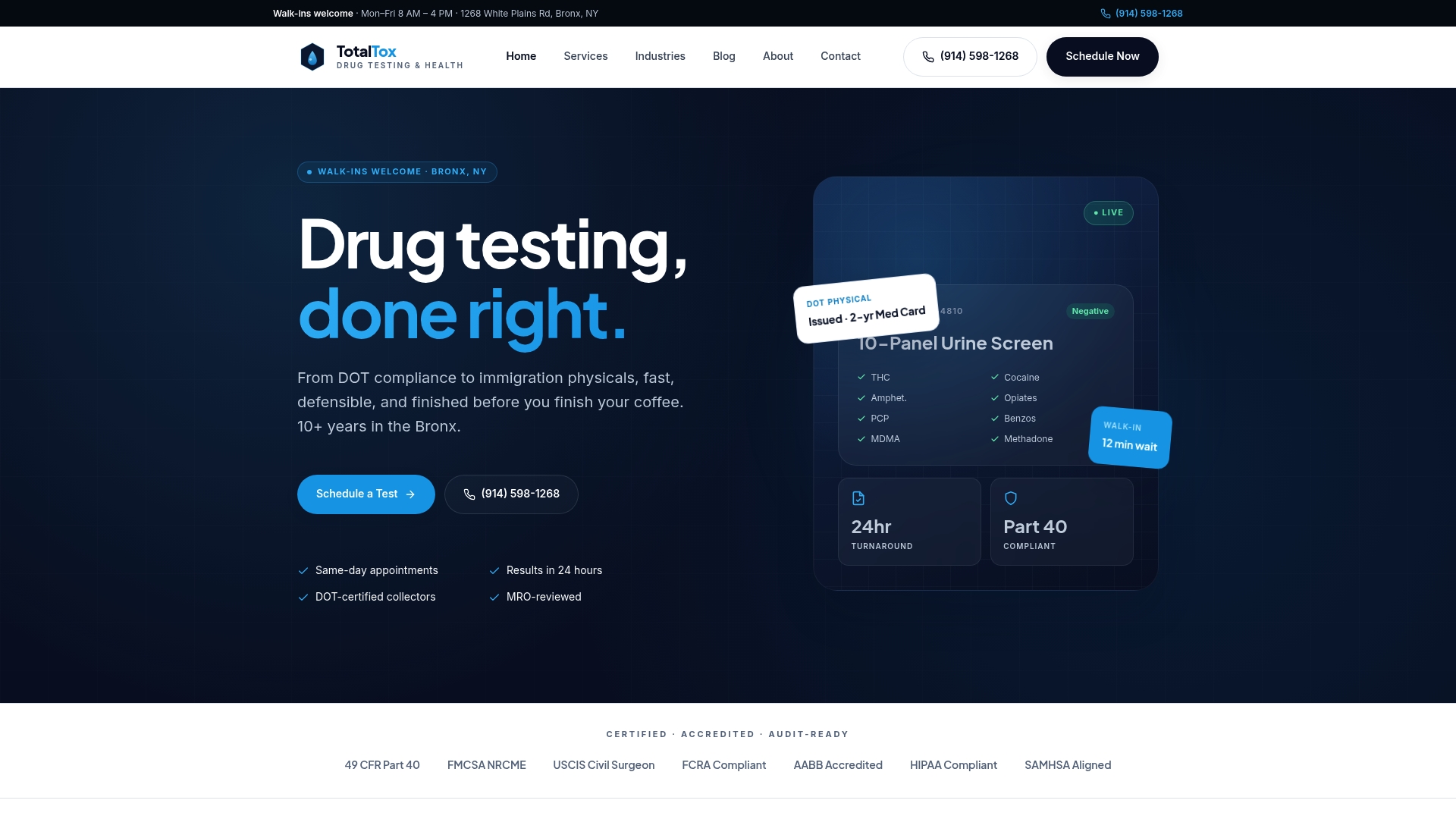
Total Tox runs a walk-in model designed around that problem. Tests are typically completed in under 15 minutes, with results delivered within 24 hours, which limits the downtime a driver or fleet absorbs while waiting on certification. Results go through MRO review and come with audit-ready documentation, which reduces the chance that an employer has to chase down missing paperwork later.
For drivers and employers in the Bronx area, this model turns a process that could stretch across multiple appointments into a single visit:
- Same-day scheduling cuts down on the lost driving time that comes with multi-day appointment waits.
- MRO-reviewed results reduce the risk of paperwork errors that trigger a repeat exam.
- Audit-ready documentation gives employers a compliance record without extra administrative follow-up.
Drivers preparing for a visit can review the preparation checklist or browse the full services list beforehand.
Impact of Insurance Coverage on DOT Physical Cost
Health insurance often does not apply the way drivers expect. Many DOT physicals are billed as occupational or employment-related exams rather than standard preventive care, which means some insurance plans exclude them entirely or apply them toward a deductible instead of covering them outright.
Some plans do reimburse a portion of the cost if the exam is billed as a routine physical, particularly when the DOT-specific paperwork is processed as an add-on to a broader annual checkup. This varies significantly by insurer and plan type, so the safest approach is calling the insurance provider directly and asking whether occupational or DOT-specific exams are covered before assuming a copay will apply.
Employers who require the exam as a condition of employment sometimes treat it as a business expense and reimburse the driver directly, sidestepping the insurance question altogether. This is a matter of company policy rather than a requirement, so it is worth confirming during hiring or before scheduling a recertification exam. For drivers without employer coverage or applicable insurance, clinics that offer transparent flat-rate pricing tend to be the more predictable option, since the total cost is known upfront rather than dependent on how a claim gets processed.
Factors Influencing Price Negotiation or Discounts
Pricing on a DOT physical is rarely fixed the way a retail price tag is. Clinics set their own fees, which means there is often room to ask about discounts, especially for employers booking multiple exams.
Volume is the biggest lever. A fleet manager scheduling exams for a dozen drivers a year has more negotiating room than a single independent driver walking in once. Clinics that specialize in occupational health frequently offer reduced per-exam rates to employers who commit to regular volume, since predictable business lets the clinic plan staffing and reduce its own overhead.
Bundling services can also lower the effective cost. A clinic that performs the physical, the drug test, and the paperwork processing in one visit often prices that package below what the same three services would cost booked separately across different providers. Asking about a bundled rate before scheduling is a simple way to find out if this applies.
Timing matters too. Clinics with slower periods may offer lower rates or added availability to fill appointment gaps, while last-minute or after-hours requests are less likely to come with any discount. Employers with recurring compliance needs, such as annual recertification for a driver roster, are generally in the strongest position to negotiate a standing rate rather than paying walk-in pricing every time.
Cost Comparison Between Initial and Follow-Up DOT Physicals
A first-time DOT physical and a routine recertification exam usually cost about the same, since both involve the same core screening: vision, hearing, blood pressure, urinalysis, and a review of medical history. The certification itself is valid for up to 24 months for most drivers, though some medical conditions require more frequent recertification on a shorter schedule set by the examiner.

Where costs diverge is when a follow-up exam is required outside the normal renewal window. If a driver develops a new medical condition, needs a waiver, or is flagged during a routine exam for additional testing like an ECG or pulmonary function test, that follow-up visit adds cost on top of the base exam fee. A driver managing a condition like high blood pressure may also need more frequent monitoring exams, which adds up over a multi-year period even if each individual visit is priced the same as the original physical.
Employers renewing certification for an entire driver roster benefit from the same volume advantages that apply to first-time exams. A fleet account that negotiates a per-exam rate typically carries that rate into renewal cycles as well, which makes budgeting for recurring compliance more predictable than treating each recertification as a one-off expense.
Prioritizing Price, Speed, or Employer-Account Benefits
Independent drivers paying out of pocket should prioritize price first, since there is no employer covering the gap between a $80 clinic and a $150 one. Employers and fleet managers are usually better off prioritizing speed and documentation quality, since a rejected form or a delayed result costs more in downtime than the exam itself.
A short way to decide:
- Independent driver: compare two or three walk-in clinics, confirm the total price including drug testing, and book the lowest transparent quote.
- Small employer: prioritize a clinic with same-day results and clean paperwork over the cheapest sticker price.
- Fleet manager: pursue a consortium or standing account to lock in per-exam savings across the whole roster.
— Total Tox
Total Tox: Services and How to Schedule
Total Tox handles DOT physicals, DOT drug and alcohol testing, and MRO-reviewed results under one roof, with walk-in and same-day appointments built into the model. That structure removes the back-and-forth of separate testing and paperwork visits, which is often where drivers and employers lose the most time.
- DOT physicals and drug testing completed in a single visit, with results typically ready within 24 hours.
- MRO-reviewed, audit-ready documentation that reduces employer follow-up and rejected paperwork.
- Service offered for drivers and employers in the Bronx, Westchester, and surrounding counties.
Browse the full services page or schedule an appointment directly.
Sources
- Implementation Guidelines for Alcohol and Drug Regulations - Chapter 10 | FMCSA
- Complete Guide to ME Certification | National Registry
FAQ
Can I get a free DOT physical?
A completely free DOT physical is uncommon, since medical examiners and clinics set their own fees and the government does not subsidize the exam. Some employers cover the full cost as part of a hiring package, which functions as free to the driver, but this depends entirely on company policy rather than any general program.
Is a DOT physical hard to pass?
Most healthy drivers pass a DOT physical without issue, since it screens for vision, hearing, blood pressure, and basic health conditions rather than testing physical performance. Drivers managing conditions like high blood pressure, diabetes, or sleep apnea may need additional documentation or a waiver, which can extend the process but does not necessarily mean failure.
What are the new DOT medical card rules for 2026?
Specific federal rule changes in the near future are not publicly listed in current FMCSA guidance at this time. Drivers should verify their certification requirements and renewal timelines directly with a certified medical examiner or through FMCSA’s official resources before assuming any change to the standard process.
How long does a DOT physical take?
A standard DOT physical usually takes well under an hour once you are in the exam room, since it covers a defined set of checks: vision, hearing, blood pressure, urinalysis, and a review of medical history. Walk-in clinics that combine the physical with on-site drug testing, like Total Tox, can often complete the full visit in a single short appointment rather than requiring a separate trip.