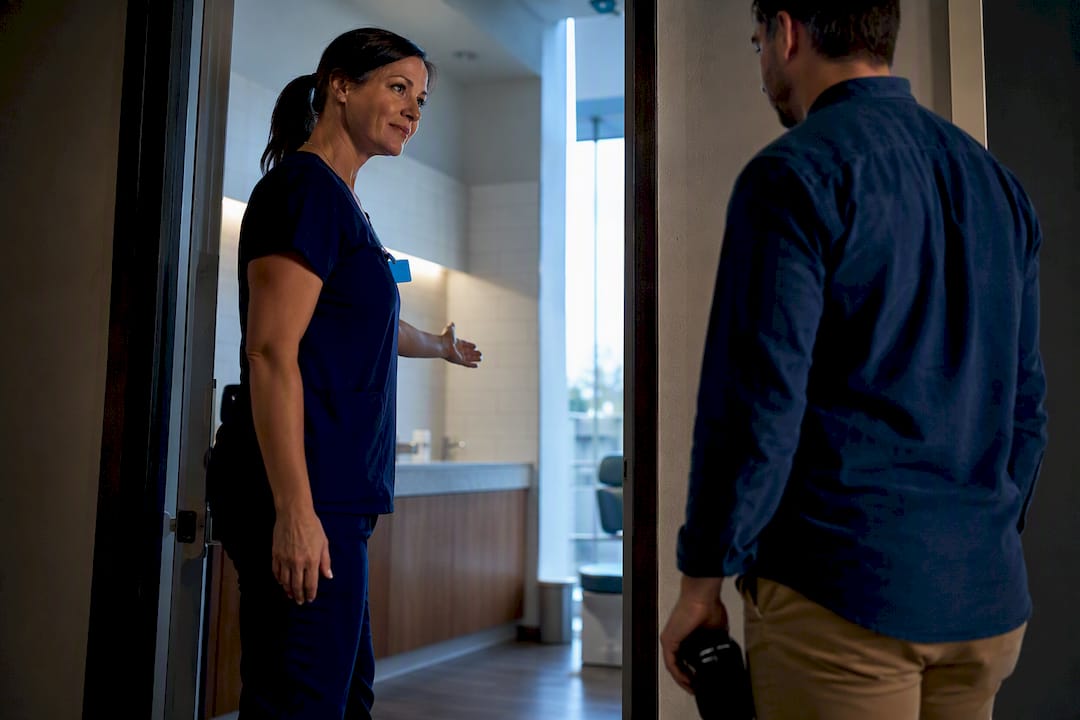
You may not let a new hire perform DOT safety-sensitive duties until you have a Medical Review Officer-verified negative drug test result in hand and have completed the required FMCSA Clearinghouse checks. Oral fluid testing is now authorized under federal rules, but until enough HHS-certified labs come online, urine collection remains the default option for most employers. Skip either step and you own the liability, not the driver.
TL;DR:
- Oral fluid testing will become the standard specimen type once two HHS-certified labs are operational, but urine testing remains the default for now due to infrastructure gaps.
- Employers must verify a negative drug test and clear the FMCSA Clearinghouse before allowing a new hire to perform safety-sensitive duties, with the MRO’s final review required for full clearance.
- All applicants in safety-sensitive roles must be treated equally for testing, and documentation proving prior drug testing compliance must be retained for at least two years.
- The DOT 5-panel drug test screens for amphetamines, cocaine, marijuana metabolites, opiates, and PCP, with cutoff levels set by HHS, not individual labs.
- Employers should proactively disclose applicant medication and hydration details before testing to minimize false positives and streamline the verification process.
Table of Contents
- Who Needs a DOT Pre-Employment Drug Test
- What the DOT 5-Panel Test Actually Screens For
- The DOT Drug Test Process, Step by Step
- Exceptions to Testing and How to Verify Them Safely
- FMCSA Clearinghouse Queries and the MRO’s Role
- How Long to Keep DOT Test Records
- Final Compliance Checklist Before Day One
- How Total Tox Supports Compliant DOT Testing
- What Rights Employees Have During DOT Testing
- Breathalyzer, Saliva, and Other DOT Alcohol Testing Methods
- Avoiding Inadvertent Positives Before Test Day
- What Actually Causes a False Positive
- The DOT Medical Examiner’s Separate Role in Hiring
- Publisher Perspective: The Mistake That Keeps Repeating
- Schedule Fast, Compliant DOT Testing With Total Tox
- Where to Verify DOT Testing Rules Directly
- Sources
- FAQ
Who Needs a DOT Pre-Employment Drug Test
The FMCSA pre-employment testing rule covers anyone about to perform a safety-sensitive function for the first time under a DOT agency’s authority, and it applies before that person turns a key or touches a control. FMCSA governs commercial driver’s license holders, but it is not the only agency writing these rules. The FAA covers pilots and certain aviation crew, the FRA covers train crew and dispatchers, the FTA covers transit operators, and PHMSA covers pipeline workers in safety roles.
“First time performing safety-sensitive functions” also covers employees returning after more than 30 days outside your random testing pool, even if they worked for you before in a different capacity.
- CDL drivers hauling freight or passengers
- Transit bus operators under FTA rules
- Pipeline maintenance and control-room staff under PHMSA
- Aviation crew and certain maintenance roles under FAA rules
- Rail crew, signal maintainers, and dispatchers under FRA rules
Treat every applicant in a covered job class the same way. Picking and choosing who gets tested, even with good intentions, creates disparate-treatment exposure that has nothing to do with drug policy and everything to do with employment law.
What the DOT 5-Panel Test Actually Screens For
Every DOT pre-employment drug test screens the same five drug classes, regardless of mode of transportation: amphetamines, cocaine, marijuana metabolites, opiates, and phencyclidine (PCP). Cutoff levels for a positive result are not set by the testing lab or by Total Tox. They come from HHS Mandatory Guidelines, which is why two different labs running the same specimen should land on the same call.
By the numbers: DOT’s May 2026 Federal Register update authorizes oral fluid collection as a valid specimen type, but implementation depends on the availability of two HHS-certified oral fluid laboratories before employers can rely on it broadly.
Urine remains the default because that lab infrastructure is not fully built out yet. Where oral fluid isn’t available and a situation calls for heightened scrutiny, collectors fall back to directly observed urine collection. Direct observation itself is reserved for specific triggers, such as a return-to-duty test or a prior test with irregularities, not a routine first-time hire.
- Amphetamines (including methamphetamine)
- Cocaine metabolites
- Marijuana metabolites (THC)
- Opiates (including certain prescription opioids)
- Phencyclidine (PCP)
The DOT Drug Test Process, Step by Step
Here’s how a compliant pre-employment DOT drug test process actually runs from offer to hire:
- Extend a contingent job offer. The offer is conditioned on a negative result and a clean Clearinghouse query, and you get the applicant’s written consent for both.
- Run the FMCSA Clearinghouse query. This happens before the road test and before scheduling the collection, so you know upfront if there’s a disqualifying record.
- Schedule the collection using the Federal Custody and Control Form (CCF). The CCF is the paper trail that follows the specimen from collection to lab to MRO. No CCF, no valid test.
- The collector verifies photo ID, observes the collection process within Part 40 rules, and completes chain-of-custody documentation. A missing signature or an unsecured restroom can invalidate the whole specimen and force a costly re-collection.
- The lab tests the specimen and reports results to the Medical Review Officer, never directly to you or the applicant.
- The MRO verifies the result. A negative gets verified and released quickly. A non-negative triggers an interview with the applicant, who can request a split-specimen retest at their own expense if they dispute the finding.
- You receive the verified negative report. Only now can the employee begin safety-sensitive duty.
Pro Tip: Build a hard rule into your applicant tracking system that blocks a start date from being entered until the MRO-verified negative is logged. Employers who allow a start date to move forward on a “clean” lab result, before MRO sign-off, create the single most common compliance gap in this entire process.
Exceptions to Testing and How to Verify Them Safely
Section 382.301 carves out narrow situations where you can skip a fresh pre-employment test, but the paperwork burden shifts entirely to you.
- The applicant must have been in a qualified drug testing program for the previous 30 days
- They must have participated in random testing for the preceding six months (or twelve months for alcohol, depending on the specific provision)
- They must have no known violations of DOT drug and alcohol rules in the past six months
You still need to check with the previous DOT-regulated employer for the past two years and get written consent from the applicant to request that history. Get it in writing, keep it on file, and never accept a verbal assurance from either the applicant or the prior employer.
The most common pitfalls: letting a new hire drive before MRO verification lands, treating an incomplete prior-employer response as good enough, and thin documentation that can’t survive an audit.
FMCSA Clearinghouse Queries and the MRO’s Role
A pre-employment Clearinghouse query returns one of two outcomes: no record, meaning the applicant is clear to proceed, or a recorded violation that has not been resolved through the return-to-duty process. A hit means the applicant cannot perform safety-sensitive duties for you until they complete that process, no matter how clean their drug test comes back.
- MRO verification generally happens within a day or two of the lab reporting a result to the MRO’s office
- A non-negative result triggers a required interview between the applicant and the MRO before anything gets finalized
- Split-specimen retesting is available if the applicant disputes a positive; the applicant typically bears that cost unless the split confirms an error
Employers often conflate “the lab came back negative” with “the MRO verified negative.” Only the second one satisfies your legal obligation under §382.301.
How Long to Keep DOT Test Records
Negative pre-employment drug test records need to stay on file for one year. Positive results, refusals to test, and any return-to-duty documentation need five years of retention, and that clock doesn’t reset just because the employee left and came back.
- Negative results: 1 year minimum retention
- Positive, refusal, or return-to-duty records: 5 years minimum retention
- New hires must be added to your random testing pool within 30 days of the verified negative landing on file
A common scheduling mistake: HR treats the 30-day random-pool deadline as flexible because the employee already tested clean at hire. It isn’t flexible, and missing it is exactly the kind of gap an audit catches.
Final Compliance Checklist Before Day One
Run through this before anyone gets behind the wheel or touches safety-sensitive equipment:
- FMCSA Clearinghouse query completed and clear (or violation resolved through return-to-duty)
- MRO-verified negative drug test result on file, not just a lab report
- Signed applicant consent forms for testing and for prior-employer history checks, where applicable
- Prior-employer verification completed and documented, if relying on a §382.301 exception
- Employee scheduled to enter the random testing pool within 30 days of the verified result
Pro Tip: Keep every document in one digital file per employee, tagged by hire date, not by document type. When an auditor asks for a specific driver’s full compliance packet, you want to pull one folder, not chase five different filing systems.
Any gap in this checklist is a reason to delay the start date, not a reason to make an exception “just this once.”
How Total Tox Supports Compliant DOT Testing
There are providers that run walk-in DOT collections across urine, saliva, and hair follicle specimens, with MRO-reviewed results and audit-ready paperwork built for exactly the recordkeeping demands above. Fast turnaround matters here: the longer an employer waits on a verified result, the longer a conditional hire sits in limbo, unable to start and unable to be released. Employers across transportation, construction, and healthcare use that speed to close the compliance gap without stalling their hiring pipeline.
What Rights Employees Have During DOT Testing
DOT testing regulations aren’t a one-way street. Applicants have specific protections built into the process, and HR teams that ignore them expose themselves to grievances and legal challenges that have nothing to do with the drug test itself.
An applicant has the right to know, before collection, that the test is a DOT-regulated test and which substances it screens for. They have the right to a private, dignified collection process, with direct observation reserved only for the specific triggering circumstances in Part 40, not applied as a default. If a result comes back non-negative, the applicant has the right to a confidential interview with the MRO before that result is finalized and reported to you, and they can explain a legitimate medical use for a substance during that conversation.
If the MRO verifies a positive, the applicant can request a test of the split specimen within 72 hours, generally at their own expense unless the retest proves the original result wrong. They also have the right to review their own testing records and request corrections to Clearinghouse entries they believe are inaccurate, directly through the Clearinghouse system.
None of these rights delay your ability to make a final hiring decision once the process concludes correctly. They exist to make sure the process concludes correctly the first time, which protects you from a wrongful-denial claim just as much as it protects the applicant.
Breathalyzer, Saliva, and Other DOT Alcohol Testing Methods
Alcohol testing works differently from drug testing in one big way: DOT does not require pre-employment alcohol tests. Under DOT’s own guidance, employers may choose to conduct one, but if they do, it has to apply to every applicant in that job class and follow Part 40 procedures exactly like a mandated test.
Two collection methods dominate DOT-regulated alcohol testing. Breath alcohol testing (BAT) uses an approved breathalyzer device and a trained Breath Alcohol Technician, and it remains the most common method because results are immediate and the equipment is well standardized across the industry. Saliva-based alcohol screening devices exist and are approved for use in certain testing situations, offering a faster, less invasive collection, though breath testing still handles the bulk of DOT alcohol screening volume.
Whichever method an employer chooses to adopt voluntarily for pre-employment screening, consistency is the rule that matters most. If you test alcohol for one applicant in a job class, you test it for all of them. Applying it selectively turns an optional compliance tool into a discrimination risk, and that risk has nothing to do with whether the applicant actually had anything to drink.
Avoiding Inadvertent Positives Before Test Day
The best way to avoid a false-flag result on a DOT pre-employment drug test is to get ahead of it before the applicant ever walks into the collection site. Ask applicants, as part of the offer paperwork, to disclose any prescription medications that could trigger a non-negative screen. This isn’t about disqualifying someone for a legitimate prescription. It’s about giving the MRO the information needed to clear a legitimate medical explanation quickly instead of stalling the hire while questions get sorted out.
Certain over-the-counter products carry a real, if often overstated, risk of interference. Some cold medicines and dietary supplements have been linked to unexpected screen results, and applicants should be told plainly to disclose anything they’re taking, prescription or not, before the collection rather than after a non-negative result comes back.
Hydration matters for a different reason. Extremely dilute urine specimens can trigger a re-collection requirement under Part 40, adding days to the hiring timeline through no fault of anyone’s judgment. Advise applicants to avoid excessive fluid intake right before a scheduled collection and to show up prepared rather than rushed.
None of this changes the testing rules or gives an applicant an excuse. It simply reduces the odds of a result that has to go through MRO review for reasons that had nothing to do with actual drug use, which keeps your hiring timeline moving instead of stuck in a review queue.
What Actually Causes a False Positive
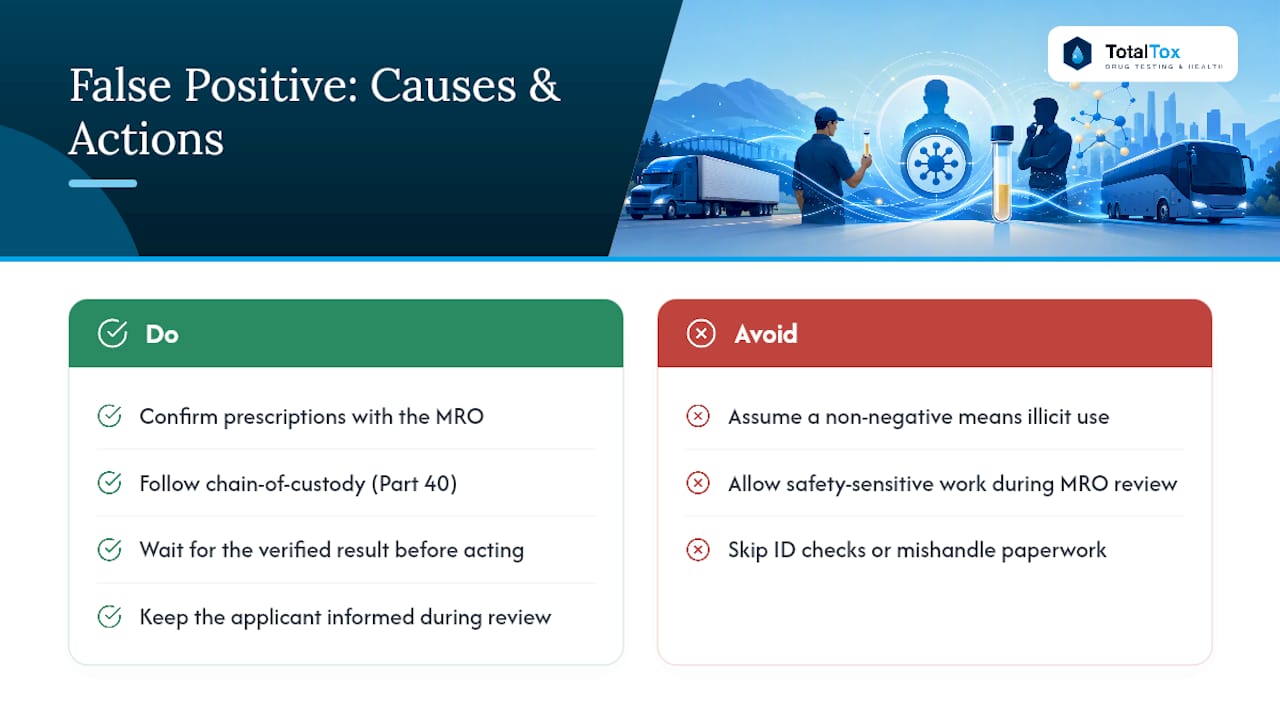
A “false positive” in DOT testing almost always traces back to one of a small number of sources, and understanding them helps HR respond correctly instead of assuming the worst about an applicant.
Cross-reactivity from prescription medications is the most frequent cause. Certain prescribed opioids and some other medications can trigger an initial non-negative screen that has nothing to do with illicit use. This is exactly why the MRO interview exists: the applicant gets a confidential chance to explain a valid prescription, and the MRO can verify it with the prescribing physician before finalizing anything.
Laboratory or specimen-handling errors are rarer but real, which is why chain-of-custody discipline under Part 40 matters so much. A collector who skips an ID check, leaves a collection site unsecured, or mishandles the Federal Custody and Control Form can create grounds to challenge a result entirely, independent of what the lab found.
The employer’s job in all of this is narrow but firm: never treat an initial non-negative lab result as a final answer, and never let anyone start safety-sensitive work while an MRO review is still open. Wait for the verified result, whichever direction it lands, and keep the applicant informed that the process is still moving.
The DOT Medical Examiner’s Separate Role in Hiring
The DOT Medical Examiner and the Medical Review Officer are not the same person doing the same job, and mixing them up trips up more HR teams than it should. The Medical Examiner conducts the DOT physical examination, a separate requirement from drug testing that assesses whether a candidate meets the physical qualification standards to safely perform the job, checking things like vision, hearing, blood pressure, and other medical fitness factors.
The physical exam and the drug test run on parallel tracks. A candidate can pass one and fail the other, and both have to clear before the hire is complete. The Medical Examiner has no role in reviewing or verifying drug test results. That’s exclusively the MRO’s job. Where the two intersect is scheduling: many employers coordinate the DOT physical and the drug test collection around the same visit for efficiency, since a physical examination facility like Total Tox that also handles DOT and employee physicals can often manage both in one appointment.
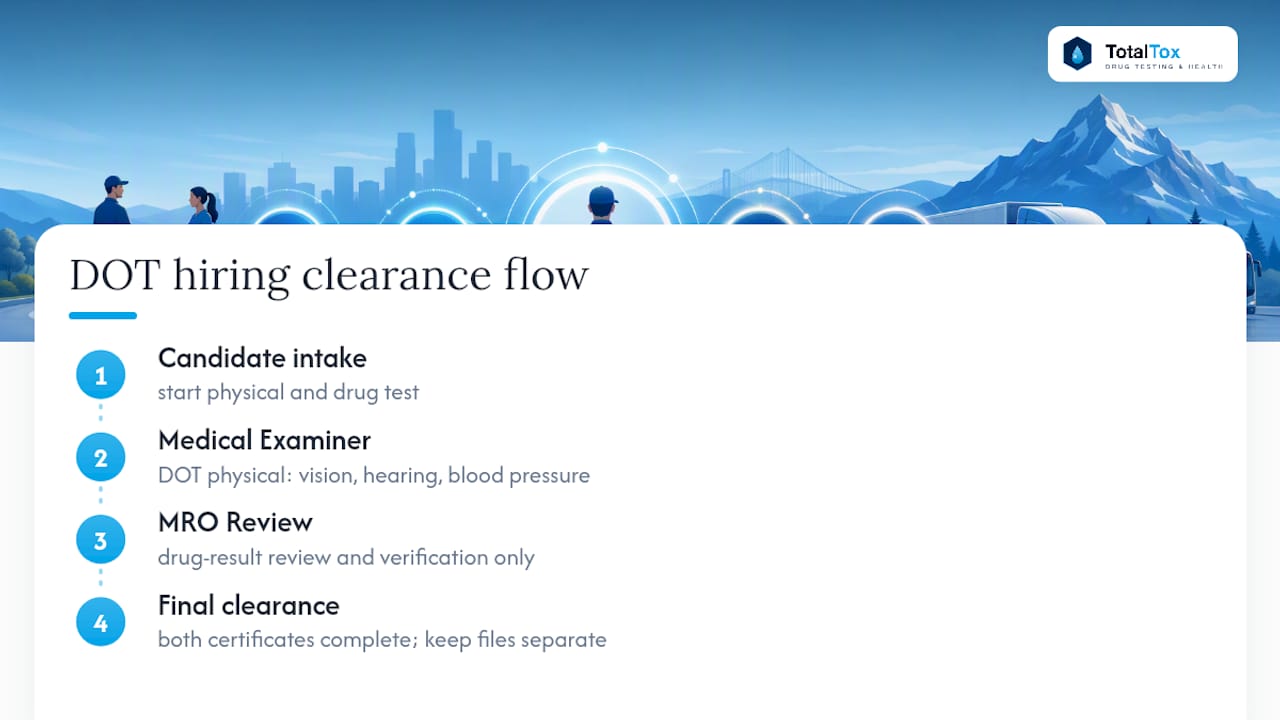
Keep the two certificates in separate compliance files even when they happen on the same day. An auditor reviewing your DOT files will want to see the medical certificate and the drug test verification as two distinct, complete records, not one merged into the other.
Publisher Perspective: The Mistake That Keeps Repeating
The recurring failure isn’t a bad-faith violation. It’s impatience: a hiring manager lets a driver start before the MRO-verified negative actually lands on file, assuming the lab result was good enough. Fix it structurally, not with a reminder email. Require HR sign-off on the MRO verification, logged as a mandatory hire condition alongside the Clearinghouse query, before any start date gets confirmed in your system.
— Total Tox
Schedule Fast, Compliant DOT Testing With Total Tox
Total Tox is the practical alternative to juggling multiple vendors for DOT compliance. Instead of scheduling a physical here, a drug screen there, and waiting days for paperwork to catch up, you get walk-in collections, MRO-reviewed results, and audit-ready documentation from one bilingual, ADA-accessible clinic.
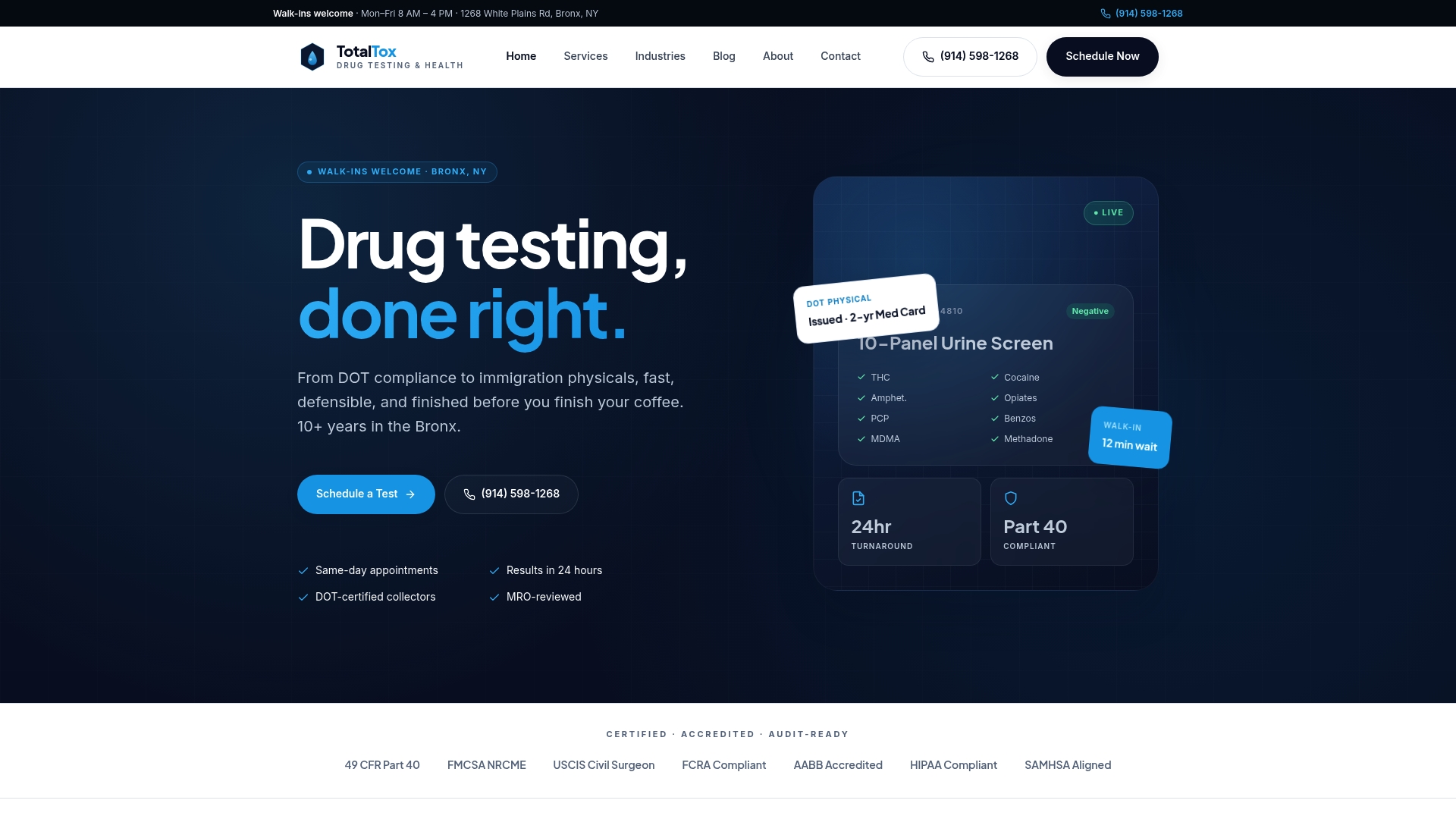
That matters most in the exact gap this article covers: the wait between “lab result” and “MRO-verified negative.” Some clinics structure their process around getting that verified result back to employers quickly, so a conditional hire doesn’t sit stalled for extended periods over paperwork. The clinic handles DOT drug and alcohol testing, DOT and employee physicals, and immigration medical exams under one roof, which means fewer appointments and fewer places for a compliance step to fall through the cracks.
If you’re onboarding a CDL driver, a transit operator, or any safety-sensitive hire this month, book a collection or physical exam with Total Tox and get the verified paperwork your compliance file actually needs.
Where to Verify DOT Testing Rules Directly
For the regulatory text itself, go straight to the source rather than a summary. 49 CFR Part 40 covers collection, chain-of-custody, and MRO procedures. 49 CFR §382.301 sets the FMCSA pre-employment rule and its exceptions. FMCSA’s implementation guidance walks through practical examples, and the 2026 Federal Register notice explains the oral fluid rollout timeline.
Sources
- What tests are required and when does testing occur | FMCSA
- Federal Register: DOT rulemaking on oral fluid testing (May 11, 2026)
- Procedures for Transportation Workplace Drug and Alcohol Testing Programs | DOT ODAPC
- § 382.301 - Pre-employment testing. | eCFR / Federal laws
FAQ
What Are the New DOT Drug Testing Requirements for 2026?
The biggest update is the authorization of oral fluid testing, though it’s rolling out gradually since it depends on two HHS-certified oral fluid labs becoming operational. Until that infrastructure is fully in place, urine collection remains the default specimen type most employers rely on.
What 5 Drugs Does DOT Test For?
A DOT drug test screens for amphetamines, cocaine, marijuana metabolites, opiates, and phencyclidine (PCP). Cutoff levels for each are set by HHS Mandatory Guidelines, not by the individual testing lab.
How Long Is a Pre-Employment DOT Drug Test Good For?
There’s no fixed expiration date on a verified negative result once you’ve hired someone. But if the same person leaves and returns after 30 or more days outside a DOT random testing pool, they need to be treated as a new pre-employment test candidate again.
How Strict Is a DOT Drug Test?
Strict enough that a lab-reported negative isn’t the finish line. The MRO must independently verify the result before an employer can allow safety-sensitive work, and any non-negative triggers a confidential interview and possible split-specimen retest before anything is finalized.
Can Total Tox Handle Both the DOT Physical and Drug Test?
Yes, Total Tox offers DOT and employee physicals alongside urine, saliva, and hair follicle drug testing, often coordinated in a single walk-in visit. Current pricing for each service is available directly on the Total Tox services page.