Federal rule 49 CFR §382.307 requires DOT-regulated employers to test a driver for alcohol or drugs when a trained supervisor has specific, contemporaneous, articulable observations of appearance, behavior, speech, or body odor suggesting impairment. Once those observations exist, the employer’s job starts immediately: pull the employee from safety-sensitive duty, arrange a test (alcohol testing within 2 hours, sooner if possible), and write down what was observed within 24 hours. We provide walk-in, MRO-reviewed testing designed to handle the process quickly and document it correctly.
TL;DR:
- Supervisor observations must be specific, written down promptly, and must not be made by the same person who conducts the alcohol test.
- Alcohol testing should occur within two hours of suspicion, but delay must be documented if not feasible, while drug testing timing is less strict but still urgent.
- Keep detailed observation records, including date, time, location, specific indicators, and supervisor name, within 24 hours or before results return.
- The trained supervisor’s role is limited to recognizing signs and removing the employee, while trained collection staff handle testing procedures and documentation.
- Establish pre-incident protocols, including trained supervisors, ready testing arrangements, and documentation templates, to ensure compliance during an incident.
Table of Contents
- What 49 CFR §382.307 and Part 40 Actually Require
- What Does Reasonable Suspicion Actually Look Like?
- Who Can Make the Call, and What Training Do They Need?
- The 2 Hour, 8 Hour, and 24 Hour Rules, Explained
- What Belongs in Your Written Record
- Step-by-Step: From Observation to Return-to-Duty
- What Total Tox Sees on the Clinic Side
- Our Take: Speed and Documentation Aren’t Competing Priorities
- How Total Tox Handles DOT Reasonable Suspicion Testing
- Sources
What 49 CFR §382.307 and Part 40 Actually Require
The regulation doesn’t let an employer test on a hunch. It demands “specific, contemporaneous, articulable observations concerning the appearance, behavior, speech, or body odors” of the driver, made by a supervisor trained to recognize the signs. 49 CFR §382.307 treats alcohol and drug indicators somewhat differently. Alcohol observations must be made at or right around the time of duty. Drug-related observations, including signs of chronic use, can be based on a broader pattern, but the trigger for testing still has to be tied to a specific incident.
One detail trips up a lot of safety managers: the person who decides reasonable suspicion exists cannot also be the person who conducts the alcohol test on that same employee. That separation of duties is not optional. It exists to keep the process defensible if a driver ever challenges the determination.
Part 40 governs everything that happens after that decision, including:
- Who can collect the specimen and under what conditions
- How the Medical Review Officer (MRO) verifies and reports lab results
- What rights the driver has, including split-specimen testing
- Rules for observed collections and chain-of-custody documentation
49 CFR Part 40 is dense, but the supervisor’s job is narrower than it looks. Recognize the signs, remove the driver, and hand off to trained collection staff. The rest is procedure, not judgment calls.
What Does Reasonable Suspicion Actually Look Like?
Reasonable suspicion isn’t a feeling. It’s a set of specific things a supervisor sees, hears, or smells, written down in language a stranger could read and understand months later. Regulators group the indicators into four buckets: appearance, behavior, speech, and odor.
- Appearance. Bloodshot or watery eyes, dilated or pinpoint pupils, flushed skin, tremors, sweating that doesn’t match the temperature, disheveled clothing that’s out of character for that employee.
- Behavior. Stumbling or unsteady gait, dropping tools repeatedly, unusual aggression or paranoia, drowsiness during a task that normally requires alertness, unexplained delays completing a routine pre-trip inspection.
- Speech. Slurred words, rambling or disjointed sentences, unusually slow or rapid speech, repeating the same statement without noticing.
- Body odor. The smell of alcohol on the breath, or an unusual chemical or marijuana odor on clothing or in a vehicle cab.
Chronic-use indicators, like ongoing weight loss, persistent nasal issues, or withdrawal symptoms, can support a drug test determination, but they carry more weight when paired with something observed that day. A supervisor citing only a pattern over months, with nothing specific happening right then, has a weaker case than one who ties the pattern to a concrete incident.
Pro Tip: Write observations as if a lawyer will read them in two years. “Employee smelled strongly of alcohol at 7:14 AM, slurred the word ‘inspection’ twice, and swayed while standing at the loading dock” holds up far better than “seemed off.”
Who Can Make the Call, and What Training Do They Need?
Only a supervisor trained to recognize the physical, behavioral, speech, and odor indicators of alcohol and controlled-substance use can make a reasonable suspicion determination. This isn’t a role you can hand to whoever happens to be on shift. FMCSA’s implementation guidance treats reasonable suspicion testing as a safety intervention, not a disciplinary tool, and that framing matters for how training gets built and documented.
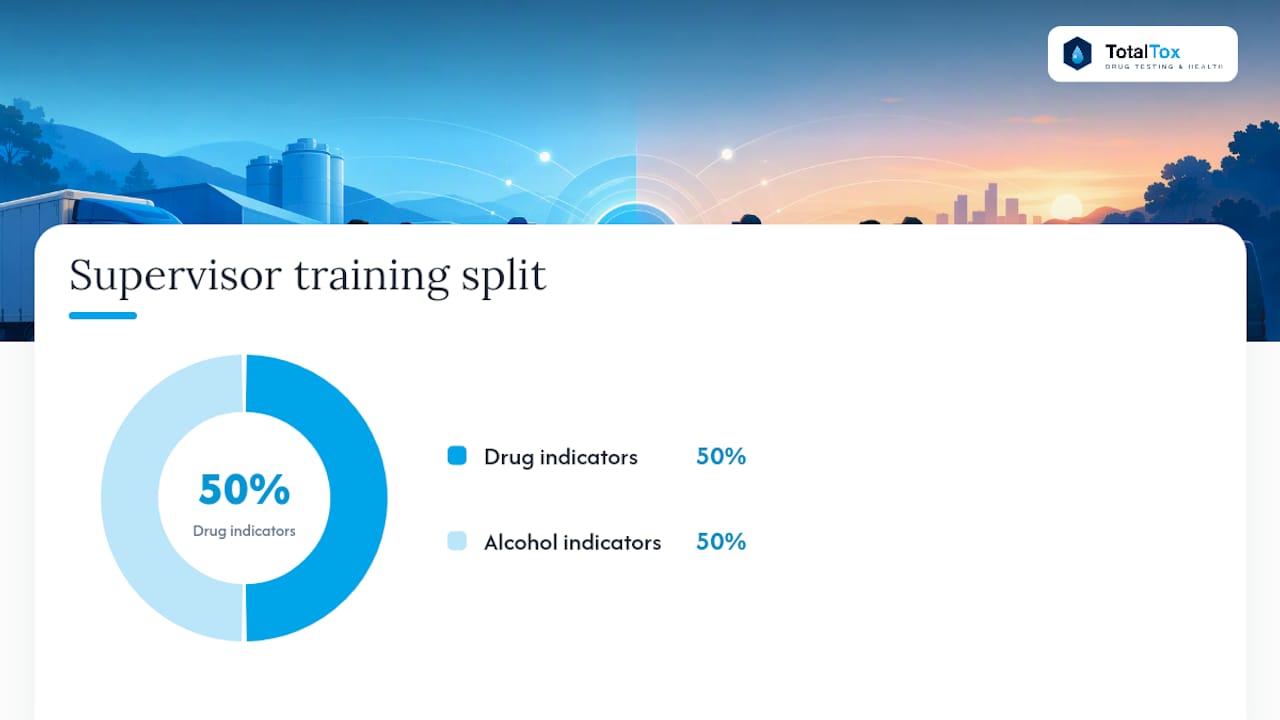
The FTA’s reasonable suspicion training video is a widely used benchmark: 60 minutes covering drug indicators and 60 minutes covering alcohol indicators, with a downloadable certificate at completion. That two-hour split is a practical floor, not a ceiling, for how much training a supervisor should have before making these calls solo.
A few operational rules employers should build into policy:
- The supervisor who determines reasonable suspicion may not also administer the alcohol test.
- Many employers use a two-witness practice for the observation itself, especially in smaller operations where a single supervisor’s judgment might otherwise be questioned later.
- Keep a training roster tied to each supervisor’s certification date, not just a one-time sign-off sheet.
- Retain the FTA certificate or equivalent proof of completion in the employee’s supervisor file, not just a shared drive.
The Designated Employer Representative (DER) role matters here too. The DER is who receives the test result from the MRO, who has authority to remove a driver from duty, and who coordinates with the collection site. If your DER and your trained supervisor pool overlap, that’s fine. If they don’t, make sure the handoff between “supervisor makes the call” and “DER coordinates the test” is written into policy, not improvised in the moment.
The 2 Hour, 8 Hour, and 24 Hour Rules, Explained
Timing is where employers get into trouble, usually not out of bad faith but out of not knowing the clock is running the moment reasonable suspicion is documented.
For alcohol testing, the sequence looks like this:
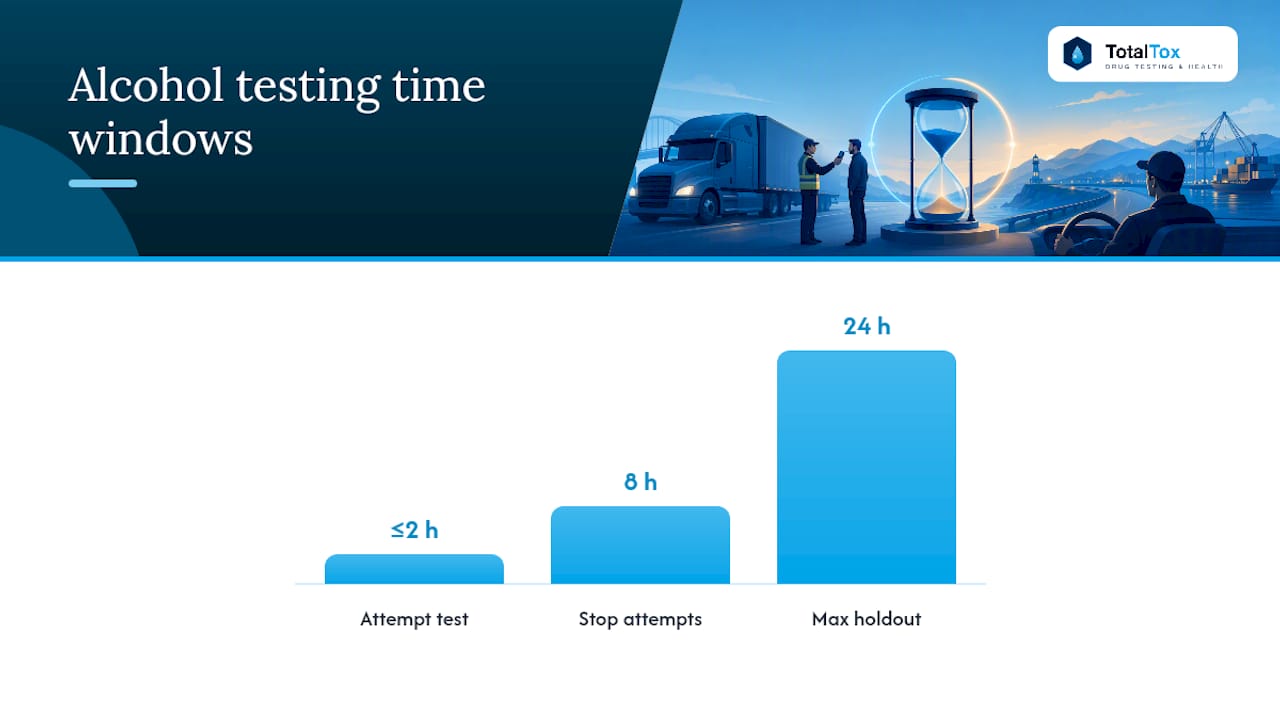
- Within 2 hours of the determination, the employer should attempt to administer the alcohol test. If it isn’t done in that window, FMCSA guidance requires a written record explaining the delay.
- By 8 hours, if the test still hasn’t happened, testing attempts must stop, and the employer documents why.
- Up to 24 hours, the driver stays out of safety-sensitive duty, unless an alcohol test comes back below 0.02.
Drug testing doesn’t run on the same clock, but urgency still matters. Detection windows shrink as time passes, so getting the employee to a collection site quickly matters more than any single deadline in the rule text. A test drawn six hours after an incident is simply less useful than one drawn within the hour.
Part 40 has also been updated to address oral fluid testing alongside urine collection, and it sets rules for directly observed collections in specific circumstances, along with same-sex observer requirements where an observed collection is required. Collectors and observers have distinct roles under Part 40, and mixing them up is a common audit finding.
Roughly 24 hours is the maximum an employer can hold a driver out of duty on a reasonable suspicion basis without an alcohol result clearing them, according to FMCSA’s guidance.
Once a sample reaches the lab, the MRO reviews any non-negative result, contacts the employee for a medical explanation if applicable, and reports a verified result back to the employer. That verification step is where a positive result becomes actionable, not before.
What Belongs in Your Written Record
49 CFR §382.307 requires the supervisor’s observations to be signed and dated within 24 hours of the incident, or before the test results come back, whichever happens first. A record built after the fact, once a result is already known, looks exactly like what it is: reverse-engineered justification.
A defensible record includes:
- Date, time, and location of the observation
- The specific indicators observed, in plain descriptive language, not conclusions like “appeared drunk”
- The name and title of the supervisor who made the determination
- Whether a test was administered, and if not, why
- Any delay in testing and the documented reason for it
A short template helps here: “On [date] at [time], I observed [employee] at [location]. I noted [specific indicator], [specific indicator], and [specific indicator]. Based on these observations, I determined reasonable suspicion existed and initiated the testing process at [time].”
Pro Tip: Keep a standardized one-page reasonable suspicion form in every supervisor’s vehicle or office, not buried in a shared drive. The two minutes it takes to fill out on the spot is worth far more than a memory reconstructed a week later.
Retain these records for the period your DOT operating authority requires, typically alongside your other testing records, and store them where an auditor can find them without a scavenger hunt.
Step-by-Step: From Observation to Return-to-Duty
Here’s the sequence that holds up under audit and keeps the driver, the workplace, and the company protected:
- Remove the employee from safety-sensitive duty immediately. Don’t let them finish “just this one delivery.”
- Secure the area if needed and arrange transport to a collection site rather than letting the employee drive themselves.
- Notify the DER so the alcohol test clock and documentation obligations start moving in parallel, not sequentially.
- Arrange collection, requesting a same-sex observer if a directly observed collection applies.
- Complete the written observation record within 24 hours, before results are known if possible.
- Wait for MRO verification. A non-negative result gets a callback from the MRO before it’s reported as verified positive.
- Handle refusals as positive results. A refusal to test, or an attempt to substitute or dilute a sample, is treated the same as a confirmed positive under DOT rules.
- If the result is positive, remove the employee from all safety-sensitive functions, refer them to a Substance Abuse Professional (SAP), and don’t allow return to duty until they complete the SAP-directed return-to-duty process, including a negative return-to-duty test and follow-up testing.
This is also the moment to remember reasonable suspicion testing sits apart from your other DOT testing categories. It’s not random, it’s not pre-employment, and it’s not post-accident. It’s triggered entirely by what a trained supervisor observes in the moment, which is exactly why the observation record carries so much legal weight.
What Total Tox Sees on the Clinic Side
Employers calling us after a reasonable suspicion incident are usually working against that 2-hour alcohol window, and they know it. Our walk-in collections require no appointment for these situations, and most tests are completed on-site quickly, with lab results reviewed by an MRO before they reach the employer.
When arranging testing with any provider, ask directly about the MRO, chain-of-custody documentation, and availability of a same-sex observer if required—these factors distinguish a vendor knowledgeable about DOT compliance from one simply running a lab test.
Our Take: Speed and Documentation Aren’t Competing Priorities
Most guidance on reasonable suspicion testing treats speed and paperwork as a tradeoff, rush the test and the documentation suffers, or slow down to get the record right and blow past the 2-hour window. That’s a false choice, and it’s the piece conventional advice tends to miss.
The employers who handle this well do both at once, because they’ve already built the form, trained the supervisor, and identified a testing site before an incident ever happens. The 24-hour documentation deadline isn’t tight if you write the observation the same day. The 2-hour alcohol window isn’t tight if you already know where to send the driver.
Where we’d push back on common practice: too many employers treat the FTA’s 60-and-60 training minimum as a one-time box to check rather than a floor to build on. A supervisor who’s watched the video once, three years ago, is not the same as one who reviews indicators annually and has actually written up an observation before. Prioritize the training refresh over almost anything else on this list. Everything downstream, the test, the record, the audit, depends on that first call being solid.
— Total Tox
How Total Tox Handles DOT Reasonable Suspicion Testing
We offer walk-in DOT drug and alcohol collections with MRO-reviewed reporting and same-day appointments, helping supervisors meet testing timeframes without delays from lab scheduling.
Every result we deliver is reviewed by an MRO and accompanied by audit-ready documentation, chain-of-custody paperwork, collection time stamps, and verification records that support compliance. When booking, ask about observer availability if a directly observed collection is required; turnaround times will be confirmed.
If you’re building or tightening your reasonable suspicion protocol now, before an incident forces the issue, start with our DOT testing services page to see collection options, or contact us directly to set up a standing arrangement your supervisors can use the moment they need it.
Sources
- 49 CFR 382.307 – Reasonable suspicion testing.
- Implementation Guidelines for Alcohol and Drug Regulations - Chapter 5 | FMCSA
- The Department of Transportation’s (DOT) rule, 49 CFR Part 40
- Reasonable Suspicion Training - Drug & Alcohol Program | FTA