If your employee drives a commercial vehicle, flies a plane, operates a transit system, or works a safety-sensitive railroad, pipeline, or maritime job, DOT drug testing rules apply, full stop. Every other employee falls under non-DOT testing, which you design yourself within state law limits. The rule that trips up more HR departments than any other: never mix the two programs… Run DOT first, keep the paperwork separate, and treat each as its own system.
TL;DR:
- DOT drug testing applies only to employees in safety-sensitive roles regulated by agencies like FMCSA, FAA, or USCG, with strict federal requirements for collection, testing, and reporting.
- Non-DOT testing offers flexibility, allowing employers to choose expanded panels, specimen types, and testing frequency, but must comply with state law and document policies carefully.
- DOT tests are limited to five substances and require federal custody forms, observed collection, and testing before non-DOT samples, which can include additional substances like fentanyl and benzodiazepines.
- Positive DOT results mandate immediate removal from safety-sensitive duties, mandatory SAP evaluation, and reporting to the Clearinghouse, unlike non-DOT results, which rely on employer policy.
- Maintaining strict separation of paperwork, forms, and procedures for both programs is essential to ensure compliance and defend against audits or disputes.
Table of Contents
- Dot Vs Non Dot: What Federal Law Actually Requires
- What Non-DOT Testing Actually Covers
- Dot Vs Non Dot Drug Test: The Operational Differences That Matter Most
- Matching Job Roles to the Right Testing Program
- What Happens After a Positive or Refused Test
- Building a Compliant Dual-Program Testing Process
- What to Expect From a DOT-Compliant Testing Clinic
- Why the Real Risk Isn’t the Test, It’s the Paperwork
- Getting Compliant DOT and Non-DOT Testing Set Up Fast
- Primary Sources for DOT Compliance
- Sources
- FAQ
Dot Vs Non Dot: What Federal Law Actually Requires
DOT testing isn’t a company policy choice; it’s a federal mandate governed by 49 CFR Part 40, which spells out exactly how specimens get collected, tested, reviewed, and reported for any employee in a safety-sensitive role regulated by the Department of Transportation. Six agencies enforce this rule across different industries: the FMCSA for commercial drivers, the FAA for aviation employees, the FTA for public transit workers, the FRA for railroad employees, PHMSA for pipeline workers, and the USCG for merchant mariners.
Every DOT program, regardless of agency, must include the same core elements:
- The federally fixed DOT 5-panel urine test, with no employer discretion to swap in different substances.
- A split-specimen collection process, so a second sample exists if the employee disputes a positive result.
- Review by a Medical Review Officer (MRO) before any result reaches the employer, ensuring legitimate medical explanations get caught before a positive test derails someone’s career.
- Alcohol testing protocols for certain safety-sensitive functions, using breath or saliva devices approved under Part 40.
DOT rules also require random testing at agency-set annual rates and reporting of certain violations to the FMCSA Clearinghouse. Both get their own detailed treatment later, but understand now: none of this is optional once an employee’s role triggers DOT coverage.
What Non-DOT Testing Actually Covers
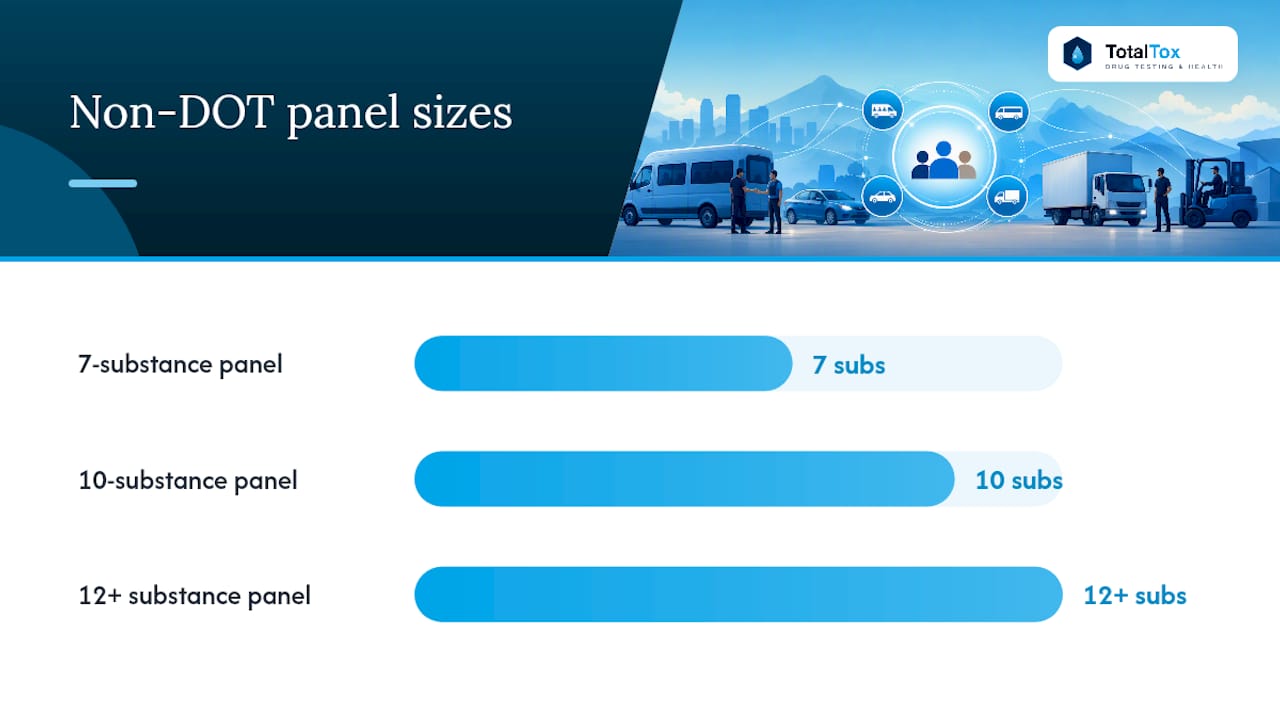
Non-DOT testing is everything else, and “everything else” gives you far more room to maneuver. As an employer, you choose the panel, the specimen type, and how often you test, as long as your practices hold up under state law and your own written policy.
That flexibility comes with real trade-offs employers need to plan around:
- You can select expanded panels covering 7, 10, 12, or more substances, urine, hair, or saliva specimens, and testing frequency that fits your risk profile rather than a federal formula.
- State law can restrict what you’re allowed to test for or how you handle a positive result. Marijuana legalization in several states has already forced companies to rewrite policies that once treated a positive THC result as an automatic firing offense.
- Privacy and workplace-protection statutes vary widely, and a policy that works in Texas may expose you to liability in New York.
Non-DOT tests get used most often for pre-employment screening, reasonable-suspicion testing after an incident, post-accident investigations, and increasingly, expanded screening for fentanyl and benzodiazepines that the DOT 5-panel doesn’t catch. According to Cisive’s analysis of DOT and non-DOT testing, employers relying on non-DOT panels should keep policy language consistent and well documented, since that’s the main defense if a testing decision gets challenged.
Dot Vs Non Dot Drug Test: The Operational Differences That Matter Most
Here’s where the rubber meets the road for HR teams building or auditing a testing program. The differences aren’t cosmetic. They dictate what forms you use, who collects the specimen, and what happens when a result comes back positive.
The DOT 5-panel tests for five substance classes only: marijuana (THC), cocaine, amphetamines, opioids, and PCP, according to FMCSA’s official substance list. Federal cutoff levels and collection procedures are locked in by regulation. Non-DOT panels, by contrast, often add fentanyl, benzodiazepines, and synthetic opioids, substances employers increasingly want visibility into but that DOT rules never mandated.
The DOT 5-panel covers fewer drug classes than a modern 12-panel non-DOT screen, which explains why many employers layer expanded testing on top of DOT compliance rather than treating the federal panel as sufficient on its own.
Collection procedures diverge just as sharply:
- DOT collections require the federal Custody and Control Form (CCF), split-specimen handling, strict observed-collection triggers (return-to-duty and follow-up tests, for example), and a temperature check on every specimen within four minutes of collection.
- Non-DOT collections use employer-specific chain-of-custody forms, and observed collections, specimen splitting, and temperature protocols are up to your written policy, not federal law.
- DOT tests must be performed first when both programs apply, with excess urine from that collection discarded before any non-DOT sample is taken, per § 40.13 of Part 40.
Random testing tells a similar story of federal rigidity versus employer discretion. DOT employers must hit agency-mandated annual random testing rates. Non-DOT employers have no such federal requirement and can limit testing to pre-employment, post-accident, or reasonable-suspicion situations if that fits their risk tolerance. Reporting differs too: DOT violations flow into the FMCSA Clearinghouse, a national database other employers can check. Non-DOT results have no federal database and stay entirely inside your own personnel files.
Matching Job Roles to the Right Testing Program
Most employers overthink this. The mapping is actually straightforward once you know which DOT agency governs a given role.
- Commercial drivers holding a CDL fall under FMCSA rules, the most common DOT category by volume of covered workers.
- Pilots and other aviation safety personnel answer to the FAA, with testing triggers tied to specific certificate types.
- Public transit operators, including bus and rail transit staff, fall under FTA jurisdiction.
- Railroad employees in safety-sensitive positions are covered by FRA rules.
- Pipeline workers in operations, maintenance, or emergency-response roles fall under PHMSA.
- Merchant mariners and other maritime safety-sensitive employees answer to the USCG.
Mixed workplaces are common. A construction firm might employ CDL-licensed delivery drivers alongside office staff and equipment operators who never touch a DOT-regulated vehicle. That’s perfectly legal, as long as you run two distinct programs and never let paperwork cross between them. When one employee needs both tests in a single visit, DOT collection happens first, excess specimen gets discarded, and each result gets logged on its own dedicated form.
What Happens After a Positive or Refused Test
The gap between DOT and non-DOT consequences is where employers face the most legal exposure if they get it wrong.
A verified DOT positive triggers immediate removal from safety-sensitive duties, a report through the FMCSA Clearinghouse, mandatory evaluation by a Substance Abuse Professional (SAP), and a structured return-to-duty process with follow-up testing before the employee can resume DOT-covered work. For CDL holders, a DOT violation also affects their license status in the Clearinghouse, visible to any future DOT employer who checks.
Non-DOT consequences are yours to define:
- Discipline, termination, or an EAP referral, decided by your written policy and whatever your state allows.
- No Clearinghouse reporting and no SAP requirement, since those exist only inside the federal DOT framework outlined in 49 CFR Part 40.
- No standardized return-to-duty process, though many employers voluntarily mirror DOT’s structure for consistency.
One point employers sometimes get backward: a clean non-DOT result never overrides or cancels a verified DOT positive. The two programs don’t talk to each other, and they’re not supposed to.
Building a Compliant Dual-Program Testing Process
Running both programs without cross-contamination takes deliberate structure, not good intentions. Here’s the sequence that keeps you audit-ready:
- Designate a program owner for DOT compliance and a separate contact for non-DOT policy decisions, even if it’s the same HR person wearing two hats.
- Use the correct forms every time. The federal CCF and Alcohol Testing Form are for DOT tests only, never substitute them for non-DOT screening.
- Keep chain-of-custody records separate for every collection, with distinct file systems so an auditor can trace either program independently.
- Train collectors and supervisors on which triggers apply to which program, especially observed-collection rules that differ between DOT and non-DOT.
- When both tests are needed at once, collect DOT first, discard excess urine from that collection, then proceed with the non-DOT sample under its own form.
- Maintain an audit-ready file with your MRO contact, lab certification details, Clearinghouse procedures, SAP referral workflow, and the exact policy language given to employees at hire.
Pro Tip: Using a DOT Custody and Control Form for a non-DOT test is one of the most common compliance errors clinics see, and it can invalidate an otherwise legitimate result during an audit or dispute.
What to Expect From a DOT-Compliant Testing Clinic
An employer’s testing program is only as strong as the clinic executing it. Some clinics build their process around the two things HR teams say matter most: speed and paperwork that holds up.
What that looks like in practice:
- Walk-in DOT drug and alcohol testing with no appointment required, cutting the downtime that comes from scheduling delays.
- MRO-reviewed results on every DOT test, so a positive never reaches your desk without a legitimate medical review first.
- Typical turnaround within 24 hours, which matters when a safety-sensitive employee is sitting idle waiting for clearance.
- Experience across varied industries where DOT and non-DOT programs frequently run side by side.
- Audit-ready documentation built to withstand a Clearinghouse review or a legal dispute.
Specific accreditation details and staff credentials are available directly through the clinic for employers setting up a new compliance relationship.
Why the Real Risk Isn’t the Test, It’s the Paperwork
Employers spend an enormous amount of energy worrying about which panel to run and barely any time worrying about whether their forms would survive an audit. That’s backward. The DOT 5-panel hasn’t changed in years and isn’t likely to. The actual compliance failures we see traced back to sloppy program separation: a CCF used for a non-DOT hire, a random testing log that mixes covered and non-covered employees, a return-to-duty file missing the SAP evaluation.
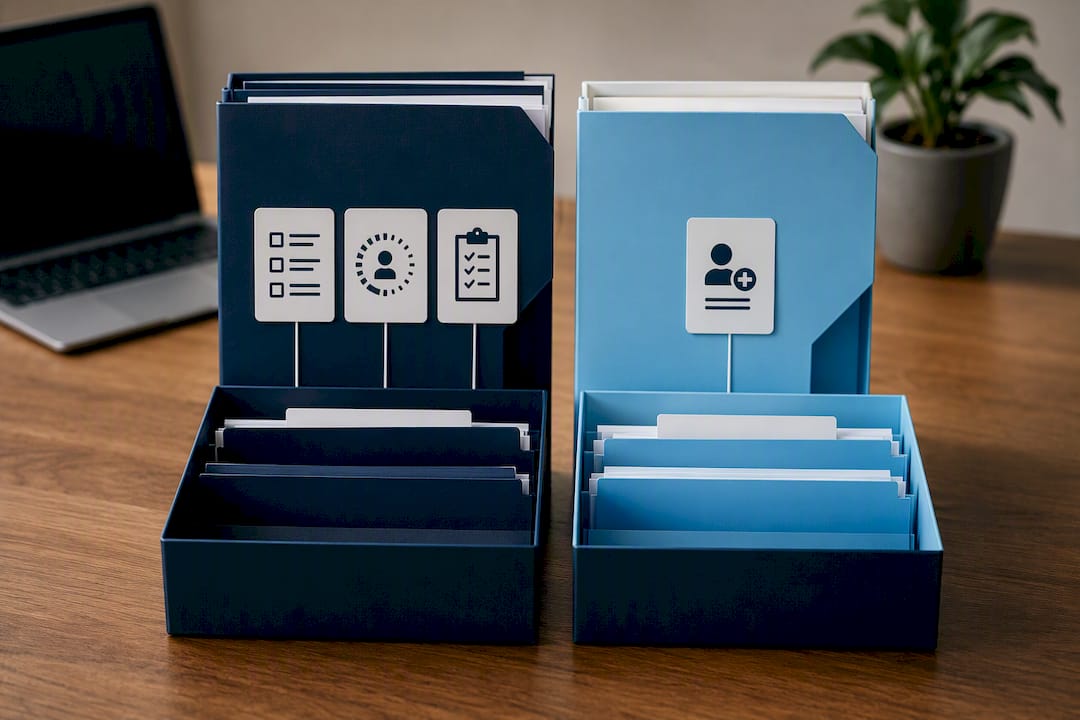
Non-DOT flexibility gets treated like a loophole when it should be treated like a liability if mismanaged. Adding fentanyl and benzodiazepine screening to catch what the federal panel misses is smart. Doing it without a consistent written policy is how companies lose disputes they should have won.
The employers who get this right treat DOT and non-DOT as two separate businesses running under one roof. Different forms, different filing cabinets, different training for the people doing collections. That discipline, more than any specific substance you choose to screen for, is what keeps a program defensible when it actually gets tested.
— Total Tox
Getting Compliant DOT and Non-DOT Testing Set Up Fast
Setting up separate DOT and non-DOT programs from scratch, or auditing ones already in place, is exactly the kind of work some local clinics handle for employers across various industries. Walk-in DOT drug and alcohol testing means no waiting for an appointment slot to open before a new hire can start or a random-testing pull can get resolved.
Every DOT result goes through MRO review before it reaches you, and turnaround typically lands within 24 hours, whether you’re running a single pre-employment screen or enrolling an entire fleet into an annual random testing pool. Non-DOT expanded panels are available for roles that don’t fall under federal jurisdiction but still carry real safety risk. Contact Total Tox to set up a compliant program, enroll drivers in random testing, or get a fast turnaround on an incident-response test through the services and booking page.
Primary Sources for DOT Compliance
For formal compliance questions, go straight to the source rather than a summary:
- 49 CFR Part 40, the full federal regulation governing DOT testing programs.
- § 40.13, the specific rule on how DOT and non-DOT tests relate and must stay separate.
- FMCSA’s substance testing guidance, covering exactly what the DOT 5-panel includes.
- SAMHSA, which sets the HHS lab certification standards DOT programs rely on.
Sources
- 49 CFR Part 40 | U.S. Department of Transportation
- § 40.13 How do DOT drug and alcohol tests relate to non-DOT tests? | U.S. Department of Transportation
- Which substances are tested? | FMCSA
- Substance Abuse and Mental Health Services Administration (SAMHSA)
FAQ
What is the difference between DOT and non-DOT drug testing?
DOT testing is governed by federal law under 49 CFR Part 40 and applies only to safety-sensitive roles regulated by agencies like the FMCSA and FAA, using a fixed 5-panel test. Non-DOT testing is set entirely by the employer, within state law, and can use expanded panels and different specimen types.
Which is more serious, a DOT or non-DOT drug test?
A DOT positive carries heavier consequences because it triggers Clearinghouse reporting, mandatory SAP evaluation, and a structured return-to-duty process that can affect a CDL holder’s ability to work in the industry. Non-DOT consequences depend entirely on employer policy and rarely carry that same federal visibility.
What does it mean if a drug test is non-DOT?
It means the test isn’t subject to federal DOT rules and instead follows your company’s own written policy, shaped by applicable state law. Non-DOT tests are common for pre-employment screening, reasonable suspicion, and expanded panels covering substances like fentanyl that the DOT 5-panel doesn’t test for.
What five drugs does DOT test for?
The DOT 5-panel covers marijuana (THC), cocaine, amphetamines, opioids, and PCP, as defined by FMCSA. This panel is federally fixed and cannot be modified by individual employers.
Can an employee take both a DOT and non-DOT test at the same clinic visit?
Yes, but federal rules require the DOT collection happen first, with any excess urine from that sample discarded before the non-DOT specimen is collected, and each test documented on its own separate form.