
Yes: use a written drug testing consent form that names the employer, the specimen types being collected, lab and Medical Review Officer (MRO) authorization, disclosure limits, and explicit refusal consequences. A written form is standard practice for workplace testing in many parts of the United States, and skipping any of these elements may weaken your legal position if an employee ever disputes a result. Tailor the wording to your state, then have counsel check it before you roll it out.
TL;DR:
- Use a specific, legally reviewed written consent form tailored for each testing scenario to avoid disputes and ensure legal enforceability.
- Clearly identify the employer, specimen type, lab, MRO, confidentiality limits, refusal consequences, and include version control on every form.
- Federal regulations require certified MRO review for DOT tests, while non-DOT employers benefit from pairing consent with audit-ready results for disputes.
- State laws vary on consent scope, record retention, and testing triggers; always specify jurisdiction and consult legal counsel for compliance.
- Implement a documented process with secure storage, limited access to results, and regular audits to maintain compliance and protect your workforce.
Table of Contents
- Drug Testing Consent Form Templates for Pre-Employment, Post-Accident, and Applicants
- Required Elements of a Drug Testing Consent Form and How to Phrase Them
- When to Use Each Form and What Federal or State Rules Apply
- Sample Consent Form Clauses HR Can Adapt
- Building an Audit-Ready Process Around Your Consent Form
- Rolling Out a Compliant Consent Process This Week
- Why Clear Consent Language Actually Protects Your Workforce
- Get Audit-Ready Testing Without the Wait
- Sources
Drug Testing Consent Form Templates for Pre-Employment, Post-Accident, and Applicants
You don’t need to reinvent this from scratch, but you do need three distinct versions, because a pre-employment screen, a post-accident test, and an applicant authorization each carry different legal weight.
Pre-employment template. This version should identify the employer and testing facility, list the specimen type (urine, saliva, or hair), state that a negative result is a condition of the job offer, and include a line for the applicant’s printed name, signature, and date. Add a short paragraph authorizing the lab to release results to the employer and, where applicable, to an MRO for review.
Post-accident template. Build in a supervisor acknowledgment block confirming the incident triggered testing under your written policy, plus explicit tampering and refusal language. Employers commonly use standard consent language that names the facility, specimen type, and disclosure authorization, then add incident details specific to the accident.
Applicant consent template. Where state law allows it, this version frames testing as a condition of the application itself rather than of continued employment. Template language from employer resources typically authorizes forwarding the specimen to a lab and releasing results back to the employer, with a caution to match the wording to your jurisdiction.
Pro Tip: Date and version every template (“v.2026.1”) so you can prove which language an employee actually signed if a dispute surfaces two years later.
Required Elements of a Drug Testing Consent Form and How to Phrase Them
Eight elements separate a defensible form from a liability. Here’s what each one does and how to word it.
- Identity of employer and participant. Name your company and the testee by full legal name. Sample line: “I, [Employee Name], consent to testing administered by [Employer Name].”
- Scope of the policy reference. Tie the form to your written drug and alcohol policy so the consent isn’t standing alone. “This test is conducted under [Company]'s Drug and Alcohol Policy, effective [date].”
- Specimen types collected. State urine, saliva, or hair explicitly, since vague language invites challenges. “Specimen(s) collected: [ ] Urine [ ] Oral fluid [ ] Hair.”
- Lab and MRO authorization. This is the clause that actually lets your testing partner talk to you. “I authorize [Lab/Clinic Name] to release results to [Employer] and to a qualified Medical Review Officer for verification.”
- Confidentiality and disclosure limits. Spell out who sees the result. “Results will be shared only with designated safety officials and kept separate from personnel files.”
- Consequences of refusal. Define refusal in plain terms, not just “may result in discipline.”
- Signature and date block. No form is complete without a dated, witnessed signature line.
- Version control notation. A small footer noting the form version and jurisdiction protects you if policies change mid-year.
Pro Tip: If your MRO authorization clause is vague, an employee’s attorney will argue the lab had no right to share results with you at all. Name the lab and the MRO process explicitly, or your test result may be inadmissible in a termination dispute.
When to Use Each Form and What Federal or State Rules Apply
Five common triggers call for testing: pre-employment, reasonable suspicion, post-accident, random (where state law permits it), and return-to-duty after a prior positive. Each trigger deserves its own consent language, because reasonable suspicion, for instance, requires documented observations from a trained supervisor before the form is even presented.
Federal rules add another layer. SAMHSA’s workplace testing guidance sets the framework most employers reference for panel selection and program design, and any employer subject to U.S. Department of Transportation (DOT) rules must route results through a certified MRO, no exceptions. Non-DOT employers can design a program without mandatory MRO review, but pairing your consent form with MRO-reviewed results still strengthens your position in a dispute.
State law is where things get complicated:
- Some states allow “condition of employment” framing outright; others require narrower consent language tied to specific triggers.
- A handful of states restrict random testing to safety-sensitive or DOT-regulated roles only.
- Several states cap how long you can retain test records or restrict who inside the company can access them.
Consent is generally required in every U.S. state, but the permissible scope of testing (random versus for-cause only) varies enough that a form drafted for one state can create liability in another.
Fast fact: DOT-regulated employers must use a certified MRO for every regulated test, a requirement that doesn’t automatically apply to non-DOT workplace programs, per SAMHSA guidance.
Note your state and form version directly on the document itself. A single line, “Jurisdiction: [State], Form v.[X],” saves you from arguing later about which policy governed a given test.
Sample Consent Form Clauses HR Can Adapt
These are the four clauses that carry the most legal weight. Copy the structure, adjust the specifics, and run the final version past counsel before use.
- Refusal clause: “Refusal includes failure to provide an adequate specimen within [timeframe] of request, refusal to sign this consent, or any attempt to alter, substitute, or dilute the specimen.” Defining refusal this precisely, rather than leaving it to interpretation, is what actually holds up in disputes when an employee claims they simply couldn’t produce a sample in time.
- Lab/MRO authorization clause: “I authorize [Clinic/Lab] to collect and test my specimen and release results to [Employer] and to a Medical Review Officer for verification, consistent with [state law/DOT regulation].”
- Confidentiality clause: State sample forms commonly pair chain-of-custody language with confidentiality promises, specifying that results are stored separately from personnel records and accessed only by named individuals.
- Hold-harmless clause: A short release limiting employer liability for accurate testing conducted in good faith. This clause carries real legal weight, so don’t finalize wording without an employment attorney’s review.
Building an Audit-Ready Process Around Your Consent Form
A signed form only protects you if the process behind it holds up. Name your lab or clinic directly on the form, and confirm their chain-of-custody procedure and MRO workflow in writing before you send your first employee for testing.
- Limit result access to HR staff or a designated safety official; store drug test records apart from general personnel files.
- Set a retention schedule (many employers keep records for one to five years depending on state law) and version your forms whenever policy changes.
- Log every signing, not just the signature itself, since consent works best as a documented process, not a single piece of paper.
- Choosing a testing partner that delivers MRO-reviewed results with audit-ready documentation removes a major point of failure if a result is ever challenged.
Pro Tip: Ask your testing vendor for a sample chain-of-custody form before you sign a contract. If they can’t produce one on request, that’s a red flag worth taking seriously.
Rolling Out a Compliant Consent Process This Week
- Pick the correct template for your scenario, pre-employment, post-accident, or applicant, and mark it with a version date.
- Send the draft to employment counsel for state-specific review before anyone signs it.
- Train supervisors on what triggers testing and how to document reasonable suspicion.
- Confirm your testing vendor’s chain-of-custody and MRO process in writing, and name that vendor on the form itself.
- Store signed forms securely and schedule a recurring audit, quarterly or annually, to catch outdated language.
Why Clear Consent Language Actually Protects Your Workforce
Vague consent forms create disputes precisely where employers can least afford them: right after a termination decision. Total Tox has seen how a specific, well-worded form heads off arguments before they start, because there’s no ambiguity for an employee’s attorney to exploit later.
The operational side matters just as much as the wording. Fast, MRO-reviewed testing keeps a flagged employee’s status resolved in a day rather than a week, which limits downtime and keeps safety-sensitive positions covered. If you want a second set of eyes on your current form, Total Tox reviews templates and testing workflows for employers across the Bronx and surrounding counties.
— Total Tox
Get Audit-Ready Testing Without the Wait
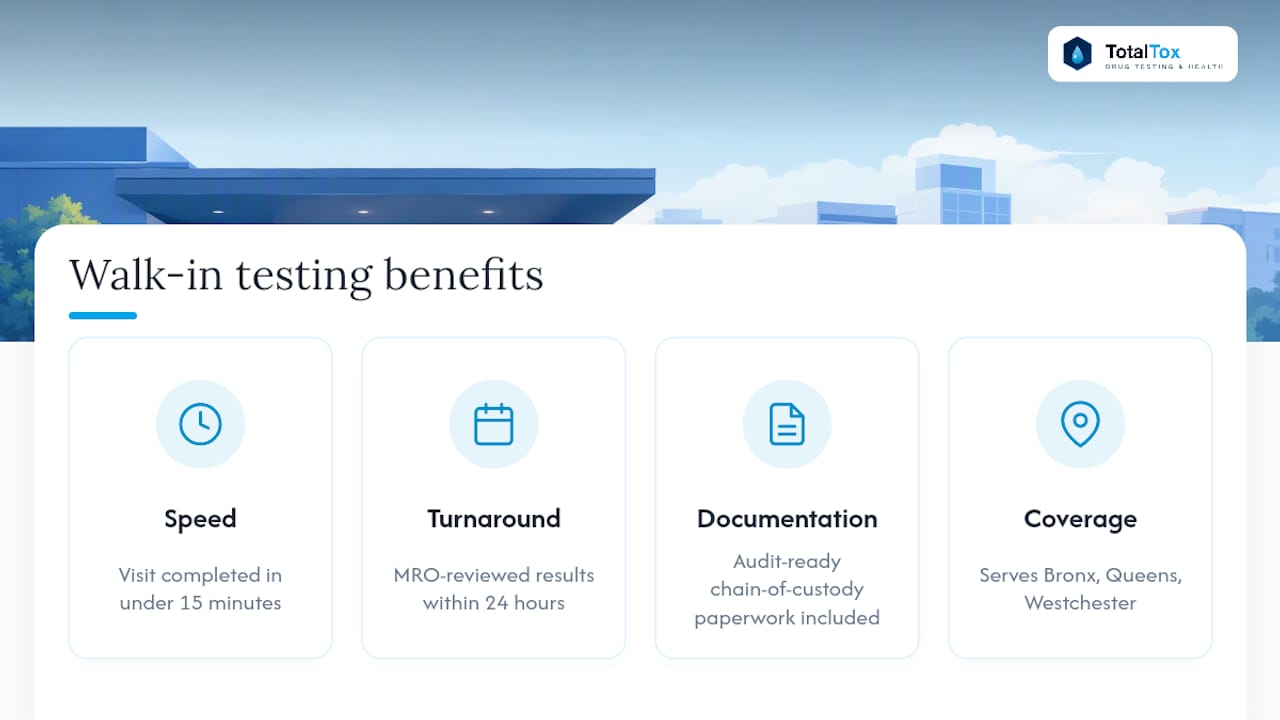
Total Tox is the walk-in alternative to scheduling a lab appointment days out and waiting a week for a callback. Employers who need a DOT physical, a pre-employment screen, or a post-accident test get seen in one visit, typically completed in under 15 minutes, with MRO-reviewed results back within 24 hours.
That speed matters most when a safety-sensitive role sits empty until the test clears. Every result comes with the audit-ready documentation your consent form promises, chain-of-custody paperwork, MRO review, and a record your legal counsel can actually point to if a dispute arises later. Total Tox works with transportation companies, construction firms, healthcare employers, and manufacturers across the Bronx, Queens, and Westchester who need testing that doesn’t stall operations.
Check current services and turnaround times for your industry, or schedule a walk-in visit directly to get your team tested and your paperwork settled this week.
This article is general information, not a substitute for advice from a qualified lawyer. Consult a qualified legal professional about your own circumstances before acting on anything here.
Sources
- Drug And/Or Alcohol Testing Consent Form
- Obtain consent to drug test employees: Drug Test Consent Form | Rocket Lawyer
- Drug / Alcohol Testing Consent Form | eForms
- Drug Test Authorization And Consent Form (Indian River County sample)