
A sound employer drug testing policy is a written document that says who is tested, when, for which substances, how samples are collected, what happens after a positive or refused test, and who sees the results. Then it is backed by a collection site that can follow it the same day, with MRO-reviewed results and paperwork you can hand to an auditor. Most policy failures come from the gap between the page and the practice, not from the wording. At Total Tox, a walk-in clinic in the Bronx, tests are typically done in under 15 minutes and results are delivered within 24 hours, so the policy you write can actually be carried out.
TL;DR
- Federal law does not require most private employers to have a drug-free workplace policy or to test. Federal contractors, grantees and safety- or security-sensitive sectors are the exceptions, so first decide which group you are in.
- A written policy should name the prohibited conduct, the test types, the substances, the collection method, the consequences and the confidentiality rules, and point staff to counseling and assistance resources.
- DOT-regulated employers follow 49 CFR Part 40 and Part 382. Everyone else must still fit OSHA’s rule on post-incident testing and the state and local law where employees work.
- A policy is only as good as its records: a trained supervisor’s written observations, collection forms and MRO-verified results.
Table of Contents
- Do you need a drug testing policy at all?
- What a written policy should cover
- Define each type of test before you use it
- DOT-regulated employers: the policy is partly written for you
- The OSHA rule that catches post-incident policies
- State and local law: the part a template cannot settle
- Drug-Free Workplace Act: what it does and does not require
- Support, not only punishment
- Make the policy auditable
- Promo: put the policy into practice in the Bronx
- Our perspective
- FAQ
- Sources
Do you need a drug testing policy at all?
Not necessarily by law, but in practice most employers that test need one. SAMHSA’s guide to federal drug-free workplace laws, published July 31, 2024, says most private employers are not required to have a drug-free workplace policy. The exceptions are federal contractors and grantees and certain safety- and security-sensitive sectors or positions.
That sorts employers into three groups:
- Federally regulated transportation employers (trucking, pipelines, and similar). Testing is mandatory and the procedures are fixed by federal rule.
- Federal contractors and grantees. The Drug-Free Workplace Act requires a policy and specific steps after a workplace drug conviction, but it does not itself require you to test.
- Everyone else: staffing agencies, construction firms, healthcare providers, manufacturers and small businesses. Testing is your choice, and your policy is what makes it defensible.
If you are in the third group, the written policy is what shows employees and a court that testing was applied for a legitimate reason and applied the same way every time.
What a written policy should cover
SAMHSA’s policy-development guide, published December 11, 2024, recommends a written statement that prohibits manufacturing, using and distributing controlled substances at work and spells out the consequences. It also says the program should raise awareness of workplace substance-use risks and tell employees about counseling, rehabilitation and employee assistance plans.
State statutes show what a complete policy looks like in detail. Arizona’s testing policy requirements list the elements: the employer’s drug and alcohol policy, who is subject to testing, the circumstances, the substances, the methods and collection procedures, the consequences of refusal, possible adverse action, employee access to results, a confidential chance to explain a positive result, and confidentiality rules. Even where your state does not demand that list, it is a good checklist.
Turn it into a working outline:
| Policy section | What to write |
|---|---|
| Purpose and scope | Why you test (safety, regulatory duty, productivity) and which roles are covered |
| Prohibited conduct | Use, possession, sale or impairment on duty, on premises or in company vehicles |
| When testing happens | Pre-employment or post-offer, random, reasonable suspicion, post-accident, return-to-duty, follow-up, whichever you actually use |
| Substances and method | The panel, and whether you use urine, oral fluid or hair |
| Collection and results | Where samples are collected, who reviews results, how a positive is verified |
| Consequences | What follows a verified positive, a refusal, a tampered or substituted specimen |
| Employee rights | Access to results, a chance to explain, confidentiality, appeal route |
| Support | Counseling, rehabilitation and assistance resources |
| Acknowledgment | A signed receipt from every employee and applicant |
For the applicant side of the document, see our guide to what to include in a pre-employment drug testing policy.
Define each type of test before you use it
A policy that says only “we may test” invites inconsistent decisions. Define each test type you intend to use, and the trigger for it. FMCSA’s implementation guide lists six types for covered drivers, and they are a useful vocabulary for any employer:
- Pre-employment or post-offer: before the person performs the job. Applying it to every candidate for the same position keeps it consistent. Our page on post-offer drug testing covers the order of steps.
- Random: unannounced selection from a defined pool. Under DOT rules the minimum annual random rates in 49 CFR Part 382 are 10% of average driver positions for alcohol and 50% for controlled substances, subject to the regulation’s exceptions and adjustments.
- Reasonable suspicion: FMCSA says it must rest on specific, contemporaneous, articulable observations about appearance, behavior, speech or body odor, made by a trained supervisor. Write the observation down at the time. We cover the timing in beating the clock on DOT reasonable suspicion and the supervisor side in same-day reasonable suspicion testing.
- Post-accident: after a defined incident. Under Part 382, required alcohol testing must stop after eight hours and controlled-substance testing after 32 hours if not completed, with the reasons documented. Our post-accident testing rules page walks through the clock.
- Return-to-duty and follow-up: after a violation. DOT’s employer FAQ says a worker with a verified positive or a refusal must complete the return-to-duty process and have a negative return-to-duty test before resuming safety-sensitive work. See DOT follow-up testing.
A non-DOT employer does not have to copy all six. It should include only the ones it will really use, because every test type you list is a promise about how you will behave.
DOT-regulated employers: the policy is partly written for you
If you employ commercial drivers or other covered safety-sensitive workers, DOT’s procedures page identifies 49 CFR Part 40 as the required framework for workplace drug and alcohol testing in federally regulated transportation industries. Your written policy should reference it, name your designated employer representative and describe what happens at a refusal.
Two practical points for transportation HR leads:
- Keep your DOT policy separate from your non-DOT policy, or clearly labeled within one document. Mixing the two is a common way to apply a federal consequence to a worker who is not covered, or to miss one for a worker who is.
- Other modes have their own rules. Pipeline employers, for example, can use our checklist for documenting PHMSA drug tests, and our guide to DOT alcohol testing at 0.04 BAC covers breath testing.
The OSHA rule that catches post-incident policies
Many construction and manufacturing policies say “any injury triggers a drug test.” OSHA’s October 11, 2018 interpretation says post-incident testing is generally permissible when done for a legitimate safety purpose, but violates the rule if it is used to penalize an employee for reporting an injury or illness. It lists permissible examples including random testing, testing unrelated to injury reporting, testing under workers’ compensation or other federal law, and root-cause testing after incidents that harmed or could have harmed employees.
What that means for your wording:
- Tie post-incident testing to investigating the cause of the incident, not to the fact that someone filed a report.
- Apply it to every employee whose conduct could have contributed, not only the one who was hurt.
- State that reporting an injury never leads to discipline by itself.
Once the language is right, the practical need is a collection site that can see the employee quickly, so the test is part of the investigation and not an afterthought.
State and local law: the part a template cannot settle
There is no single national rulebook. SAMHSA’s state-law guide says rules vary substantially: some states broadly allow workplace testing, while others restrict who may be tested, the methods, rehabilitation or discipline. It also cautions employers to account for state and local marijuana laws, and says legalization does not necessarily prevent an employer from keeping a no-use policy.
The examples show how different the rules are:
- Arizona requires specific policy content and notice to prospective employees, and allows testing for job-related purposes consistent with business necessity, according to its statute.
- Minnesota permits testing only as authorized by statute and under a written policy that meets the statute’s requirements, and applicants with a conditional offer for the same position must be treated consistently, says its legislative research guide (2010 edition, so confirm the current statute).
- Ohio states in Section 3796.28, effective March 20, 2026, that its marijuana chapter does not require employers to accommodate marijuana use or prohibit employer testing, drug-free workplace or zero-tolerance policies.
- Oklahoma’s House Bill 3127 has employment amendments taking effect November 1, 2026, including zero-tolerance drug and alcohol standards for safety-sensitive positions, subject to the bill’s federal-law and funding qualifications.
For employers in New York City, Westchester and the surrounding counties, the practical step is to have the state and city rules on cannabis testing reviewed by your employment counsel before you set the substance panel. New York has its own limits on testing for cannabis, and they carry exceptions for certain roles, so a policy copied from another state can be wrong on day one. Staffing agencies placing people across state lines need a state-by-state addendum, not one document. Healthcare operators with multiple facility types can also look at compliance tracking for nursing homes when they need to keep their written policies and staff acknowledgments current. Our guide on healthcare worker drug testing covers the clinical setting.
Drug-Free Workplace Act: what it does and does not require
If you hold federal contracts or grants, the Drug-Free Workplace Act applies. It does not require drug testing. It does require a published policy and a set of steps after a workplace drug conviction. SAMHSA’s December 2024 guide says covered employees must notify the employer within five calendar days after a workplace criminal drug conviction, and the employer must notify the contracting agency within 10 days after receiving notice. Under 41 U.S. Code § 8102, the employer must then impose a sanction or require satisfactory participation in a drug-abuse assistance or rehabilitation program.
Government agencies and their contractors should write both deadlines into the policy and name who receives the notice.
Support, not only punishment
SAMHSA’s recommendation to list counseling and assistance resources is not decoration. It gives employees a route to ask for help before a test, and it gives the employer a consistent answer after one. Include the employee assistance plan contact, how to request leave for treatment under your benefits, and a statement that seeking help voluntarily is handled confidentially. Employers building a broader wellbeing program can find ideas in these employee wellness day ideas.

Make the policy auditable
An auditor, a plaintiff’s lawyer or a client agency will ask for the same things:
- The signed policy and the employee’s acknowledgment.
- The trigger documentation, such as the supervisor’s observations for a reasonable-suspicion test, written when they were made.
- The collection record, showing the person was tested promptly.
- The verified result from a Medical Review Officer (MRO), the licensed physician who reviews a lab result and speaks with the donor about legitimate prescriptions before a positive is reported to you.
- The action taken, matched to the policy’s stated consequence.
Keep results confidential and shared only with people who need them. Our article on drug test confidentiality covers who may see them.
Promo: put the policy into practice in the Bronx
A policy that says “test the same day” fails if nobody can collect that day. Total Tox runs walk-in and same-day collections for urine, saliva and hair testing, DOT drug and alcohol testing and employee physicals, with MRO-reviewed results typically within 24 hours and audit-ready paperwork designed for DOT, OSHA and USCIS compliance. The clinic is bilingual and ADA-accessible, and serves employers in Bronx, New York, Westchester and Queens counties. See the full list on our services page.
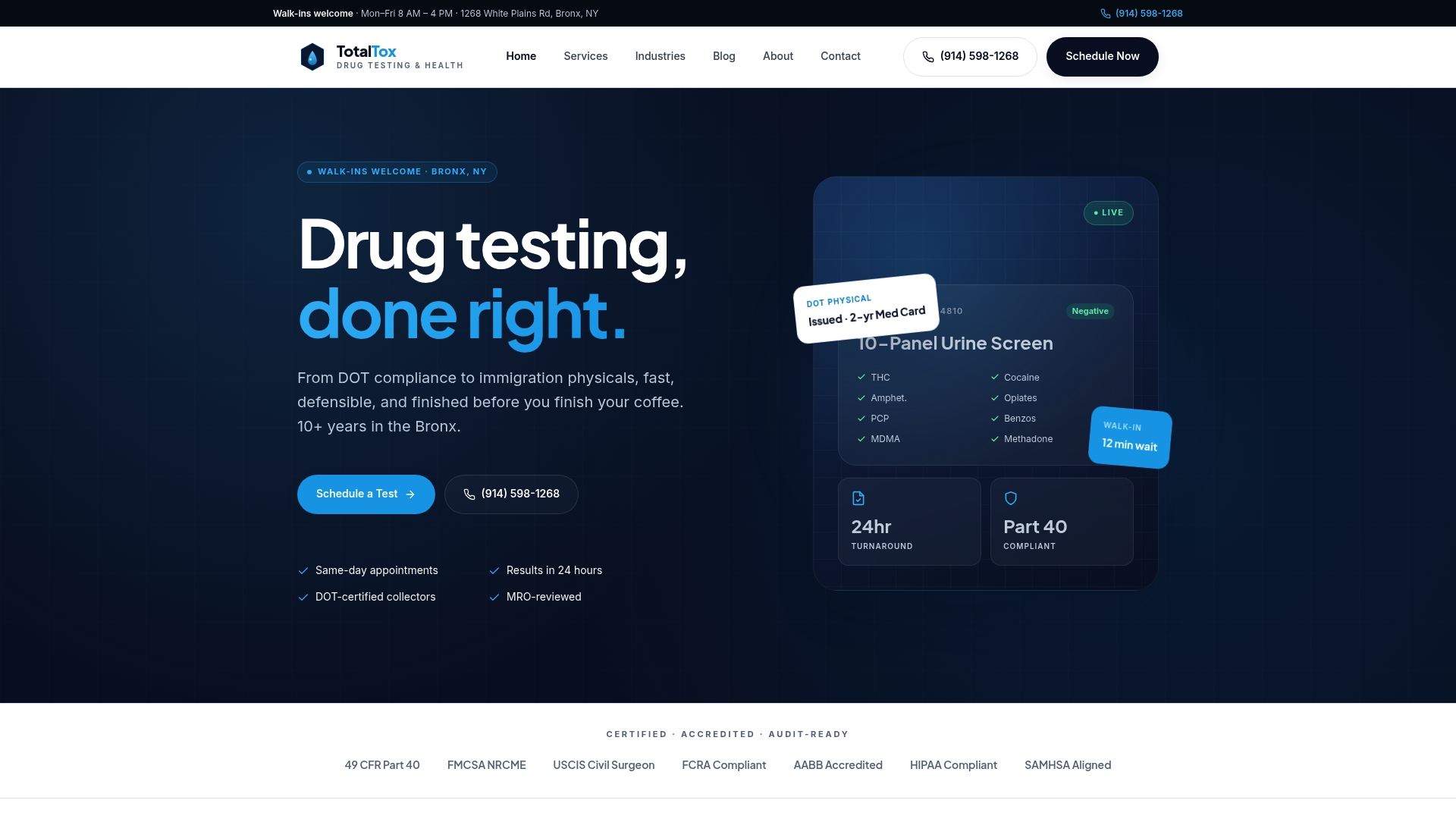
Staffing agencies can send new hires straight from an offer, and construction and transportation employers can send a supervisor’s referral the same day it is made.
Our perspective
We see a drug testing policy as an operating document, not a legal shield. The strongest ones are short, name each test type the company will really use, and match every consequence to a step someone can carry out that day.
That is why we built our clinic around speed and paperwork. Walk-in and same-day collections, typically under 15 minutes at the clinic, let a supervisor act on a reasonable-suspicion observation or a post-incident investigation while it is still fresh. MRO-reviewed results, typically within 24 hours, mean you are not acting on an unverified lab number.
The audit-ready documentation matters just as much. When a policy, a signed acknowledgment, a collection record and a verified result line up, an inspection becomes a matter of handing over a folder. We would rather help an employer get that folder right the first time than explain a gap afterwards.
Total Tox
FAQ
Does the Drug-Free Workplace Act require employers to drug test?
No. According to SAMHSA’s federal-law guide, most private employers are not required to have a drug-free workplace policy at all, and the Act’s duties for contractors and grantees concern policy and post-conviction steps. DOT-regulated employers are a separate case, because federal transportation rules require testing.
Can we test employees after any workplace injury?
Only with care. OSHA’s 2018 interpretation says post-incident testing is generally permissible when done for a legitimate safety purpose, but not when used to penalize an employee for reporting an injury. Write the policy around investigating the cause of the incident.
Is one policy enough for all our locations?
Usually not. SAMHSA says no single set of rules applies nationwide, and states and cities differ on who may be tested, methods and discipline, including marijuana. Use a core policy with a state or city addendum, and have counsel review it where you operate.
What is the difference between reasonable-suspicion and random testing?
Random testing is unannounced selection from a defined pool and needs no individual suspicion. Reasonable-suspicion testing is triggered by specific, documented observations from a trained supervisor about a particular person’s appearance, behavior, speech or body odor.
Sources
- SAMHSA: Develop a Policy
- SAMHSA: Drug Testing Federal Laws and Regulations
- SAMHSA: State and Local Laws and Regulations
- FMCSA: Implementation Guidelines for Alcohol and Drug Regulations
- 41 U.S. Code § 8102
- OSHA: Clarification of Position on Workplace Safety Incentive Programs and Post-Incident Drug Testing
- Arizona Revised Statutes § 23-493.04
- Minnesota House Research: Workplace Drug and Alcohol Testing
- Ohio Revised Code § 3796.28
- Oklahoma House Bill 3127 (enrolled)
- DOT: Procedures for Transportation Workplace Drug and Alcohol Testing
- DOT: Employer FAQs
- eCFR: 49 CFR Part 382