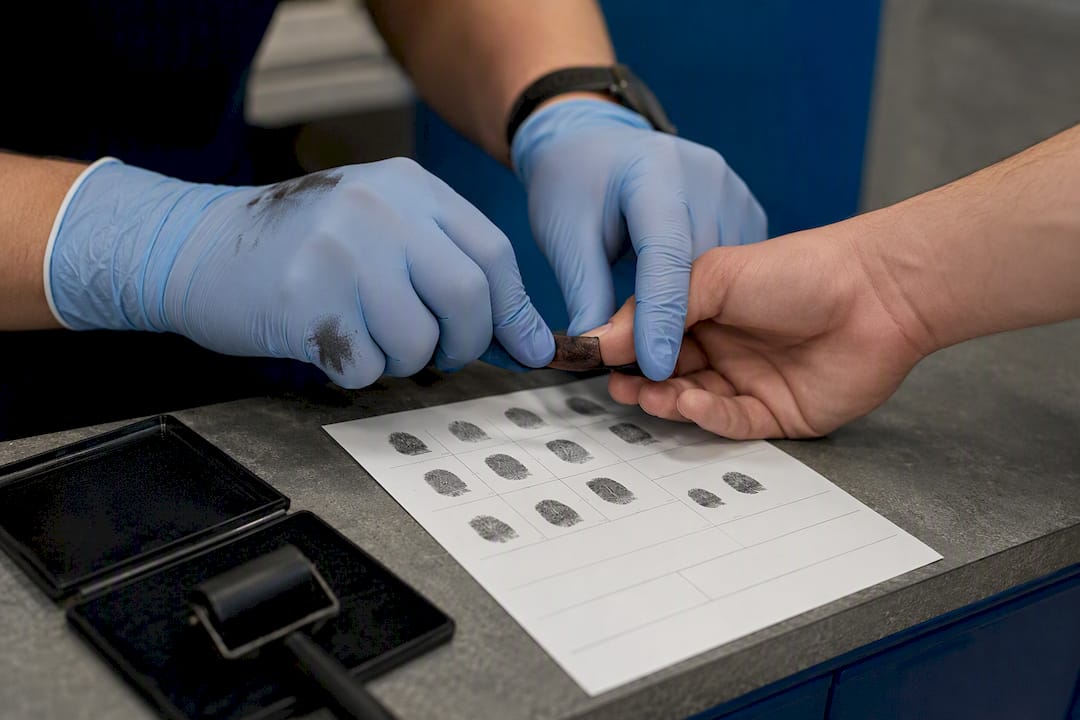
The FD-258 is the FBI’s official applicant fingerprint card, the paper (or fillable PDF) form employers, licensing boards, and government agencies require for civil background checks. If you need one, download the official FBI PDF and fill in every required field, or skip the guesswork entirely and let a trained provider capture legible rolled prints for you.
TL;DR:
- Using a professional fingerprinting service reduces the risk of rejected cards due to improper ink pressure, smudges, or incomplete fields, ensuring faster processing.
- Accurate completion of the ORI, personal details, and reason code is crucial, as errors or omissions lead to delays or misrouted results.
- Electronic capture and printing from authorized providers eliminate smudging issues and improve the legibility of biometric data on FD-258 cards.
- Submitting the correct card type and verifying all submitted information aligns with the requesting agency’s instructions prevents rejection and processing errors.
- Proper handling and storage of completed cards, including keeping them flat, dry, and protected from damage, are essential for maintaining ridge detail quality.
Table of Contents
- What Is FD-258 and When Is It Required?
- Where to Get an Official FD-258 and Training Aids
- How to Fill Out an FD-258: Required Fields Step by Step
- How to Capture Legible Fingerprints on an FD-258
- Common Reasons FD-258 Cards Get Rejected
- Submission Options: Mail, State Bureaus, or Live-Scan
- FD-258 vs. SF-87: Which Card Do You Actually Need?
- Legal and Privacy Considerations When Submitting FD-258 Cards
- How to Store and Handle FD-258 Cards Properly
- Reading Fingerprint Impressions on an FD-258 Card
- FD-258 Uses Beyond Criminal Background Checks
- Total Tox’s Perspective: When to Skip the DIY Route
- Get Your FD-258 Prints Right the First Time with Total Tox
- Sources
What Is FD-258 and When Is It Required?
FD-258, formally the Applicant Fingerprint Form, is the standard hard-card the FBI uses for civil and applicant-based fingerprint submissions, according to NIST’s glossary entry on the format. This is different from a criminal booking card. You’ll encounter it during employment screening, professional licensing, immigration processing, adoption clearances, and firearm permit applications.
Employers, state licensing boards, and federal or state agencies are the typical requestors. Every card carries an Originating Agency Identifier, or ORI, a code that tells the FBI’s processing system exactly which agency requested the check and where results should route.
- FD-258 handles civil and applicant submissions, not criminal arrest processing
- The requesting agency’s ORI must appear correctly for results to reach the right destination
- Standardized formatting lets scanning equipment and human reviewers process cards consistently across all fifty states
Where to Get an Official FD-258 and Training Aids
The canonical source is the fillable FD-258 PDF on fbi.gov. It’s free, it’s the current version, and it includes basic field instructions right on the form. That’s your starting point for a fd-258 fingerprint card if you’re printing or completing one yourself.
Agencies that need physical cardstock in bulk, along with training aids like FP-0007 and FP-0025, order them through the FBI’s LE ordering page. Bulk ordering requires a valid ORI, which is why individual applicants generally can’t order cards this way.
- Print the fillable PDF at home or work for a onetime submission
- Agencies and fingerprinting businesses order bulk stock and training materials through FBI supply channels
- Authorized live-scan and walk-in fingerprinting providers can capture your prints electronically and print them directly onto an FD-258, which sidesteps ink smudging entirely
How to Fill Out an FD-258: Required Fields Step by Step
Getting the paperwork right matters as much as getting the prints right. Follow this order when completing your fd-258 fingerprint card:
- ORI field. Enter the requesting agency’s Originating Agency Identifier exactly as they provided it. A wrong or blank ORI is one of the fastest ways to get a card rejected, per UCR guidance on fingerprint card preparation.
- Name (NAM). Print your legal last name, first name, and middle name in that order, matching your government ID.
- Date of birth and place of birth. Use the exact format the card specifies, typically month, day, year.
- Sex and race. These fields help distinguish individuals with similar names in the database.
- Date fingerprinted and reason fingerprinted. State the actual capture date and cite the reason code or plain-language purpose your requesting agency gave you, such as “employment” or “licensing.”
- Signature of person fingerprinted. Sign in the designated box, in front of the technician who rolled your prints.
- Employer or contributor fields, and FBI number if known. Fill these in if your requesting agency asks for them; leave them blank otherwise rather than guessing.
Type or print in black ink only, keep every entry inside its box, and don’t write anything in areas marked “leave blank.” If a finger is missing or amputated, note it clearly in that finger’s block instead of leaving it empty and unexplained.
How to Capture Legible Fingerprints on an FD-258
Technique is where most rejected cards actually go wrong, not the paperwork. FBI guidance is specific: roll each finger from nail base on one side, across the pad, to nail base on the other side, a motion known as nail-to-nail, per the official FD-258 instructions. Flat impressions, when requested, get pressed straight down without rolling.
Operators run into the same handful of problems over and over:
- Too little ink pressure produces faint, patchy ridges that scanners can’t read
- Too much ink or pressure blurs the ridge detail into solid black smudges
- Rolling too fast or shifting the finger mid-roll causes smearing or double impressions
- Stray ink marks outside the designated blocks confuse automated processing
FBI and UCR guidance also caps retabs at two attempts per impression block. Beyond that, the card is flagged rather than repeatedly reworked. Mark any amputated or bandaged finger explicitly rather than leaving the block blank.
Pro Tip: If your hands are dry, ashy, or calloused (common with manual labor jobs), rub a small amount of lotion in a few minutes before rolling. Dry skin doesn’t hold ink evenly, and that’s a leading cause of “insufficient ridge detail” rejections that send people back for a second appointment.
Common Reasons FD-258 Cards Get Rejected
Most rejections trace back to a short list of preventable mistakes. Run through this before you submit:
- Missing required fields, especially a blank ORI, missing date of birth, or missing place of birth
- Illegible or smeared prints from uneven ink, rushed rolling, or finger movement
- Wrong card type submitted when the requesting agency actually wanted an SF-87 or a different form entirely
- Incorrect or outdated ORI, which misroutes results to the wrong agency
- Exceeding retab limits, more than two attempts on any single impression block
A quick self-check before mailing: confirm every box is filled or intentionally blank, hold the card at arm’s length to spot smudges, and double-check the ORI against what your requesting agency actually gave you.
Submission Options: Mail, State Bureaus, or Live-Scan
How you send your completed FD-258 depends entirely on what the requesting agency told you. Some accept mailed hard cards directly; others route everything through a state identification bureau first.
- Mailing a hard card works for agencies that process paper directly, but always confirm the mailing address and include any cover letter or payment the agency specified
- State identification bureau routing is common for licensing and employment checks, where the state acts as a pass-through to the FBI
- Live-scan capture electronically records prints and prints them onto an FD-258 or transmits them digitally, and most agencies now accept this origin as fully valid
- Follow the requesting agency’s instructions on address, ORI, and preferred reply method exactly. A card that’s otherwise perfect gets delayed if it goes to the wrong recipient.
FD-258 vs. SF-87: Which Card Do You Actually Need?
FD-258 covers civil and applicant fingerprinting for most employment, licensing, and immigration purposes. SF-87, by contrast, is used specifically for federal employment background investigations tied to certain government positions.
- If a federal agency HR office requested your prints for a government job application, they likely want SF-87
- If an employer, state board, or immigration process requested prints, FD-258 is almost always correct
- Always confirm the exact form name with whoever requested it. Submitting the wrong card wastes the appointment and restarts the entire process, sometimes adding weeks to a licensing or hiring timeline.
Legal and Privacy Considerations When Submitting FD-258 Cards
Fingerprint data on an FD-258 gets routed to the FBI’s Criminal Justice Information Services division and, depending on the reason fingerprinted, cross-checked against criminal history databases. That means the information you submit isn’t just paperwork. It’s biometric data tied permanently to your identity record.
Know what you’re authorizing before you sign the card. The “reason fingerprinted” field determines the legal basis for the search, and different reason codes trigger different levels of database access. An employment check searches different records than an immigration or licensing check, even though the physical card looks identical.
You have a right to ask the requesting agency what the results will be used for and how long the record will be retained. Most licensing boards and employers are required to tell you this as part of the consent process, particularly under state-level background check laws that increasingly regulate how biometric data gets stored and shared.
If you believe your FBI record contains an error after a background check comes back, you can request a copy of your Identity History Summary and challenge inaccurate information directly with the FBI rather than only disputing it with the requesting employer or agency. That process exists precisely because fingerprint-linked records follow people for years, sometimes decades, and a data-entry mistake on someone else’s file occasionally gets attached to the wrong person.
Never submit a fingerprint card to an unverified third party. Legitimate requestors are always specific about the ORI, the reason code, and where the card should be sent. Anyone asking for your prints without that specificity is a red flag worth pausing on before you sign anything.
How to Store and Handle FD-258 Cards Properly
A completed FD-258 is a physical document carrying sensitive biometric and personal data, and it needs to be treated that way from the moment prints are rolled until it reaches its destination.
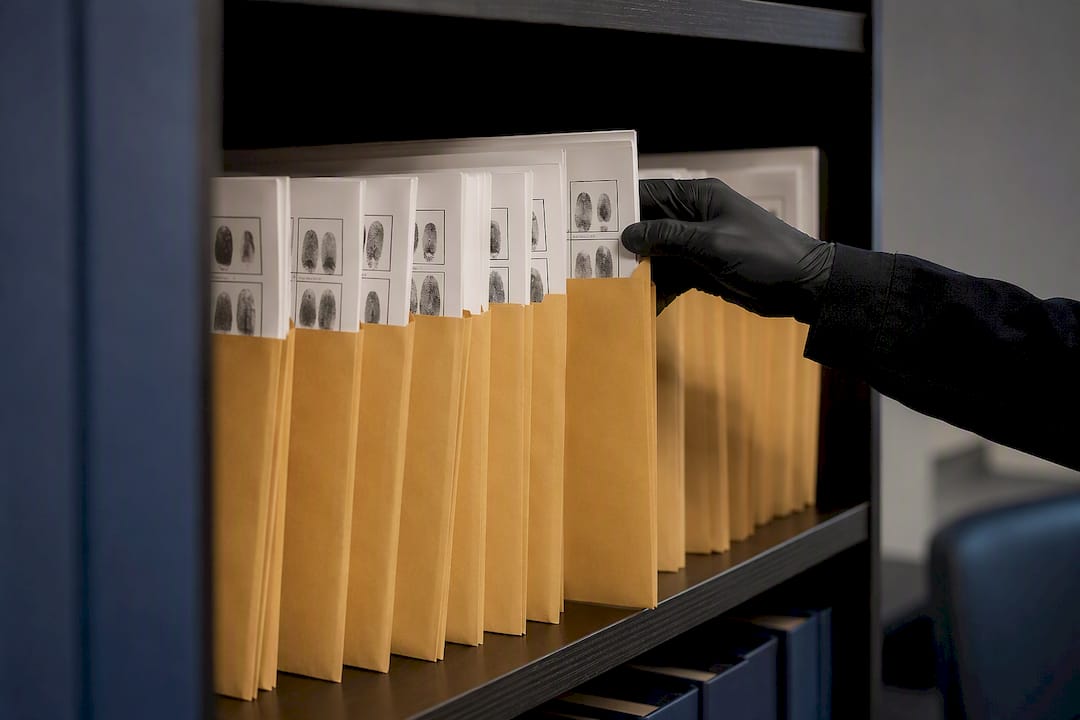
Keep the card flat and dry immediately after printing. Wet or smudged ink that gets rubbed against another surface, even a folder or an envelope, can degrade ridge detail that took a technician several careful attempts to capture. Let the ink set for a few minutes before sliding it into any protective sleeve.
Store cards in a rigid envelope or folder rather than folding them. A fold line across a fingerprint block can obscure ridge patterns enough to trigger a rejection when the card reaches a scanner. Most fingerprinting providers use kraft envelopes specifically sized to the card to prevent bending in transit.
If you’re an employer or licensing board holding completed cards before batch submission, store them somewhere with restricted access, ideally locked, since the card contains a person’s full name, date of birth, and biometric identifiers in one place. Avoid stacking cards with paper clips or staples through the fingerprint blocks. Even a small puncture can create a mark that confuses automated processing.
Once submitted, keep a copy of the completed card, or at minimum a record of when and where it was sent, in case you need to confirm submission details if the agency reports it never arrived.
Reading Fingerprint Impressions on an FD-258 Card
Each FD-258 has ten individual blocks for rolled impressions, plus a set of blocks near the bottom for simultaneous flat impressions used to verify the rolled prints are in the correct finger order. Reading them correctly matters if you’re checking your own card for quality before mailing it.
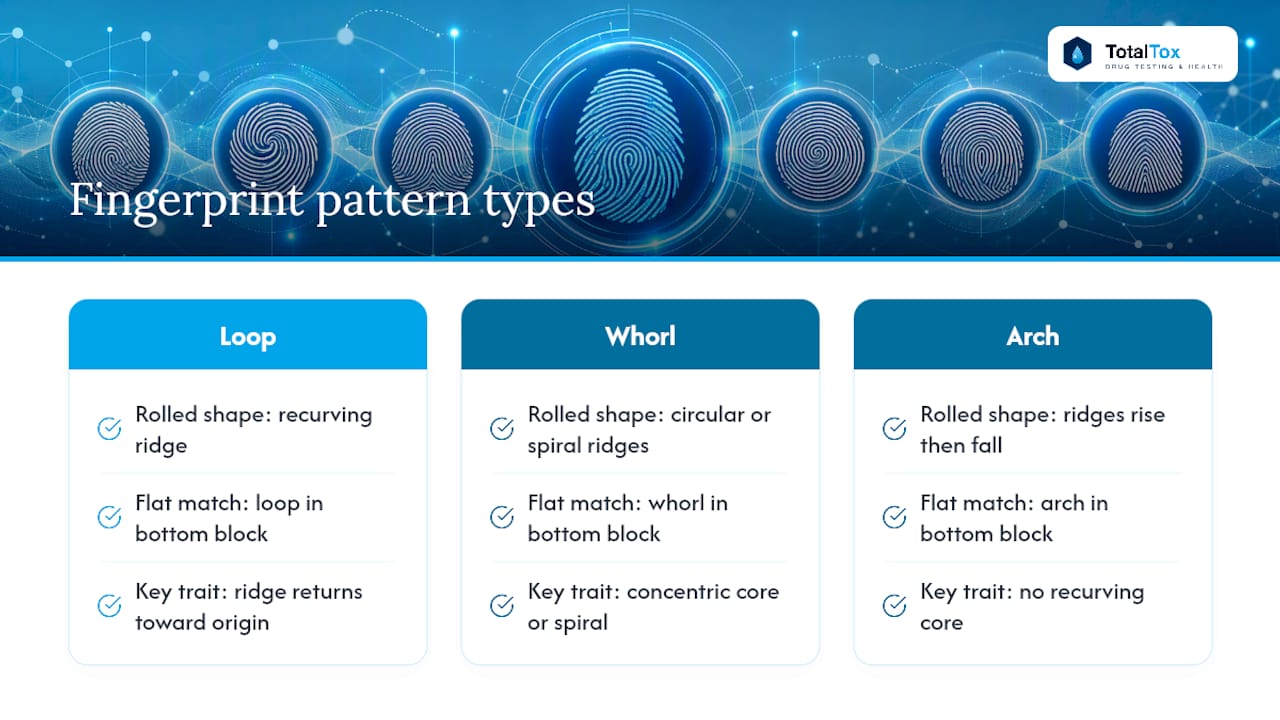
A properly rolled print shows continuous, unbroken ridge lines running the full width of the block, with clear separation between individual ridges rather than a solid dark smear. You should be able to trace a ridge from one side of the impression to the other without it fading into a blank patch or merging into the ridge beside it.
The three basic pattern types you’ll see are loops, whorls, and arches, and a trained technician or reviewer checks that the pattern type in the rolled block matches the pattern type in the corresponding flat impression at the bottom of the card. A mismatch there usually means a finger was rolled in the wrong block, which is exactly the kind of error a second set of eyes catches before submission rather than after rejection.
Faint or “washed out” areas within a ridge pattern indicate insufficient ink or pressure, while solid black patches with no visible ridge separation mean too much of both. Neither is usable for identification purposes, which is why FBI guidance and UCR’s fingerprint card preparation guidelines treat retabs as a limited, not unlimited, fix.
FD-258 Uses Beyond Criminal Background Checks
Criminal history review is the use case most people assume, but it’s far from the only one. Employment screening is probably the most common reason a Bronx-area applicant ends up filling out an FD-258, particularly for positions in healthcare, transportation, education, and childcare where state law mandates a fingerprint-based check before hire.
Professional licensing boards, everything from nursing and real estate to private security and commercial driving, routinely require FD-258 submissions as part of the application process. Immigration processing uses FD-258 for certain visa categories and adjustment-of-status applications where biometric verification supports the case file. Adoption and foster care agencies require it for every adult in a household. Firearm dealer licensing, at both individual and business levels, is another common trigger.
Each use case shares the same card format but a different reason code and often a different requesting ORI, which is why matching the exact instructions from whoever requested your prints matters more than the general process itself.
Total Tox’s Perspective: When to Skip the DIY Route
Filling out an FD-258 yourself is entirely doable if you’re patient and methodical about the fields. The prints themselves are where most people struggle, and honestly, that’s not a knock on anyone’s fine motor skills. Rolling a legible nail-to-nail impression takes repetition, the right ink consistency, and a feel for pressure that most people only develop by doing it wrong a few times first.
That’s the gap professional capture closes. Trained technicians roll dozens of prints a week, use calibrated ink pads, and catch smearing or under-inking before the card ever leaves the building. At Total Tox, walk-in fingerprinting appointments typically wrap up in under 15 minutes, with MRO-reviewed documentation that’s audit-ready for whatever licensing board or employer requested it.
If you’ve got one shot at a licensing deadline or an employer is waiting on results, professional capture is the lower-risk path.
— Total Tox
Get Your FD-258 Prints Right the First Time with Total Tox
Rejected fingerprint cards cost time you probably don’t have, especially with a licensing deadline or new-hire start date on the line. Total Tox runs walk-in fingerprint capture that prints directly onto the official FD-258 card, checked for legibility before you leave, so you’re not gambling on whether your ORI, rolled prints, and required fields will clear review the first time.
The process takes minutes, not an entire afternoon, and every submission comes with MRO-reviewed, audit-ready documentation your employer or licensing board can accept without follow-up questions. Total Tox serves employers, individual applicants, and licensing candidates across the Bronx, Manhattan, Westchester, and Queens, offering a walk-in model featuring fast intake, trained technicians, and reliable results. Browse Total Tox’s fingerprinting and occupational health services or schedule your appointment to get your FD-258 captured correctly on the first try.
Sources
- Applicant Fingerprint Form (FD-258) — FBI
- Guidelines for preparation of fingerprint cards and associated criminal history information — UCR (FBI)
- Fingerprint Card Order Form and Training Aid Links — LE (FBI)
- FD-258 — NIST glossary