
Fit for duty testing is a job-specific medical evaluation that determines whether an employee can safely perform the essential functions of their role. Employers can require it after a job offer, following a leave or injury, or when there’s an objective, documented reason to question someone’s ability to work safely, but the request has to be job-related and consistent with business necessity under the ADA. Employers should keep a paper trail showing what triggered the request; employees should ask for that reasoning in writing and know their medical results are protected information, not shared with a supervisor by default.
TL;DR:
- Employers must keep detailed documentation showing the objective and job-related reasons for requesting fit for duty testing, with a clear connection to safety concerns.
- Medical evaluations should include multiple assessments such as physical exams, occupational history, and psychological tests, performed only by qualified professionals with specific credentials.
- Results typically categorize employees as fit, fit with restrictions, temporarily unfit, or unfit, with restrictions requiring concrete accommodations like modified duties or phased returns.
- Fast, organized toxicology testing and timely reporting support compliance, reduce disputes, and help employers manage safety-sensitive roles efficiently.
- Employers are responsible for paying for all required assessments, and testing must always align with ADA rules, emphasizing confidentiality and job-relatedness.
Table of Contents
- When Do Employers Use Fit for Duty Testing?
- What Legal Limits Protect Employees During Testing?
- What Does a Fit for Duty Evaluation Actually Include?
- Who Should Perform the Evaluation?
- What’s the Typical Process, Timeline, and Cost?
- How Should You Interpret Fit for Duty Results?
- Balancing Safety and Fairness in Fit for Duty Decisions
- How Total Tox Supports Fit for Duty and Compliance Testing
- Where to Read More on Fit for Duty Law and Clinical Guidance
- Sources
- FAQ
When Do Employers Use Fit for Duty Testing?
Timing matters as much as the reason. Before a job offer, employers generally cannot ask disability-related questions or require a medical exam at all. Once an offer is made, a fitness for work assessment becomes permissible as a condition of employment, as long as every candidate in that job category gets the same requirement.
After hiring, the legal bar shifts. A systematic review of fitness-for-work assessment criteria found that job analysis and clearly defined essential functions substantially improve how valid these evaluations are, and most legitimate post-hire triggers fall into a short list:
- Observed impairment on the job, such as slurred speech, unsteady movement, or erratic behavior
- A workplace safety incident or near-miss involving the employee
- Return to work following a serious injury, surgery, or extended medical leave
- Regulated, periodic exams required for safety-sensitive roles (commercial drivers, pilots, machine operators)
Roles governed by federal safety rules, like DOT-regulated commercial driving positions, often require recurring physicals regardless of any specific incident. That’s a regulatory baseline, not a targeted accusation against one worker.
What Legal Limits Protect Employees During Testing?
Any evaluation that asks for medical information counts as a “medical examination” under ADA guidance, which means it has to be job-related and no broader than necessary. Employers can’t use a fitness for duty exam as a backdoor way to screen for disabilities unrelated to the actual job.
If an employee discloses a condition during the process, that can trigger the employer’s duty to explore reasonable accommodation rather than simply issuing a pass or fail. Medical findings also need to be stored separately from personnel files, accessible only to people with a genuine need to know, under standard ADA confidentiality rules.
For HR teams, a short compliance checklist keeps referrals defensible:
- Document the objective basis for the referral before scheduling anything
- Confirm the request aligns with a written, current job description
- Loop in employment counsel or your ER team for anything beyond routine physicals
- Keep the essential-functions list on hand for the examiner
Pro Tip: Write down what happened, when, and who observed it, before you ever pick up the phone to schedule an evaluation. A referral built on a vague “I have concerns” is far easier to challenge than one built on dated, specific observations.
What Does a Fit for Duty Evaluation Actually Include?
No single test settles the question. A StatPearls clinical review on fitness for duty and return to work concludes that reliable evaluations combine several tools, not one silver-bullet test.
- Clinical interview and occupational history focused on the specific tasks the job demands, not a generic health check.
- Focused physical exam and functional capacity testing, sometimes including task simulation that mirrors real job movements like lifting or climbing.
- Toxicology screening (urine, saliva, or hair) when the role is safety-sensitive or subject to DOT-mandated testing rules.
- Psychological fitness for duty evaluation, reserved for cases with a documented, objective trigger, typically involving standardized testing, a structured interview, and collateral information from supervisors or records.
The same StatPearls review cautions that standardized methods don’t translate cleanly across every occupation. A construction laborer and an air traffic controller need different benchmarks for the same word: fit.
Who Should Perform the Evaluation?
Credentials matter more than convenience here. Medical fitness for duty exams should go to an occupational medicine clinician, someone trained specifically in matching health status to job demands, not just a general practitioner doing a favor.
Psychological evaluations belong exclusively with licensed psychologists or psychiatrists. The IACP’s fitness for duty evaluation guidelines require a documented, objective basis for referral and stress that examiners must remain impartial, with no prior treating relationship or conflict of interest.
Physical capability testing should come from a certified functional capacity evaluation provider using validated protocols, not an ad hoc strength test someone improvised.
When writing the referral, HR should request in writing:
- The examiner’s relevant license and specialty
- Confirmation of no prior relationship with the employee
- A written report following recognized professional standards
What’s the Typical Process, Timeline, and Cost?
The process starts with paperwork, not an appointment. A proper referral includes a written explanation of the concern, the current job description, a list of essential functions, and documented informed consent from the employee.
- HR submits the written referral package to the examiner or clinic.
- The employee completes the clinical interview and physical or psychological components, sometimes across more than one visit if specialist referrals are needed.
- Toxicology results, when required, typically return within 24 to 48 hours depending on the panel and lab, though rapid options at walk-in clinics can shorten that window considerably.
- The employer receives a fitness determination, often with specific restrictions rather than a blanket pass or fail.
Employers pay for exams they require, whether that’s a post-injury return to work evaluation or routine DOT-mandated screening. There’s rarely an exception to this rule when the employer initiates the referral.
Pro Tip: Ask the clinic upfront how they package results. A report that arrives audit-ready, with MRO review already completed, saves your team from chasing down documentation later when a regulator or insurer asks for it.

How Should You Interpret Fit for Duty Results?
Results usually land in one of four buckets, according to the systematic review of fitness-for-work assessment methods: fit, fit with restrictions or modifications, temporarily unfit, or unfit. Very few cases land at the extremes.
- “Fit with restrictions” should translate into concrete accommodations: modified duties, a phased return schedule, or temporary reassignment.
- If the employee disputes the outcome, an independent medical exam or a second opinion from another qualified examiner is a reasonable next step.
- Employers should never use these evaluations as a disciplinary shortcut. Legal guidance on FFDE practice recommends exhausting standard performance management first, and documenting that you tried, before referring someone for evaluation.
Balancing Safety and Fairness in Fit for Duty Decisions
The best outcomes happen when HR, safety managers, and the occupational health provider plan the referral together, before anyone picks up the phone to schedule anything. A referral written by one department in isolation tends to miss either the safety rationale or the legal guardrails, and that gap is where disputes start.
Speed matters more than most employers realize. When toxicology results arrive fast, MRO-reviewed, and organized for an audit, the whole process feels less punitive to the employee and less risky to the business. A slow, disorganized process reads as suspicion; a quick, well-documented one reads as routine.
— Total Tox
How Total Tox Supports Fit for Duty and Compliance Testing
Total Tox is a practical alternative to scheduling a fit for duty exam weeks out with a hospital occupational health department. We run walk-in drug and alcohol testing, DOT and CDL physicals, and MRO-reviewed toxicology screens, with most in-clinic tests completed in under 15 minutes and results back within 24 hours.
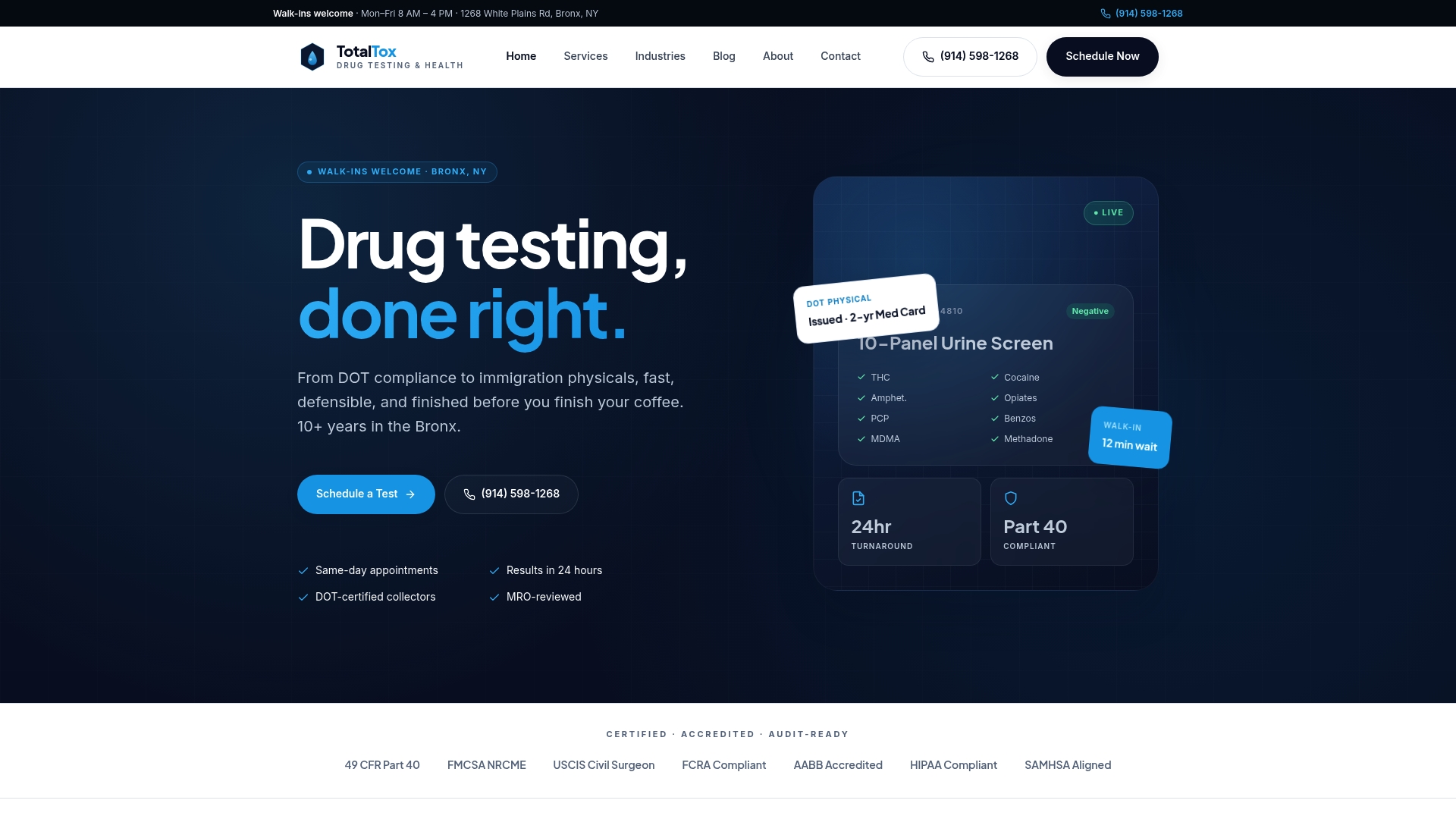
That turnaround matters when a safety-sensitive role sits idle waiting on paperwork. Our documentation is organized to support compliance and regulatory requirements, helping HR teams manage paperwork efficiently. We’ve served employers and individual clients in the Bronx for over 10 years, handling thousands of tests annually across our industries served. If your organization needs a compliant, fast turnaround for a return to work evaluation, DOT physical, or routine screening, schedule a visit and get results your legal and safety teams can rely on.
Where to Read More on Fit for Duty Law and Clinical Guidance
- StatPearls’ clinical review on fitness for duty and return to work covers the medical evaluation basics.
- The IACP’s fitness for duty guidelines detail psychological evaluation standards.
- The TSA’s management directive offers a real-world example of agency policy on management-initiated referrals.
- Ada explains employer obligations and disability protections during medical exams.
This article is general information, not a substitute for advice from a qualified doctor. Consult a qualified healthcare professional about your own circumstances before acting on anything here.
Sources
- Fitness for Duty and Return to Work - StatPearls - NCBI Bookshelf
- Criteria and methods used for the assessment of fitness for work: a systematic review
- Fitness for Duty Evaluation Guidelines - IACP
- TSA management-initiated fitness-for-duty evaluations (directive example)
FAQ
What Happens if You Fail a Fit for Duty Test?
A failed result usually leads to a “not fit” or “fit with restrictions” determination rather than automatic termination; employers should explore accommodations or modified duty before taking disciplinary action.
Who Can Perform a Fit for Duty Evaluation?
Medical evaluations should come from occupational medicine clinicians, psychological evaluations from licensed psychologists or psychiatrists, and physical capability testing from certified functional capacity evaluation providers.
Who Pays for a Fitness for Duty Exam?
The employer pays when it requires the exam, whether for a return to work evaluation, a safety incident follow-up, or routine DOT-mandated physicals.
Who Decides if an Employee Is Fit for Work?
The examining clinician or psychologist makes the medical determination, but the employer decides how to apply restrictions to the actual job, often with input from HR and the employee’s supervisor.