
An I-693 RFE is not a denial. It means USCIS needs a correction or missing piece of evidence before it can approve your case, and the fix is usually straightforward. The moment you receive one, hand every page to both your immigration attorney and the civil surgeon who signed the form. Don’t wait for the deadline to start working. Respond as early as you reasonably can.
TL;DR:
- Most I-693 RFEs result from incomplete forms, missing signatures, outdated editions, or vaccination documentation issues that are easy to correct with proper preparation.
- Responding early with a complete, accurate, and sealed correction minimizes delays, and every correction should be verified with your civil surgeon before mailing.
- USCIS allows three correction methods: annotating and re-signing, submitting a new form, or only filling in deficient sections on a new form, but tampered envelopes can lead to rejection.
- The new rule effective November 2023 restricts the validity of I-693 forms to the specific application they support, making quick responses more critical if cases are withdrawn or denied.
- Using expedited clinics like Total Tox can often fix deficiencies in same-day appointments, reducing weeks of processing time and ensuring audit-ready documentation.
Table of Contents
- What USCIS Reviews on Form I-693 and Why Officers Issue an RFE for Medical Exam
- The Most Common Reasons USCIS Sends an I-693 Deficiency Notice
- How to Respond to an I-693 RFE: Exact Steps, Documents, and Mailing Tips
- How Civil Surgeons Fix I-693 Deficiencies (Three USCIS-Accepted Methods)
- The 2025 Rule Change on I-693 Validity Every Applicant Should Know
- What Happens After You Submit Your I-693 RFE Response
- Clinic-Level Tips to Avoid an I-693 RFE in the First Place
- Total Tox’s Perspective on Correcting I-693 Deficiencies
- Get Your I-693 Corrected Fast With Total Tox
- Sources
What USCIS Reviews on Form I-693 and Why Officers Issue an RFE for Medical Exam
USCIS officers check your completed Form I-693 against the CDC technical instructions that were in effect on the date your civil surgeon signed it, not the date USCIS reviews the file. That distinction matters because instructions change, and an officer applying a newer standard to an older exam is applying the wrong rulebook.
Officers typically flag a narrow set of issues:
- Incomplete sections or blank fields the civil surgeon should have filled in
- Missing or illegible signature and civil surgeon identification (CSID) number
- Vaccination documentation that doesn’t match what’s required
- Missing lab or chest X-ray results when the exam calls for them
- A sealed envelope that appears opened, tampered with, or improperly resealed
Per the USCIS Policy Manual, officers shouldn’t demand requirements that didn’t exist when your exam happened. If you get an RFE citing a rule that postdates your signature date, that’s worth flagging to your attorney immediately.
The Most Common Reasons USCIS Sends an I-693 Deficiency Notice
Most I-693 RFEs trace back to a handful of recurring problems, and almost all of them are preventable with a careful pre-appointment check.
- Incomplete forms or outdated editions. A blank field or an expired form edition triggers an automatic deficiency notice.
- Vaccination gaps. Missing immunization records or unclear proof of a completed series is the single most frequent, and most avoidable, cause of an I-693 RFE.
- Signature problems. If a physician who isn’t a USCIS-designated civil surgeon signs the form, or the CSID is missing, USCIS rejects it outright.
- Envelope issues. A torn, opened, or unsealed envelope raises a red flag, even when the medical content inside is perfectly fine. Lost mail and administrative scanning errors cause a smaller but real share of these notices too.
- Policy timing. If your underlying application was withdrawn, denied, or refiled, your existing I-693 may no longer count as valid evidence.
Vaccination documentation is widely considered the top preventable trigger among these causes, which is exactly why a thorough records review before your exam saves weeks of back-and-forth later.
How to Respond to an I-693 RFE: Exact Steps, Documents, and Mailing Tips
An RFE response is a paperwork race against a clock, and every day you sit on it is a day added to your case timeline. Here’s the order that actually works.
- Read the entire RFE, then forward every page to your attorney and your civil surgeon. Don’t summarize it or send only the page that seems relevant. The full notice tells the clinic exactly what USCIS flagged and how to fix it.
- Confirm your response deadline on the notice itself, then set an internal deadline several days earlier. USCIS typically gives you a response window, but AILA guidance urges applicants not to wait out the full period, since faster responses reduce the risk of visa allocation timing problems in employment-based cases.
- Let the civil surgeon decide the correction method. Some deficiencies need only an annotation and re-signature; others require a whole new form. That call belongs to the medical provider, not the applicant.
- Assemble the required evidence, which usually includes corrected form pages, updated vaccination records, any missing lab or X-ray reports, the original sealed envelope if USCIS returned it, and a cover letter from your attorney summarizing what changed.
- Mail your response using tracked delivery to the exact address on the RFE notice. Keep the tracking number and a full copy of everything you send.
- Schedule any outstanding vaccines or tests immediately. If the RFE calls for a shot or a screening you haven’t completed, book it the same week and get documentation of completion before your civil surgeon finalizes anything.
Pro Tip: Call your civil surgeon’s office before mailing anything and ask them to confirm the corrected I-693 matches the exact deficiency USCIS cited. A quick five-minute call catches mismatched corrections before they cost you another round of delay.
How Civil Surgeons Fix I-693 Deficiencies (Three USCIS-Accepted Methods)
USCIS gives civil surgeons three ways to correct a flagged I-693, and which one applies depends entirely on what’s wrong.
- Annotate and re-sign the original form. If only a few fields need correcting, the civil surgeon marks the deficient sections, both the applicant and the surgeon re-sign and re-date, and the form goes back into a sealed envelope.
- Complete an entirely new I-693. For more substantial gaps, such as missing lab work or an outdated form edition, the clinic starts fresh, fills out a new form, and seals it in a new envelope.
- Complete only the deficient sections on a new form. This hybrid approach lets the civil surgeon fill in just what’s missing on a new I-693 while including the original form and its supporting documentation together.
The USCIS Policy Manual confirms all three methods are acceptable. What isn’t acceptable is a compromised envelope: if the seal shows tampering, USCIS may reject the response outright regardless of how accurate the medical content is, which forces you back to square one with a fresh appointment.
The 2025 Rule Change on I-693 Validity Every Applicant Should Know
USCIS made a change that directly affects how you should think about timing an RFE response.
Any Form I-693 signed on or after November 1, 2023, is generally valid only for the specific immigration application it accompanies. If that application gets withdrawn or denied, the I-693 no longer counts as valid evidence, even if the medical exam itself is still technically current.
This policy took effect through a USCIS newsroom alert dated June 11, 2025, and it raises the stakes on responding to an I-693 RFE quickly. If your case gets denied while an RFE response is pending, or you decide to withdraw and refile, you’ll likely need to start over with a brand-new medical exam rather than reusing the old one. That makes coordinating fast with your civil surgeon and attorney more important than it used to be, not less.
What Happens After You Submit Your I-693 RFE Response
Processing time after you send your response varies by service center, current caseload, and how complex your original deficiency was. There’s no fixed national timeline, but responding early in your window tends to shorten the wait rather than lengthen it.
A few outcomes are possible once USCIS reviews your response:
- Your case moves forward toward approval or an interview
- USCIS issues a second RFE if something is still missing or unclear
- You receive a Notice of Intent to Deny (NOID), which is more serious and time-sensitive than an RFE
- USCIS returns documentation asking for further correction on a narrow point
If you haven’t seen any movement well past your service center’s posted processing times, that’s the point to have your attorney check case status or request an update, rather than waiting indefinitely.
Clinic-Level Tips to Avoid an I-693 RFE in the First Place
Most RFEs are preventable with better preparation before the exam ever happens, not better paperwork after the fact.
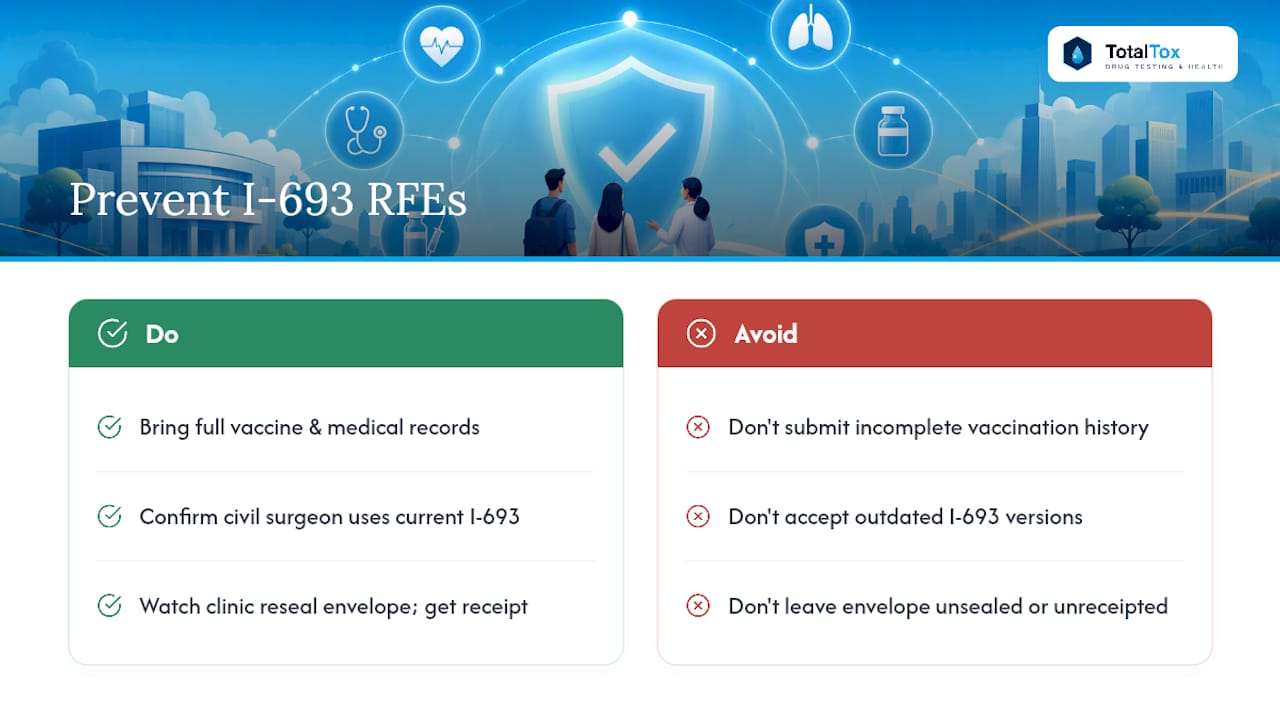
Bring your complete medical and vaccination history to the civil surgeon appointment, including old immunization cards, prior lab results, and any documentation from a previous I-693 if you’re refiling. A good clinic cross-checks your records against CDC requirements on the spot and flags gaps before the form gets signed. Always confirm the civil surgeon is using the current edition of Form I-693; an outdated version is an automatic, entirely avoidable deficiency. Ask the clinic to reseal your envelope in front of you and provide a receipt confirming delivery to you or your attorney.
Pro Tip: Choose a clinic offering expedited scheduling and MRO-reviewed lab results if you’re already responding to an RFE. Every day saved on the medical side is a day added back to your response window.

Total Tox’s Perspective on Correcting I-693 Deficiencies
We’ve spent more than 10 years and thousands of exams learning that most I-693 problems are small, technical, and completely fixable when a clinic moves fast. Expedited scheduling, careful sealed-envelope handling, and MRO-reviewed documentation close most gaps within days, not weeks. That said, medical corrections are only half the equation. Always run your timeline and next steps by your immigration attorney before mailing anything back to USCIS.
— Total Tox
Get Your I-693 Corrected Fast With Total Tox
Total Tox is the local alternative to scrambling through general urgent care clinics that don’t specialize in immigration exams. We run expedited, walk-in appointments specifically for I-693 corrections, so instead of waiting weeks for a general practitioner slot, you can often get seen the same day your attorney flags the deficiency.
Our civil surgeons review your RFE, determine whether an annotation, a new form, or a partial correction applies, and reseal your I-693 properly with documentation you can hand straight to your attorney. Every result comes MRO-reviewed and audit-ready, which matters when USCIS is scrutinizing your paperwork closely. If you’re facing an I-693 RFE right now, visit our immigration exam services page or contact our Bronx clinic to book an expedited appointment today.