
A last chance agreement (LCA) is a written contract between an employer and an employee, usually with a union representative involved, that offers one final opportunity to keep a job after serious misconduct instead of immediate termination. It holds up in court and arbitration only when the terms are specific, lawful, and consistently enforced. Vague language, or terms that conflict with the ADA, ADEA, or DOT rules, can undo the whole agreement.
TL;DR:
- Last chance agreements are enforceable written contracts used to retain employees after misconduct if terms are clear, lawful, and consistently applied.
- They are appropriate for conduct issues like drug or alcohol violations, safety violations, insubordination, or attendance problems, but not for skill deficiencies.
- Drafting an effective LCA requires specific incident details, measurable conditions, clear breach consequences, and signatures from all parties, including union reps where applicable.
- Federal laws such as the ADA, ADEA, and DOT regulations impose strict limits on LCA language, especially concerning disability accommodations and safety-sensitive testing procedures.
- Proper documentation, prompt verified testing, and legal review are essential to enforce an LCA successfully and prevent challenges in arbitration.
Table of Contents
- What a Last Chance Agreement Covers and Why Employers Use Them
- Deciding Whether an LCA Is the Right Move
- Building an Enforceable Last Chance Agreement: The Drafting Checklist
- Federal Rules That Limit What an LCA Can Say
- How Arbitrators View Last Chance Agreements in Union Settings
- Investigating and Enforcing a Breach Without Losing at Arbitration
- What Employees and Union Reps Should Push Back On
- A Practical Checklist and Sample Language Patterns
- Balancing Safety, Fairness, and Compliance
- Fast, MRO-Reviewed Testing Backs Up Every LCA You Write
- Sources
- FAQ
What a Last Chance Agreement Covers and Why Employers Use Them
A last chance agreement is a negotiated, signed document that replaces termination with a conditional continuation of employment. The employee agrees to specific terms; in exchange, the employer holds off on firing them for a specific violation that would normally justify it. In union settings, the shop steward or business agent usually signs alongside the employee and employer, which locks the agreement into the collective bargaining framework rather than leaving it as a side deal.
Most LCAs get triggered by a narrow set of recurring problems; understanding relapse risks and prevention strategies can support early recovery efforts, as seen in non nicotine aids for relapse prevention.
- A positive drug or alcohol test, especially in safety-sensitive roles like commercial driving
- A serious safety violation, such as bypassing a lockout procedure on machinery
- Insubordination or a documented pattern of workplace conflict, including bullying or harassment
- Chronic attendance problems after progressive discipline has already failed
Notice what’s missing: skill deficits. Employers rarely use an LCA to address someone who simply isn’t good on the job. That’s what a performance improvement plan is for. LCAs address conduct, not competence, and mixing the two into one document tends to confuse everyone involved, including the arbitrator who might eventually read it.
Deciding Whether an LCA Is the Right Move
An LCA makes sense when the employer wants to retain someone whose skills or tenure are worth preserving, or when a union contract expects some resolution short of termination for a first serious offense. It rarely makes sense when the underlying conduct involves an immediate safety threat, a criminal act, or a situation where regulation blocks the substitution entirely.
Run through this before drafting one:
- Is there a documented, verifiable record of the incident, not just a manager’s account?
- Would retaining this employee actually cost less than recruiting and training a replacement?
- Does the collective bargaining agreement anticipate or require a last-chance option before discharge?
- Is the role subject to DOT drug testing rules, meaning a Substance Abuse Professional evaluation has to happen first, regardless of what the LCA says?
- Has the company applied this option consistently to employees in comparable situations?
If the answer to any of the first three is a flat no, an LCA probably isn’t the right tool. If the answer to the fourth is yes, the LCA has to work around the SAP process, not instead of it.
Building an Enforceable Last Chance Agreement: The Drafting Checklist
Arbitrators reviewing a disputed LCA tend to focus on one thing: whether the language is specific enough that both sides knew exactly what compliance and breach looked like. According to arbitrator commentary compiled by the American Arbitration Association, a well-drafted final opportunity contract should identify the triggering conduct precisely and spell out the exact conditions for continued employment, not general good behavior.
A defensible LCA includes:
- The specific incident that triggered the agreement, with dates and supporting evidence attached
- Objective, measurable conditions, like “no positive test in the next 12 months” rather than “improved conduct”
- Testing or treatment obligations, including who administers them and how results get confirmed
- Reporting requirements, such as check-ins with a supervisor or HR contact on a set schedule
- A precise definition of what counts as a breach and what happens immediately after one
- A stated duration or expiration date, or a clear justification if the agreement is meant to be indefinite
- How the agreement affects grievance or arbitration rights going forward
- Signatures from the employee, employer representative, and union rep where applicable, plus something of value exchanged (the job continuation itself usually satisfies this)
Pro Tip: Attach the MRO confirmation report for any positive drug test directly to the LCA file, not just a summary. If enforcement ever gets challenged, the underlying lab documentation is what actually holds up.
Also nail down the operational details: name the treatment provider or SAP by name if one is involved, state confidentiality expectations, and set a retention period for the file. Loose ends here are what turn a routine termination into a costly grievance.

Federal Rules That Limit What an LCA Can Say
An LCA doesn’t operate in a legal vacuum. Three federal frameworks shape what employers can and can’t put in one, and getting any of them wrong can void enforcement entirely or create new liability.
The EEOC has confirmed that offering an LCA is legal, but it doesn’t replace the individualized accommodation analysis the ADA requires. An employer can’t use a last-chance agreement to sidestep disability protections or demand an employee stop taking legally prescribed medication as a condition of continued employment. That’s not a theoretical risk: the EEOC reached a $150,000 settlement with Lonza America over allegations that the company conditioned an employee’s return to work on stopping prescribed opioids.
Key constraints to build into any LCA:
- ADA/EEOC: Individualized accommodation review still applies; an LCA can’t be a blanket substitute
- ADEA/OWBPA: A valid age-discrimination waiver needs plain language, a 21-day consideration period, a 7-day revocation window, and advice to consult an attorney
- DOT/Part 40: For safety-sensitive roles, the LCA cannot replace the SAP evaluation or return-to-duty testing process
For DOT-regulated employees, the SAP follow-up testing plan requires a minimum of six unannounced tests in the first year, and that schedule can extend up to five years. No LCA language overrides that requirement, no matter what the employer and employee agree to on paper.
How Arbitrators View Last Chance Agreements in Union Settings
Union involvement isn’t a formality in most LCAs; it’s what makes the agreement stick when it’s tested. A steward’s signature signals that the union reviewed the terms and isn’t going to later argue the employee signed under duress with no representation.
Arbitrators reviewing a breach dispute tend to ask a narrower set of questions than people expect:
- Did the agreement clearly displace the usual just-cause standard, or does just-cause still apply on top of it?
- Was the proof standard for a breach spelled out, or is the employer relying on a subjective judgment call?
- Has the employer enforced this kind of clause consistently with other employees, or is this the first time?
That last point trips up more employers than any legal technicality. According to a labor and employment analysis from Cozen O’Connor, arbitrators disfavor indefinite LCAs and treat inconsistent enforcement as grounds for a waiver argument. If a company let a similar violation slide once without consequence, that leniency can undercut its ability to enforce the same clause the next time.
Investigating and Enforcing a Breach Without Losing at Arbitration
The moment a suspected breach surfaces, evidence handling becomes the whole case. Sloppy documentation here is what turns a clean termination into a grievance the employer loses.
- Preserve everything immediately: the failed test result, witness statements, timestamps, and any physical evidence tied to the incident.
- If the breach involves a drug or alcohol test, confirm the result through the Medical Review Officer before taking any action, not the initial screening result alone.
- Identify who has authority to confirm the breach and notify the employee in writing, citing the exact LCA clause violated.
- Document the internal decision-making process, including who reviewed the evidence and when the call was made.
- Attach every supporting document to the termination notice itself, not just a reference to a file.
Pro Tip: Chain-of-custody gaps are the single most common reason a drug-related termination gets challenged successfully. A collection process with a documented handoff at every step closes that gap before it opens.
What Employees and Union Reps Should Push Back On
Signing an LCA under pressure, without reading it carefully, is how employees end up bound to terms they never actually understood. A union rep’s job here is to turn soft language into something measurable before anyone signs.
Push for these changes before signing:
- Replace vague standards like “improved behavior” with specific, testable events and thresholds
- Require written notice and a real chance to respond before any breach determination is final
- Confirm the agreement doesn’t waive ADA accommodation rights or restrict lawful, prescribed medication use
- Question any off-duty conduct clause that reaches beyond the workplace without a clear safety justification
Watch for these red flags: being told to sign on the spot with no time to review or consult a rep, a release of claims that’s broader than the incident at hand, and testing requirements that run indefinitely with no connection to a SAP-defined schedule.
A Practical Checklist and Sample Language Patterns
Good LCA language is specific enough that a stranger reading it later would know exactly what happened and what was required. A trigger clause might read: “Following a confirmed positive test for [substance] on [date], Employee agrees to the following conditions as a condition of continued employment.” A breach clause should name the exact consequence, not a vague reference to “further discipline.”
Before finalizing:
- Attach the incident report, lab or MRO confirmation, and any prior discipline record
- Confirm signatures from the employee, employer, and union rep where one exists
- For DOT cases, name the SAP and coordinate the testing schedule directly with the MRO-reviewed results process
- Loop in legal counsel whenever ADA, ADEA, or DOT rules intersect with the situation
SHRM publishes sample last-chance agreement forms that many employers use as a starting template, though every one still needs customization for the specific incident and jurisdiction.
Balancing Safety, Fairness, and Compliance
An LCA works when it’s specific and enforced the same way every time. It fails when HR drafts it alone, without legal counsel or SAP and MRO coordination for regulated roles. Document every step. The paperwork you build now is what protects the decision later.
— Total Tox
Fast, MRO-Reviewed Testing Backs Up Every LCA You Write
A last-chance agreement is only as strong as the testing and documentation behind it. The company offers walk-in drug and alcohol testing with fast turnaround, MRO-reviewed confirmation, and audit-ready paperwork designed to support enforcement decisions.
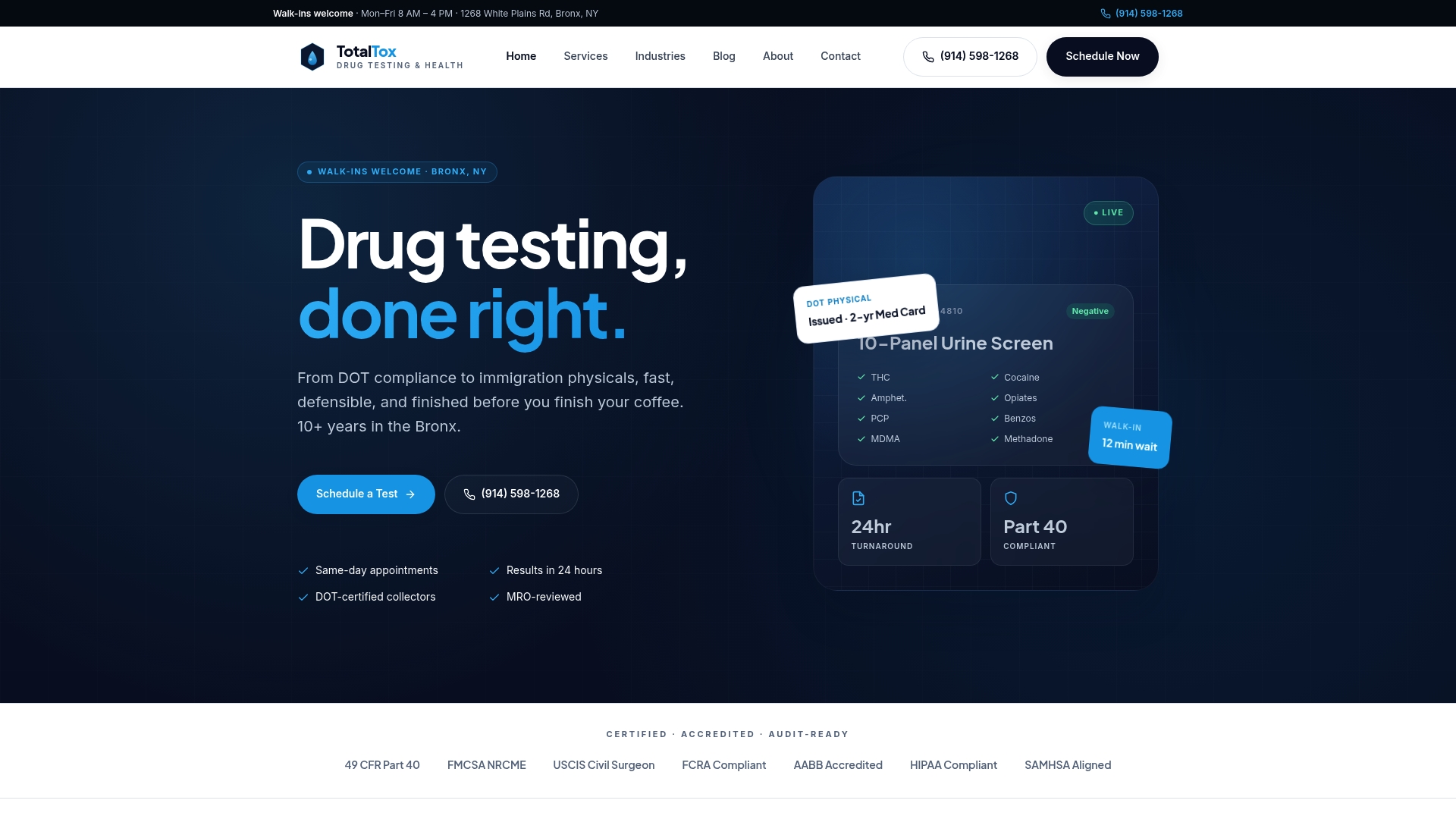
That speed matters when an LCA’s clock is running: a delayed test result means a delayed enforcement decision, and every day of delay is a day an arbitrator can later question. Total Tox handles urine, saliva, and hair follicle collection for DOT and non-DOT cases alike, so whether the agreement calls for random testing or a single confirmatory check, the documentation trail is ready before you need it. Visit the Total Tox services page to schedule a walk-in appointment or set up an ongoing testing arrangement tied to your company’s LCA program.
This article is general information, not a substitute for advice from a qualified lawyer. Consult a qualified legal professional about your own circumstances before acting on anything here.
Sources
- Last-chance Agreements: Expert Insights from Labor Arbitrators
- EEOC guidance: Applying performance and conduct standards to employees with disabilities
- DOT Rule 49 CFR Part 40 Section 40.305
FAQ
Are Last Chance Agreements Legal?
Yes. Employers can legally offer an LCA, but the EEOC requires that it not replace individualized ADA accommodation analysis. For DOT-regulated roles, the agreement also can’t override the required SAP and return-to-duty testing process.
How Do You Challenge or Get Out of a Last Chance Agreement?
Challenges usually focus on whether the terms were vague, whether the employee had a real chance to respond before a breach was declared, or whether the employer enforced similar violations inconsistently in the past. A union rep or employment attorney can review whether the agreement conflicts with ADA, ADEA, or DOT rules, which can undermine its enforceability.
How Long Does a Last Chance Agreement Last?
Duration varies by employer and situation, but most LCAs run somewhere between six months and two years, with a defined expiration date written into the terms. Arbitrators tend to view indefinite agreements with skepticism, since an open-ended term makes it harder to prove the employee actually completed the conditions.
Is Severance Legally Required When an LCA Ends in Termination?
No federal law requires severance pay in the United States, with or without a last-chance agreement in place. Severance is typically a matter of company policy, individual negotiation, or collective bargaining agreement terms, not a legal entitlement tied to how the termination occurred.