
You need a legal paternity test, not a home kit, whenever results will touch child support, custody, immigration paperwork, or a birth certificate change. Courts and agencies require witnessed collection and verified chain of custody. A drugstore or mail-order kit almost never qualifies, no matter how accurate the lab is. The next step is simple: schedule identity-verified collection at an accredited testing site, or follow whatever instructions the court or agency already sent you.
TL;DR:
- Court-admissible paternity tests require witnessed collection, signed chain-of-custody forms, verification of ID, and lab accreditation, not home kits.
- The typical cost ranges from $300 to $800, with expedited services and additional legal documentation increasing the price.
- Accredited clinics with same-day, identity-verified collection minimize the risk of a case being dismissed due to procedural gaps.
- Special situations like immigration, prenatal testing, or disputed paternity require tailored procedures, often with court or agency involvement.
- Confirming provider accreditation and documentation procedures before testing ensures results will be legally valid and court-ready.
Table of Contents
- What Makes a Legal Paternity Test Court-Admissible?
- How Do You Get a Court-Admissible Paternity Test?
- What Does a Legal Paternity Test Cost, and How Long Does It Take?
- Special Situations: Court Orders, Immigration, Prenatal, and Contested Cases
- How Do You Choose a Legal Paternity Testing Provider?
- Why In-Clinic Collection Matters for Legal Cases
- Getting a Court-Ready Paternity Test in the Bronx
- Where to Verify Paternity Testing Rules and Costs
- Sources
- FAQ
What Makes a Legal Paternity Test Court-Admissible?
The lab science behind a $30 mail-order kit and a court-admissible test is identical. What separates them is documentation. A Labcorp explainer on parental and legal DNA testing puts it plainly: courts reject at-home results mainly because nobody can prove whose cheek the swab actually touched.
Chain of custody is the paper trail that closes that gap. It starts the moment a collector, not the test subject, handles the swabs and ends when the lab logs intake. Each step gets a signature and a timestamp.
- Identity verification: government-issued photo ID checked against the person being swabbed.
- Witnessed collection: a neutral collector, not a parent or attorney, watches the swab happen.
- Sealed transport: samples go into tamper-evident packaging with a signed custody form attached.
- Lab intake logging: the laboratory records exactly when and from whom the sample arrived.
Accreditation matters just as much. Illinois Legal Aid Online states that paternity tests submitted for court purposes must come from an accredited laboratory and be interpreted by a qualified expert. Some Illinois courts require a probability of paternity at 99.9% or higher before the result carries legal weight in a contested case.
A court-ready report typically includes the probability of paternity, the lab’s accreditation number, examiner signatures, and a notarized copy if the court requests one. If the case goes to a hearing, the lab may need to provide an affidavit or send someone to testify about how the test was run.
Pro Tip: Ask any provider, before you pay, whether their reports include a signed chain-of-custody form as standard. If they hesitate or call it optional, that is a red flag.
How Do You Get a Court-Admissible Paternity Test?
Getting a legal paternity test right means following a specific sequence. Skip a step and a judge can throw out the result entirely.
- Request a legal or court-admissible kit specifically. Say those exact words when you call. Standard consumer kits and legal kits often ship from the same lab but include different paperwork.
- Confirm the collection location. Legal collections happen at an approved clinic, doctor’s office, or authorized collection site, never at home, since a third party has to witness the swab.
- Bring photo ID and any court paperwork. The collector checks ID against the person being tested and records it on the chain-of-custody form.
- Complete the witnessed collection. A trained collector swabs the inside of each cheek, seals the samples, and has everyone present sign the form before the samples leave the room.
- Wait for lab analysis. The lab compares genetic markers between the child and alleged father and calculates a paternity index, the statistical basis for the final probability of paternity.
- Receive the report. Results go to whoever ordered the test, either you directly or the court or agency that requested it.
- File with the court if ordered. If a judge ordered the test, the report typically goes straight to the court file, and your attorney or the agency handling the case will guide the next legal step, such as a paternity acknowledgment or a custody or support order.
What Does a Legal Paternity Test Cost, and How Long Does It Take?
A 2025 cost survey puts typical U.S. legal paternity test pricing between $300 and $800, with most families paying $400 to $500 for a standard one-child, one-alleged-father case. Standard processing runs 2 to 5 business days once the lab receives samples.
| Cost factor | Typical impact |
|---|---|
| Standard vs. expedited processing | Rush service adds a separate fee on top of the base test |
| Notarized hard copy | Extra charge, often requested for court filing |
| Expert witness testimony | Billed separately if a case goes to a hearing |
| Additional alleged father or child | Each additional tested person adds to the base cost |
| Prenatal or post-mortem testing | Specialized collection and lab handling raise the price |
A few things push the price up or down:
- Whether collection happens through a clinic versus a private physician’s office.
- The lab’s accreditation level and whether it offers in-house expert testimony.
- How many people need testing, since a mother, child, and two possible fathers cost more than a single alleged father case.
Who pays depends on how the test got ordered. If you request it voluntarily, you cover the cost out of pocket. If a court or a state IV-D child support agency orders it, federal rules under 45 CFR § 303.5 require the agency to use a competitively procured, accredited lab, and the agency can bill the noncustodial parent for the fee once paternity is established. Courts sometimes split costs between both parties, particularly when paternity is confirmed.
Special Situations: Court Orders, Immigration, Prenatal, and Contested Cases
Not every paternity case is straightforward, and the standard process bends for a handful of common scenarios.
- Court-ordered testing: A judge or IV-D child support agency schedules the collection, and the agency’s accredited lab list, required under 45 CFR § 303.5, determines which providers qualify.
- Immigration cases: USCIS or a consular office may request a legal paternity test to establish a biological relationship for a visa or citizenship claim, and they typically want the same notarized, chain-of-custody documentation courts require.
- Prenatal testing: Non-invasive blood-based paternity tests can determine parentage before birth without the risks tied to invasive procedures like amniocentesis, though they generally cost more than a standard postnatal test.
- Deceased or unavailable alleged father: Grandparent or sibling DNA testing can establish probable paternity, but accuracy runs lower than a direct father-child comparison, so labs often recommend testing multiple relatives.
- Refusal or disputes: If someone refuses to test, courts can compel it, and repeated refusal can lead to a legal presumption of paternity or even contempt proceedings, a point echoed in Florida’s paternity statute, which lays out how probability thresholds create rebuttable presumptions.
How Do You Choose a Legal Paternity Testing Provider?
A cheap price with no documentation is worse than no test at all. Here’s what to check before you book anything.
- Confirm accreditation. Ask directly which accrediting body certifies the lab and whether that certification covers legal paternity testing specifically.
- Ask who collects the sample. It should be a trained, neutral third party, never a parent, friend, or the tested individual.
- Verify the chain-of-custody process. Get a straight answer on how samples are sealed, transported, and logged at intake.
- Ask about turnaround and rush options. Standard processing runs a few business days; find out the added cost for expedited results.
- Confirm notarization and testimony availability. If your case might reach a courtroom, ask whether the lab provides notarized copies and expert witnesses.
- Get pricing in writing. A provider that won’t quote a clear price before collection is a warning sign.
Red flags worth walking away from: no documented chain-of-custody process, vague or unverifiable accreditation claims, and pricing that seems too low for a test claiming full court admissibility. Once testing is done, keep every original document, receipts, signed forms, and the lab report, since courts and agencies frequently request originals rather than copies.
Pro Tip: If your case involves a support or custody dispute, ask your attorney whether the test needs to be ordered directly by the court. A voluntary test you paid for yourself sometimes still needs to be re-run under court order to count as evidence.
Why In-Clinic Collection Matters for Legal Cases
Documentation wins or loses a paternity case long before a judge reads the report. A test can be scientifically flawless and still get tossed out if the chain of custody has a gap.
That is the practical case for walk-in, identity-verified collection. Same-day appointments and MRO-reviewed results mean less time between the court order and a usable report, and a bilingual, ADA-accessible clinic removes barriers that otherwise slow a legal timeline down for people who need results fast.
— Total Tox
Getting a Court-Ready Paternity Test in the Bronx
A local provider handles DNA & paternity testing with an identity-verified, chain-of-custody process similar to that used for DOT and workplace testing programs. That means witnessed collection, reviewed results, and audit-ready paperwork designed to hold up whether a court, a custody attorney, or an immigration office is asking for it.
Bring a government-issued photo ID and any court or agency paperwork tied to your case. The provider operates on a walk-in, same-day model, so there’s no lengthy intake process standing between you and a scheduled collection. Same-day scheduling keeps things moving when a court deadline is close.
If you already have a court order or a child support agency letter, bring it to your appointment so staff can document the request correctly from the start. Check the services page for what to expect during collection, or reach out through the contact page to set up a visit and confirm documentation requirements before you come in.
Where to Verify Paternity Testing Rules and Costs
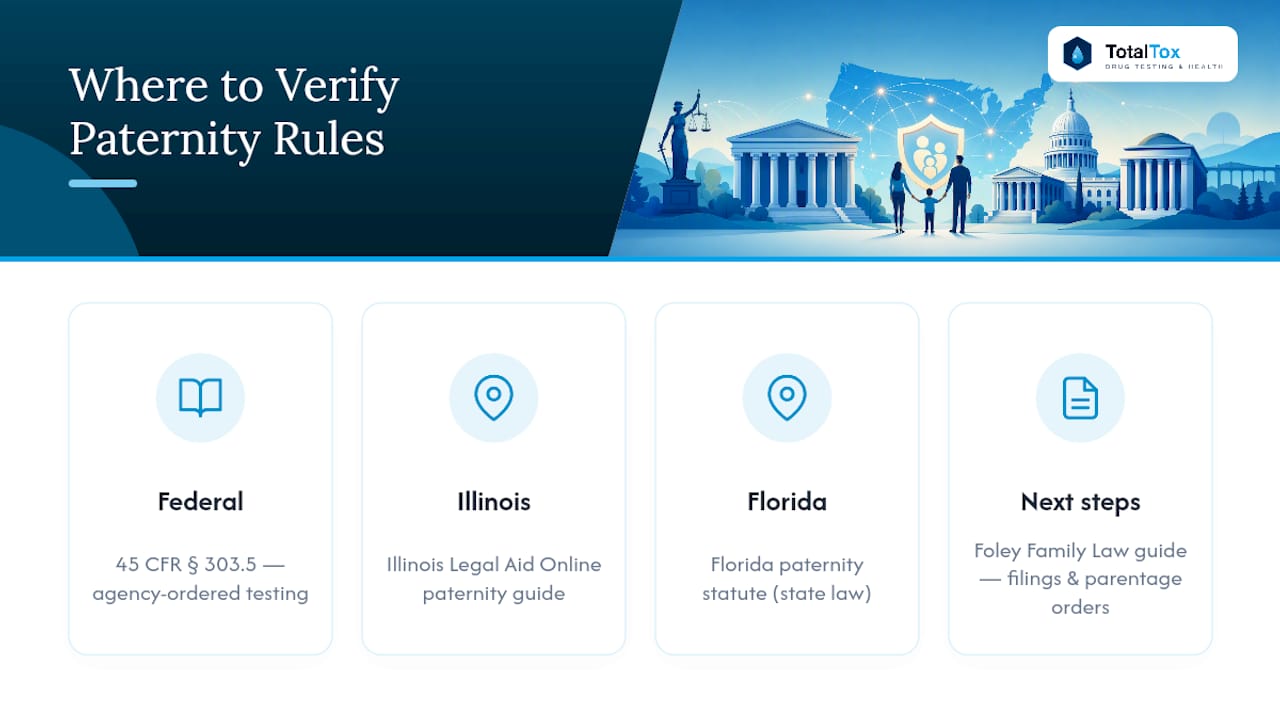
For federal rules on agency-ordered testing, read 45 CFR § 303.5. Illinois residents can check Illinois Legal Aid Online’s paternity test guide, while Florida readers should review Florida’s paternity statute. For next legal steps after results, Foley Family Law’s paternity guide walks through court filings and parentage orders.
This article is general information, not a substitute for advice from a qualified lawyer. Consult a qualified legal professional about your own circumstances before acting on anything here.
Sources
- 45 CFR § 303.5 — Establishment of paternity
- What is a paternity test? | Illinois Legal Aid Online
- DNA paternity test: Procedure, accuracy & results — Cleveland Clinic
- At-Home Parental and Legal DNA Testing | Labcorp DNA
FAQ
What Is the Difference Between a Legal and a Home Paternity Test?
Both use the same DNA analysis, but a legal test adds witnessed collection, photo ID verification, and a signed chain-of-custody form. A Labcorp explainer notes that courts reject home kit results specifically because that documentation is missing, not because the science is less accurate.
How Much Does a Legal Paternity Test Cost?
Legal paternity tests in the U.S. typically run $300 to $800, with most one-child, one-father cases landing around $400 to $500. Rush processing, notarized copies, and expert testimony each add separate fees on top of that base price.
How Can Someone Legally Establish Paternity?
You can request voluntary acknowledgment, ask a court to order testing, or go through a state child support agency if support or custody is at stake. Once a test confirms paternity, results typically get filed with the court, and next steps like a paternity order or updated birth certificate follow the process described by Foley Family Law.
How Accurate Are Court-Ordered DNA Paternity Tests?
Court-ordered tests analyzing enough genetic markers can produce a probability of paternity well above 99%, and some states, per Illinois Legal Aid Online, require 99.9% or higher before results carry a legal presumption. The Cleveland Clinic notes buccal swab based testing is highly reliable when samples are properly collected and documented.