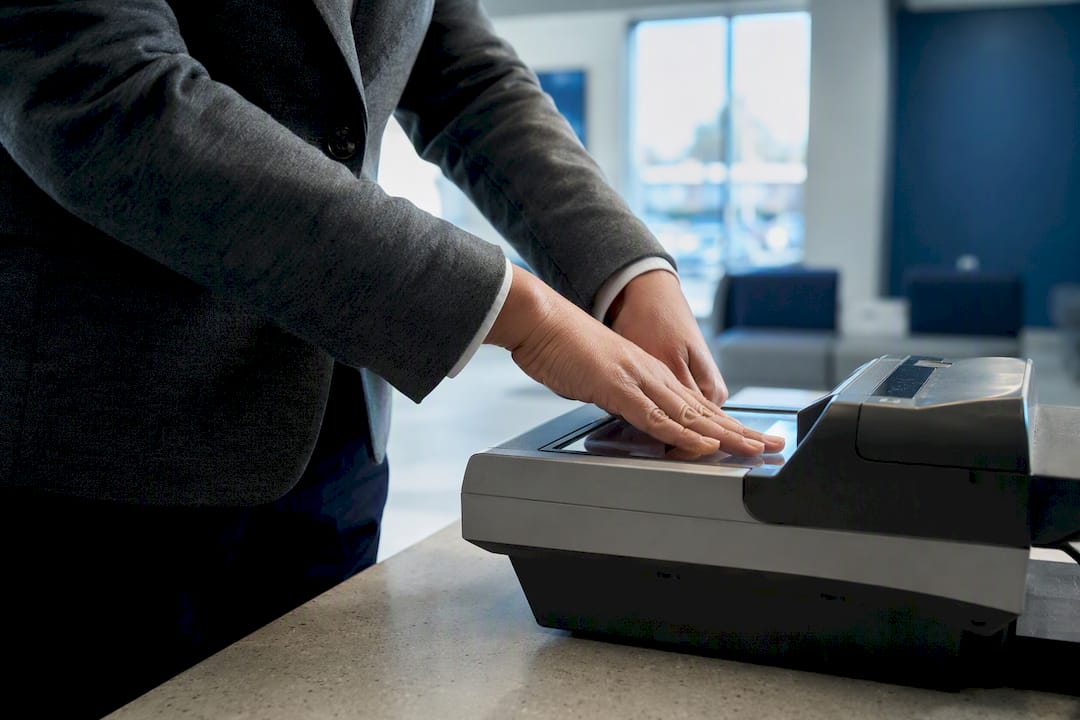
An ORI, or Originating Agency Identifier, is a nine-character code that tells the fingerprint system exactly which agency should receive your results. The single most important thing to do with it: use the exact ORI your requesting agency gives you. Never guess, and never pull one off a random search result — a wrong code sends your fingerprint results to the wrong place and can stall your background check for weeks.
The FBI’s CJIS Division assigns and manages ORIs, and state repositories like Florida’s FDLE maintain their own registries for verification. Total Tox, which processes fingerprint submissions for employers and individuals across the Bronx, sees the same pattern repeatedly: applicants who show up without a confirmed ORI are the ones who get turned around.
- Your ORI comes from the agency requesting the background check, not from a Live Scan provider or a Google search.
- The code is always nine characters, often starting with a state prefix.
- Contacting the requesting agency directly resolves missing or unclear ORI questions faster than anything else.
Quick fact: An ORI is a nine-character identifier that gives agencies the correct level of access to CJIS systems and NCIC transactions — it is not something an applicant creates or chooses.
Key Takeaways
Using the exact ORI your requesting agency provides, and confirming the OCA and service code in writing before your appointment, is the single most reliable way to avoid a rejected Live Scan submission.
| Point | Details |
|---|---|
| ORI defines routing | The ORI tells the fingerprint system which agency receives your results; a wrong code sends results elsewhere. |
| Never guess the ORI | Get it directly from the requesting agency’s paperwork, website, or a written email confirmation. |
| ORI, OCA, and service code differ | The ORI names the agency, the OCA tracks the case internally, and the service code explains why you’re being fingerprinted. |
| Validate before you go | Copy the ORI exactly and confirm it against your state’s registered Live Scan submitter list when available. |
| Total Tox verifies paperwork on-site | Staff at Total Tox’s Bronx locations check ORI and service codes before submission to reduce rejected Live Scan prints. |
Table of Contents
- What does an ORI number actually mean?
- How does an ORI fit into a Live Scan submission?
- How do you find the correct ORI for your submission?
- What should you bring to your Live Scan appointment?
- What do you do if your ORI was wrong or the submission got rejected?
- How Total Tox helps prevent rejected Live Scan submissions
- The one habit that prevents almost every Live Scan delay
- Get Your Live Scan Fingerprinting Done Right the First Time
- Sources
What does an ORI number actually mean?
An ORI identifies the specific agency authorized to receive your fingerprint-based background check results. It is not a personal ID, a case number, or something tied to you as an applicant. It belongs to the agency, board, or employer requesting the check, and it tells the fingerprint system exactly where those results should land.
The format is always nine characters, typically a two-letter state code followed by seven digits or letters (for example, an Illinois state police entry might look like IL0010200). Every ORI is assigned and vetted by the FBI CJIS Division or a state’s own CJIS/DOJ authority, and it comes with a defined access level. Law enforcement agencies get one tier of access; licensing boards, employers, and other non-law-enforcement requesters get a different, more restricted tier.
- ORIs support specific lookup transactions (agencies use codes like QO and ZO to pull up agency contact and translation records).
- An agency needs a valid ORI just to order fingerprint cards and supplies from the FBI.
- Not every requester already has one. New licensing programs or newly formed agencies sometimes have to apply for an ORI before they can process any fingerprint submissions at all.
Key point: the ORI is proof of authorization. It exists so that criminal history information only flows to agencies the FBI and state repositories have actually cleared to receive it.
How does an ORI fit into a Live Scan submission?
When you sit down at a Live Scan machine, the technician enters more than just your fingerprints. They transmit the ORI, your biographic information, and usually an OCA (Originating Case Agency number) and a service or purpose code, all bundled together and routed as one package.
These three pieces do different jobs. The ORI names the receiving agency. The OCA is the agency’s own internal tracking number for your file. The service code explains why the prints were taken (employment, licensing, immigration, and so on). Miss one, and the whole submission can get rejected.
- The Live Scan operator keys in the ORI, OCA (if provided), and service code exactly as written on your paperwork.
- The system transmits your prints along with those codes to the state repository, which forwards them based on the ORI.
- Results route back to the agency tied to that ORI, not to you or the Live Scan location.
Some states add another layer. California, for instance, generally requires applicants to bring a completed Request for Live Scan Service form in addition to knowing the ORI, since the form carries all three codes in one place.
Pro Tip: If your paperwork only lists an ORI with no OCA or service code, don’t assume it’s optional. Call the requesting agency before your appointment and ask whether those fields apply to your case.
How do you find the correct ORI for your submission?
Start with the paperwork you already have. Most requesting agencies hand you the ORI as part of the application packet, an offer letter, or licensing instructions, so check there before doing anything else.
- Check your application packet or instruction sheet first. Licensing boards, employers, and immigration attorneys almost always print the ORI directly on the forms they give you.
- Visit the licensing board or agency’s official website. Many publish their ORI on the same page as their fingerprinting instructions.
- Ask your employer’s HR department. If a job offer requires fingerprinting, HR typically has the exact ORI on file.
- Search your state’s registered Live Scan resources. Florida’s FDLE, for example, maintains a current list of registered Live Scan submitters where you can validate a complete ORI and see its associated fee.
- Call or email the requesting agency directly if you still can’t find it. Ask them to send the ORI in writing so you have a record.
If the agency tells you it doesn’t have an ORI yet, be patient. Getting a new ORI issued can take several weeks, so build that lead time into any licensing or hiring deadline.
Before you show up for your appointment, run through a short validation checklist:
- Copy the ORI character for character. Do not round, abbreviate, or guess a digit you’re unsure about.
- Confirm the service or purpose code matches what’s printed on your instruction sheet.
- Keep a copy of your provider receipt after the appointment. It’s your proof of submission if anything needs tracing later.
What should you bring to your Live Scan appointment?
Bring the instruction sheet or letter that lists your ORI, a government-issued photo ID, and, if your state requires it, a completed Request for Live Scan Service form. If the requesting agency gave you an OCA or case number, bring that too. Missing any one of these is the most common reason applicants get sent home to reschedule.
Once you’re at the counter, have the technician confirm a few things out loud before you sit for prints:
- The ORI matches your paperwork exactly, character by character.
- The service or purpose code lines up with why you’re being fingerprinted (employment, licensing, immigration, etc.).
- Your applicant type is correct, since some codes differ between employees, volunteers, and license applicants.
The most common errors that trigger a re-submission are a mistyped ORI, a missing OCA, and a service code that doesn’t match the requester’s expectations. Florida’s own Live Scan guidance is blunt about the stakes: failing to provide the correct ORI means the requesting department never receives your results at all.
Pro Tip: Take a photo of your completed intake form before you leave the Live Scan location. If a submission gets flagged later, you’ll have proof of exactly what codes were entered.

If a submission does fail, keep every receipt the provider gives you. You’ll need it to open a dispute with either the Live Scan vendor or the requesting agency.
What do you do if your ORI was wrong or the submission got rejected?
A rejected submission usually shows up one of two ways: your Live Scan provider tells you the transmission failed, or the requesting agency contacts you saying they never received anything. Either way, don’t resubmit blindly.
- Contact the requesting agency first and confirm the exact ORI, OCA, and service code in writing, ideally by email so you have a record.
- Bring that written confirmation back to your Live Scan provider and request a corrected re-submission.
- Ask the provider whether a re-submission fee applies. Some charge a reduced rate for correcting their own data-entry error; others charge full price if the original codes you supplied were wrong.
- Give the corrected submission a few business days to process before following up again.
Pro Tip: If the requesting agency and the Live Scan provider each blame the other for the error, ask the agency to escalate directly to their state repository or CJIS support contact. That’s usually faster than going back and forth yourself.
How Total Tox helps prevent rejected Live Scan submissions
Fingerprint rejections almost always trace back to a paperwork gap, not a fingerprint quality issue. Total Tox’s Bronx location handles walk-in Live Scan fingerprinting alongside DOT compliance testing and immigration physicals, and staff review the ORI, OCA, and service code on your paperwork before you’re ever seated at the scanner.
- Walk-in appointments with same-day processing, so a paperwork correction doesn’t cost you a week of waiting.
- Staff verification of ORI and service codes against your instruction sheet before submission.
- Audit-ready documentation and receipts for every fingerprint transaction, useful if an agency ever needs proof of submission.
Quick fact: Total Tox has run fingerprint, drug, and physical testing services in the Bronx for many years, processing numerous tests annually with a consistent focus on catching paperwork errors before they become rejections.
The one habit that prevents almost every Live Scan delay
Most guidance on ORI numbers focuses on definitions when applicants actually need a behavior change: stop treating the ORI like something you look up and start treating it like something you confirm in writing. The agencies that publish clean, obvious ORI instructions (Florida’s FDLE among them) are the exception, not the rule. Plenty of licensing boards and employers hand out incomplete packets, and applicants fill the gaps with guesswork.
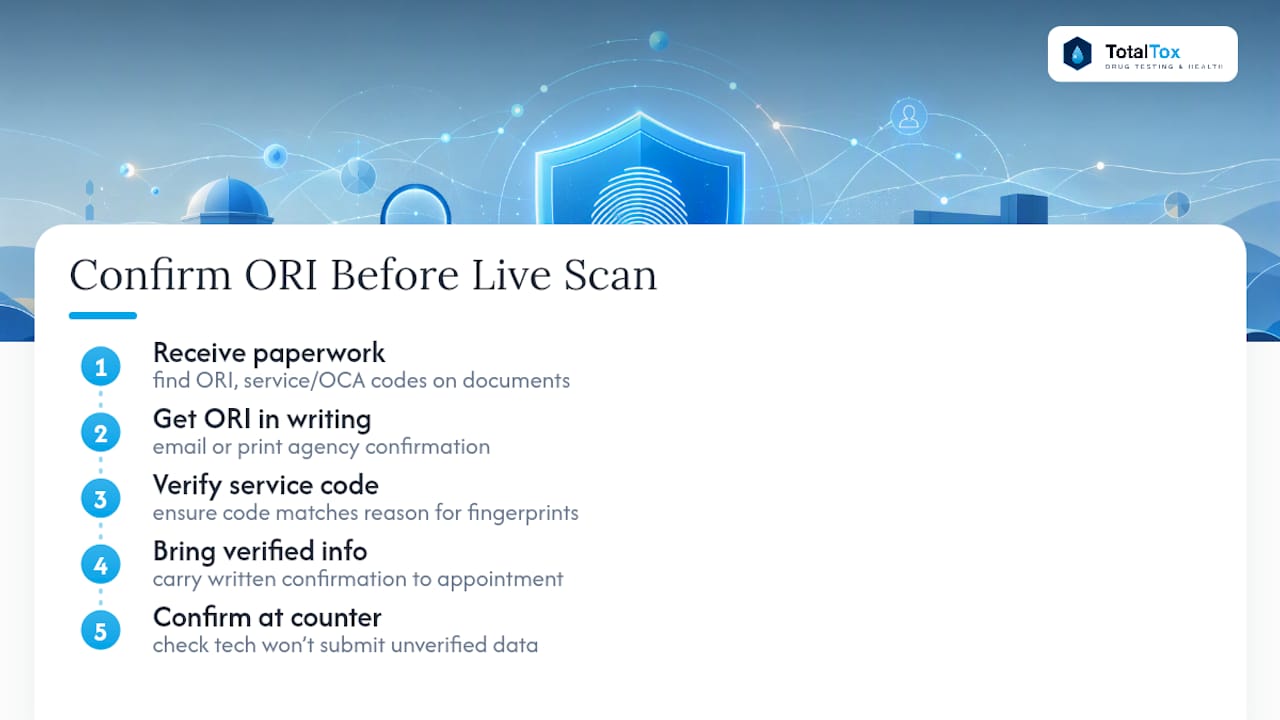
That’s the real failure point. Not the fingerprint quality, not the Live Scan machine, but a code copied wrong or an OCA nobody mentioned. The conventional advice, “get your ORI before your appointment,” is correct but incomplete. It should read: get your ORI in writing, confirm the service code matches your reason for fingerprinting, and don’t let a Live Scan technician submit anything you haven’t personally verified against your own paperwork.
If you take one thing from this article, make it that habit. It costs you two extra minutes at the counter and saves you a multi-week resubmission cycle.
— Total Tox
Get Your Live Scan Fingerprinting Done Right the First Time
Total Tox is the Bronx option for applicants who want their Live Scan handled without the guesswork that leads to rejected submissions. Unlike mailing prints to a distant processing center or hoping a self-service kiosk catches your paperwork errors, Total Tox has staff on-site who check your ORI, OCA, and service code against your instruction sheet before you ever sit down at the scanner.
Same-day walk-in appointments mean a paperwork correction doesn’t turn into a lost week, and every submission comes with audit-ready documentation you can hand to an employer, licensing board, or immigration attorney if questions come up later. Total Tox also handles the DOT physicals, drug testing, and immigration exams that often accompany a background check, so one visit can cover several requirements at once.
Bring your paperwork and confirmed ORI to a Total Tox location, or check current Live Scan and fingerprinting services to see what to prepare before you walk in.
Sources
- WHERE DO I GET THE ORI NUMBER TO SUBMIT TO THE LIVESCAN VENDOR/PROVIDER? - FL HealthSource
- ORI File
- Ordering fingerprint cards and training aids — FBI