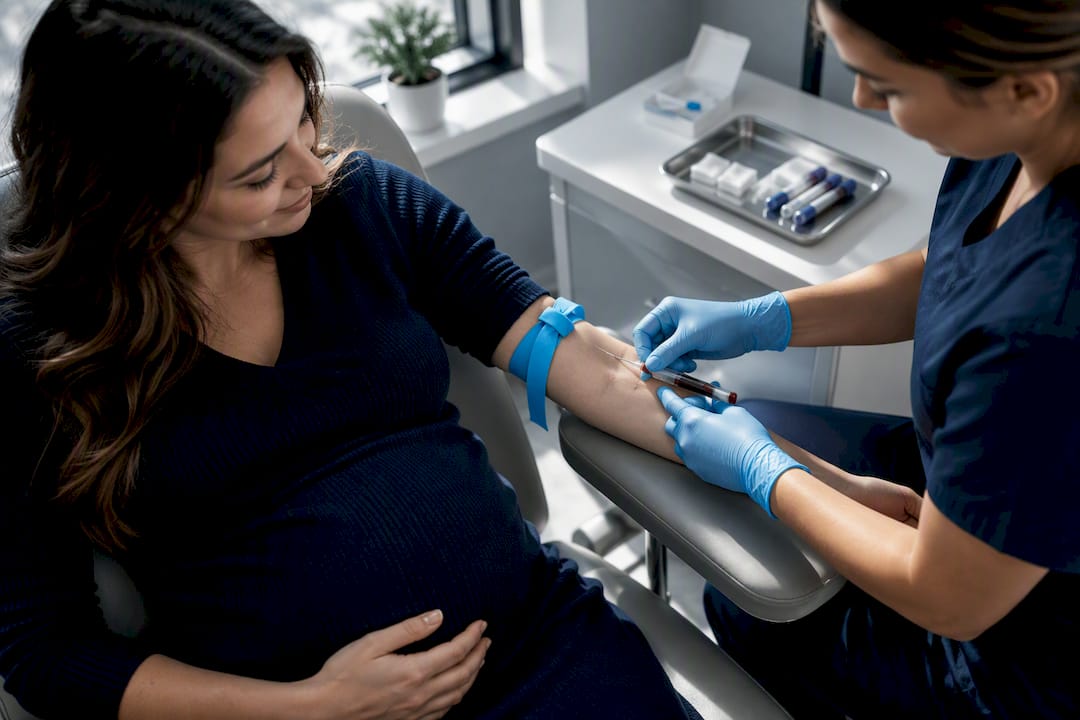
A postnatal paternity test uses a painless cheek swab, and when collected under a witnessed chain of custody at an AABB-accredited lab, it can produce results that hold up in court or immigration proceedings. Walk-in clinics can typically collect samples the same day. The difference between a private answer and one a judge or immigration officer will accept comes down entirely to how the sample was gathered, not which lab runs the DNA panel.
TL;DR:
- Legal paternity results require collection under witness supervision, ID verification, and documentation at an AABB-accredited lab for court or immigration use.
- Walk-in clinics using legal collection methods typically deliver results within about one week, with the probability of paternity usually reported at 99% or higher for a positive match.
- At-home kits are unsuitable for legal purposes because they lack the chain-of-custody process, making their results inadmissible in court or government proceedings.
- Prenatal non-invasive testing can provide early paternity answers with high accuracy after eight to nine weeks of pregnancy, but inconclusive results are possible if fetal DNA levels are too low.
- Invasive prenatal procedures carry higher risks and are usually reserved for medical reasons, while non-invasive blood tests are safer, more convenient, and sufficient for most paternity cases during pregnancy.
Table of Contents
- How Buccal-Swab Postnatal Testing Works and Why It’s Accurate
- Legal vs. At-Home Kits: Which One Do You Actually Need?
- Completing a Walk-In Postnatal Legal Collection Step by Step
- Timeline and What Your Lab Results Actually Mean
- What a Legal Paternity Test Costs and Who Pays for It
- Publisher EEAT: What Walk-In Clinics Offer for Legal Testing
- How Prenatal Paternity Testing Works Before Birth
- When During Pregnancy Can This Test Be Done?
- How Accurate Is This Testing, and Where Does It Fall Short?
- Weighing Non-Invasive Testing Against Invasive Prenatal Procedures
- Practical Perspective: Avoidable Errors That Cause Retesting
- Get a Walk-In Legal Paternity Test Without the Guesswork
- Sources
- FAQ
How Buccal-Swab Postnatal Testing Works and Why It’s Accurate
A buccal swab is a soft brush rubbed against the inside of the cheek for a few seconds. It picks up epithelial cells loaded with nuclear DNA, which is why the method has become the default for relationship testing worldwide. It’s also why nobody needs a needle to answer a paternity question.
Buccal swabs made up the vast majority of all samples collected for relationship testing in 2024, according to AABB’s technical report summary. That dominance reflects both accuracy and practicality.
Labs compare 20 or more genetic markers between the alleged father, the child, and often the mother. A match across those markers produces a probability of paternity, usually expressed as a percentage. The Cleveland Clinic notes that swabbing is painless for newborns and adults alike, with no fasting, needles, or special prep required before a visit.
Legal vs. At-Home Kits: Which One Do You Actually Need?
The DNA science behind a $20 drugstore kit and a court-ordered test is identical. What separates them is everything that happens around the swab, not the swab itself. If a court, USCIS, or a state child support agency will ever see the result, only a supervised legal collection counts.
A test qualifies as legally admissible when it includes:
- Collection performed by a neutral third party, not a parent or relative
- Government-issued photo ID checked and recorded for every adult participant
- A signed chain-of-custody form documenting who handled the sample and when
- Testing performed at an AABB-accredited laboratory, which both USCIS and federal child support agencies require for official use
At-home kits skip every one of those steps. There’s no witness, no ID check, and no sealed chain-of-custody envelope, so the result can’t later be certified as evidence. Courts and immigration officers won’t accept it retroactively either. If you’re deciding between a $60 mail-order kit and a supervised clinic visit, ask yourself first whether anyone outside your household will ever need to see the paperwork. Government agencies, family courts, and USCIS petitions all require the legal version from day one.
Completing a Walk-In Postnatal Legal Collection Step by Step
A same-day legal collection is faster than most people expect, but the order of operations matters. Miss a step and you may have to start over.
- Decide legal or private before you arrive. Legal tests cost more because of the paperwork and witnessed process, but a private test can’t be upgraded later.
- Bring valid photo ID for every adult being tested. A driver’s license, passport, or state ID works; the child does not need ID.
- Complete consent and chain-of-custody forms on-site. Staff will verify identities, sometimes take a photo of participants, and document the process step by step.
- Get swabbed. The collector observes the swab going into each participant’s mouth, seals it in front of you, and labels it immediately.
- Receive your tracking information. You’ll get a receipt confirming the sample was sent to the lab, along with an estimated results date.
Pro Tip: Call ahead and confirm the clinic collects for an AABB-accredited lab specifically for legal or immigration cases. Some walk-in locations only offer private testing, and you don’t want to find that out after your swab is already sealed.
Newborns can be swabbed within days of birth. Collectors typically use a smaller pediatric swab and take extra care with infants, but the process itself doesn’t change.
Timeline and What Your Lab Results Actually Mean
Turnaround depends entirely on which track you chose. A legal chain-of-custody test through a walk-in clinic commonly returns results within about a week of collection, since the lab has to process the sample under stricter documentation controls. A basic at-home kit can take one to two weeks by Cleveland Clinic’s account of typical consumer processing.
When results arrive, the lab issues a technical report with two key figures: a percentage probability of paternity and a Combined Paternity Index (CPI). Here’s what matters once you’re staring at that report:
- A probability at or above the lab’s threshold, often 99% or higher, is reported as an inclusion (he is very likely the biological father).
- A CPI near zero with no matching markers is reported as an exclusion.
- Administrative agencies frequently treat a probability of 95% or greater as legally probative, creating a presumption of paternity in contested cases.
- After receiving results, you can request certified copies for court filings, submit them directly to a child support agency, or use them as part of a USCIS petition packet.
If someone wants to contest the result, they generally have to request a retest through the same legal channel, not by ordering a separate kit elsewhere.
What a Legal Paternity Test Costs and Who Pays for It
Retail pricing for a legal chain-of-custody paternity test at a walk-in clinic typically runs higher than an at-home kit, mainly because of the witnessed collection, ID verification, and certified documentation involved. Exact pricing varies by clinic and by how many participants need testing (mother, alleged father, and child).
In some cases, you won’t pay out of pocket at all:
- State IV-D child support agencies can order and sometimes fund genetic testing in contested cases, particularly when a man denies paternity during a support proceeding.
- Agencies may later recoup testing costs from the alleged father if paternity is confirmed.
- Immigration petitions generally require the petitioner to pay for testing directly at an AABB-accredited lab.
The single biggest way to avoid paying twice is choosing the legal collection track from your very first visit. A private test result can never be converted into court evidence after the fact, which means starting over, and paying again, from scratch.
Publisher EEAT: What Walk-In Clinics Offer for Legal Testing
A clinic built around fast, documented testing removes most of the friction that causes retesting. Total Tox offers walk-in collections with results that are MRO-reviewed and paired with audit-ready paperwork, the same operational discipline it applies to DOT and workplace drug testing.
That structure matters for paternity cases specifically. A collection team that already handles chain-of-custody protocols daily for regulated drug testing is far less likely to skip a step on a paternity swab. Missing ID verification or an incomplete consent form is exactly what forces families back for a second visit, and a clinic’s services page that spells out documentation requirements upfront helps clients arrive prepared the first time.
How Prenatal Paternity Testing Works Before Birth
Some readers researching postnatal options are also weighing whether to test earlier, before the baby arrives. Non-invasive prenatal paternity testing analyzes small fragments of fetal cell-free DNA that circulate in the pregnant mother’s bloodstream alongside her own DNA. A lab draws blood from the mother and a cheek swab or blood sample from the alleged father, then isolates the fetal DNA fragments and compares genetic markers against the father’s profile.
This approach doesn’t require any procedure on the fetus itself. The mother’s blood draw is the only invasive step, and it carries the same minimal risk as any standard blood test. That’s a meaningful distinction from invasive prenatal procedures, which physically sample fluid or tissue from around the developing fetus.
The science depends on there being enough circulating fetal DNA in the maternal blood sample to get a reliable read. Labs need a minimum concentration of fetal DNA fragments, called the fetal fraction, before they can run a confident comparison. Too little fetal DNA in the sample and the lab may need to redraw blood later in the pregnancy.
For families who ultimately need a legally admissible result, most of what applies to postnatal walk-in testing, the witnessed collection, the ID verification, the AABB-accredited lab, still governs how a prenatal result would need to be handled if it’s ever used for legal or immigration purposes.
When During Pregnancy Can This Test Be Done?
Timing depends on hitting a threshold of fetal DNA in the mother’s bloodstream, not a fixed calendar date. Most labs that offer this testing set the earliest collection window around eight to nine weeks into the pregnancy, since that’s typically when fetal DNA fragments reach a testable concentration in maternal blood.
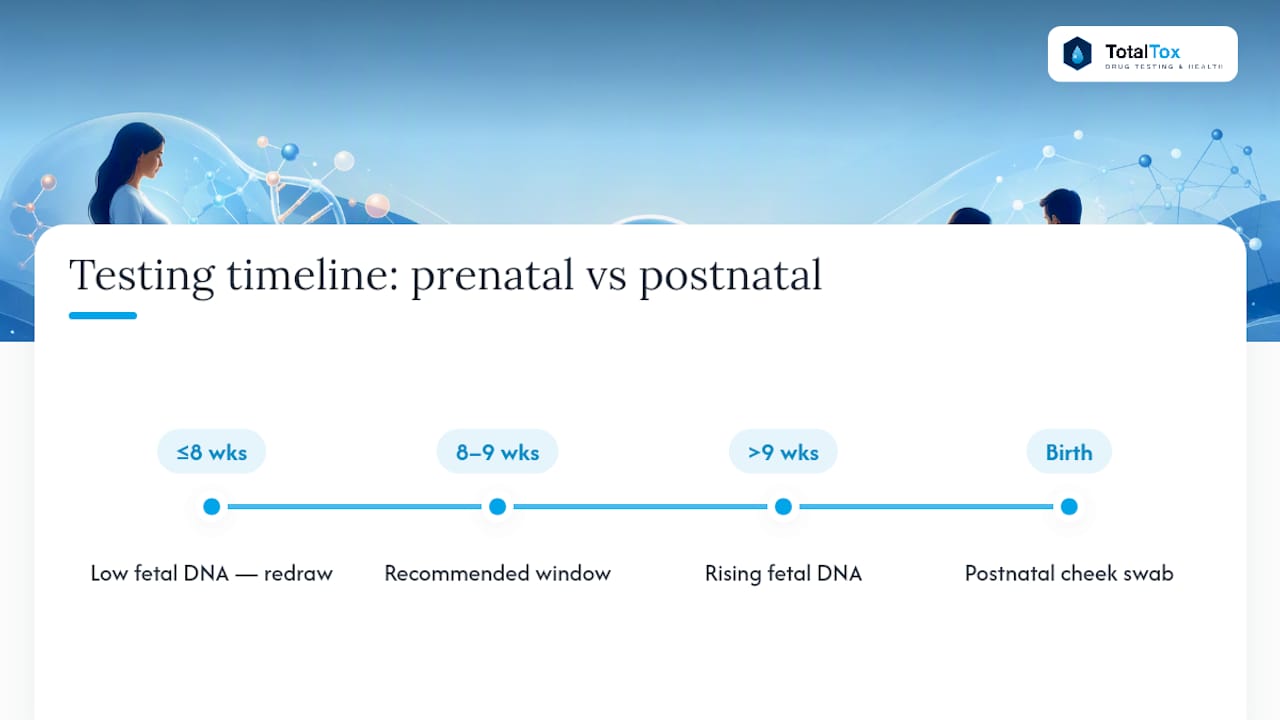
Testing earlier than that window risks an inconclusive result. If the fetal fraction comes back too low, the lab may ask for a second blood draw a few weeks later rather than attempting to force a read from an insufficient sample. That’s a scheduling headache worth avoiding by simply waiting until the recommended window rather than rushing the first draw.
There’s no meaningful upper limit. A pregnant person can pursue this testing at any point later in pregnancy right up through delivery, since fetal DNA concentration only increases as pregnancy progresses. Some people choose to wait until closer to the second trimester specifically because it reduces the odds of needing a redraw.
Compare that to postnatal testing, where timing is a non-issue. A cheek swab can be collected within days of birth with no waiting period tied to biological development. That’s one reason many families default to postnatal testing when there’s no urgent reason to know before delivery: it sidesteps the timing calculation entirely and gets a definitive answer with a single simple swab.
How Accurate Is This Testing, and Where Does It Fall Short?
Modern non-invasive prenatal paternity testing can report a very high probability of paternity or a clear exclusion when the sample quality is strong. The accuracy hinges almost entirely on that fetal fraction number mentioned earlier. When there’s enough fetal DNA circulating in the maternal blood sample, labs can distinguish the fetal genetic markers from the mother’s own DNA with a high degree of confidence.
The limitations show up mostly around sample quality rather than the underlying science. A fetal fraction that’s too low produces an inconclusive result rather than a wrong one, which is a meaningfully different failure mode than getting a false answer. Multiple pregnancies (twins or higher-order) can also complicate the analysis, since separating out multiple sets of fetal DNA fragments from one maternal blood draw is more technically demanding than analyzing a single fetus.
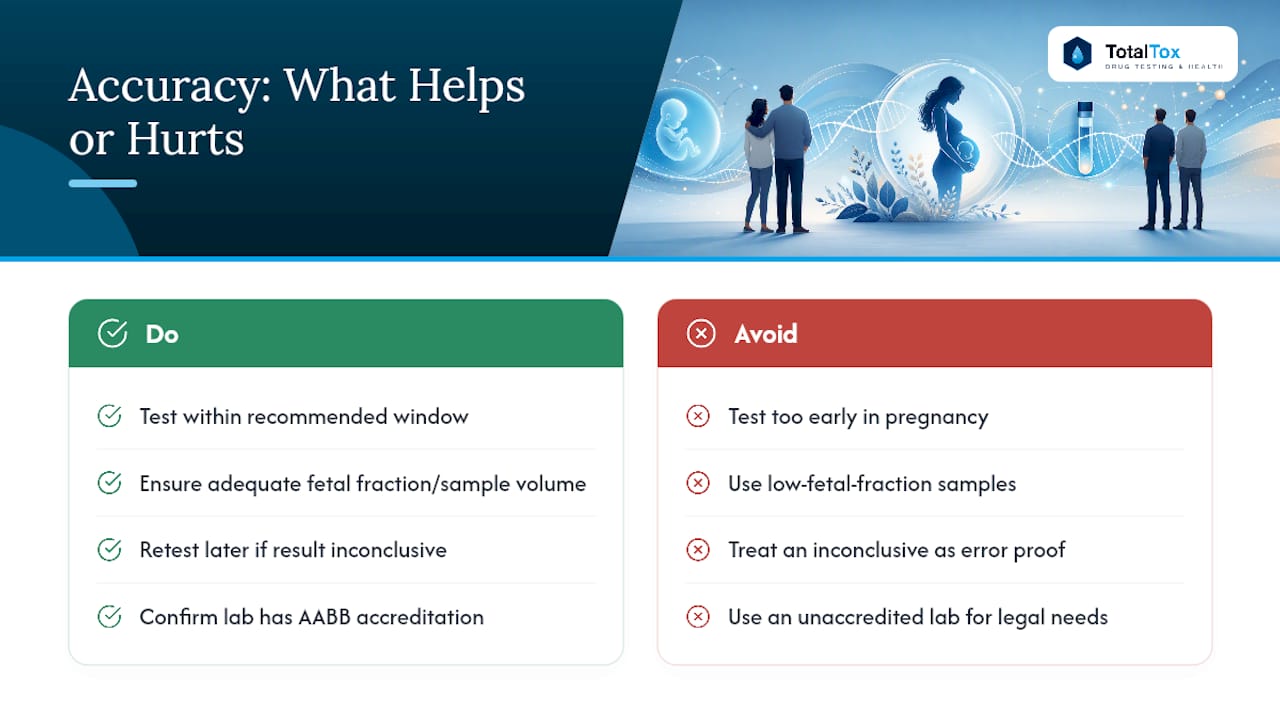
Timing errors compound the accuracy problem. Testing too early, before the recommended window, is the single most common reason for an inconclusive result rather than any flaw in the lab’s methodology. Body mass and certain maternal health factors can also occasionally affect how much fetal DNA shows up in a given blood draw, though labs generally account for this with their minimum threshold requirements.
None of this makes the test unreliable when done at the right time with adequate sample volume. It does mean prospective parents should treat an inconclusive result as a signal to retest later in pregnancy, not as a red flag about the method itself. Anyone who needs a legally admissible answer during pregnancy should also confirm the testing lab holds the same AABB accreditation required for postnatal legal tests, since accreditation standards don’t relax just because the sample came from a blood draw instead of a cheek swab.
Weighing Non-Invasive Testing Against Invasive Prenatal Procedures
The core advantage of blood-based prenatal paternity testing is right in the name: it doesn’t require any physical procedure on the fetus or the amniotic environment. Invasive prenatal testing methods, like amniocentesis or chorionic villus sampling, involve inserting a needle or catheter to collect fluid or tissue directly from around the fetus. Those procedures carry a small but real risk of complications, including infection or, rarely, pregnancy loss.
Non-invasive testing sidesteps all of that risk because the only sample collected is a standard maternal blood draw, the same low-risk process as any routine blood test during pregnancy. That risk profile is the main reason expectant parents lean toward the blood-based option when paternity needs to be resolved before birth rather than waiting for delivery.
The tradeoff is precision under certain conditions. Invasive procedures collect fetal genetic material more directly, which can make them less susceptible to the fetal fraction problem that occasionally forces a redraw with non-invasive testing. Invasive testing also typically happens later in pregnancy and is usually reserved for situations where genetic or chromosomal information is needed for medical reasons, with paternity answered as a secondary benefit rather than the primary purpose.
For most people whose only goal is establishing paternity, and who have no separate medical reason for an invasive procedure, the risk-benefit balance points toward the non-invasive blood draw or, once the baby arrives, a simple postnatal cheek swab. Choosing an invasive method solely to get a paternity answer earlier rarely makes sense when a safer option exists and the wait is only a matter of weeks.
Practical Perspective: Avoidable Errors That Cause Retesting
The costliest mistake we see is starting with an at-home kit when the real goal was always a custody case or an immigration filing. A close second: showing up without ID, thinking a paternity swab is casual. It isn’t. And always ask, before you swab, whether the lab is actually AABB-accredited. Skipping that question is how families end up paying for the same test twice.
— Total Tox
Get a Walk-In Legal Paternity Test Without the Guesswork
Total Tox is the direct alternative to mailing off a kit and hoping the paperwork holds up later: a walk-in visit with MRO-reviewed results and audit-ready documentation built the same way as our DOT and workplace testing.
Bring valid photo ID for every adult being tested and be ready to complete consent and chain-of-custody forms on-site. If your result needs to hold up with a court, a state child support agency, or USCIS, ask specifically for the AABB-accredited legal collection track, not the private option, before you sit down for your swab. Anyone weighing consent or custody questions ahead of a test should also review general guidance on parental rights before their appointment. Check our full testing services to see what a visit involves, or find hours and location details on the Total Tox homepage to schedule your same-day appointment.
Sources
For accreditation standards, see AABB’s technical report. For agency policy, see ACF’s paternity guidance and USCIS’s DNA evidence memo.
This article is general information, not a substitute for advice from a qualified lawyer. Consult a qualified legal professional about your own circumstances before acting on anything here.
- AABB 2024 technical report summary
- Cleveland Clinic — DNA paternity test overview
- Administration for Children & Families — Paternity disestablishment
FAQ
Is a Cheek Swab Enough for a Legal Paternity Test?
Yes, the same buccal swab used in private testing works for legal cases. What makes it admissible isn’t the swab itself, it’s the witnessed collection, ID verification, and chain-of-custody paperwork done alongside it at an AABB-accredited lab.
Can I Use an At-Home Kit Result in Court?
No. At-home kits lack the witnessed collection and documented chain of custody that courts, USCIS, and child support agencies require, so the result can’t be certified as evidence after the fact.
How Much Does a Legal Paternity Test Cost?
Pricing varies by clinic and the number of people tested; current pricing is available directly through Total Tox’s services page. Some costs may be covered by state child support agencies in contested cases.
How Long Does It Take to Get Results?
A legal chain-of-custody test through a walk-in clinic commonly returns results within about a week, while basic at-home kits can take one to two weeks according to the Cleveland Clinic.
What Probability Counts as a Match?
Labs typically report an inclusion when the probability of paternity reaches 99% or higher, while agencies often treat 95% or greater as legally probative in contested administrative cases.