Yes, you can almost always fulfill a fingerprinting requirement from outside the requesting state, either through an approved out-of-state Live Scan submission or a completed FD-258 hard card sent for card-scan conversion. Before you schedule or pay anything, call the requesting agency and get the exact ORI or service code, plus their photo and receipt rules. That one phone call prevents most rejections.
TL;DR:
- Out-of-state fingerprinting options depend on whether the requesting agency accepts Live Scan or hard-card submissions, with vendor recognition varying by state.
- Confirm the exact ORI or service code and specific photo or ID requirements before scheduling to prevent rejection delays.
- Mail-in FD-258 cards require careful handling, tracking, and exact mailing addresses to avoid common processing delays.
- Each state may have unique rules; for example, Indiana uses a card scan program, Illinois demands a certifying statement, and New York restricts out-of-state capture for certain licenses.
- Using local services like Total Tox for walk-in fingerprinting can reduce errors and turnaround times, especially when time is critical for licensing or employment deadlines.
Table of Contents
- How out-of-state fingerprinting works: Live Scan vs. FD-258 hard card
- Verify the requesting agency: questions that prevent a rejected submission
- Step-by-step process for completing fingerprints from another state
- How states handle this differently: Indiana, Florida, Illinois, New York, and Colorado
- Mailing, security, and documentation for FD-258 cards
- Costs, timelines, and how long your receipt stays valid
- What to bring to your fingerprint appointment
- When you can’t do this remotely: PIV badges, NIH, and strict in-state rules
- Getting fingerprinted locally through Total Tox
- [What the state-by-state patchwork actually reveals highlights important teleradiology state licensing: how coverage works · AstraRad considerations that explain why agencies may require in-state fingerprint capture.](#what-the-state-by-state-patchwork-actually-reveals-highlights-important-teleradiology-state-licensing-how-coverage-works-astraradhttpsastraradcomlicensing-considerations-that-explain-why-agencies-may-require-in-state-fingerprint-capture)
- Schedule fingerprinting and compliance services with Total Tox
- Sources
How out-of-state fingerprinting works: Live Scan vs. FD-258 hard card
Two methods dominate interstate verification requirements, and picking the wrong one wastes time and money.
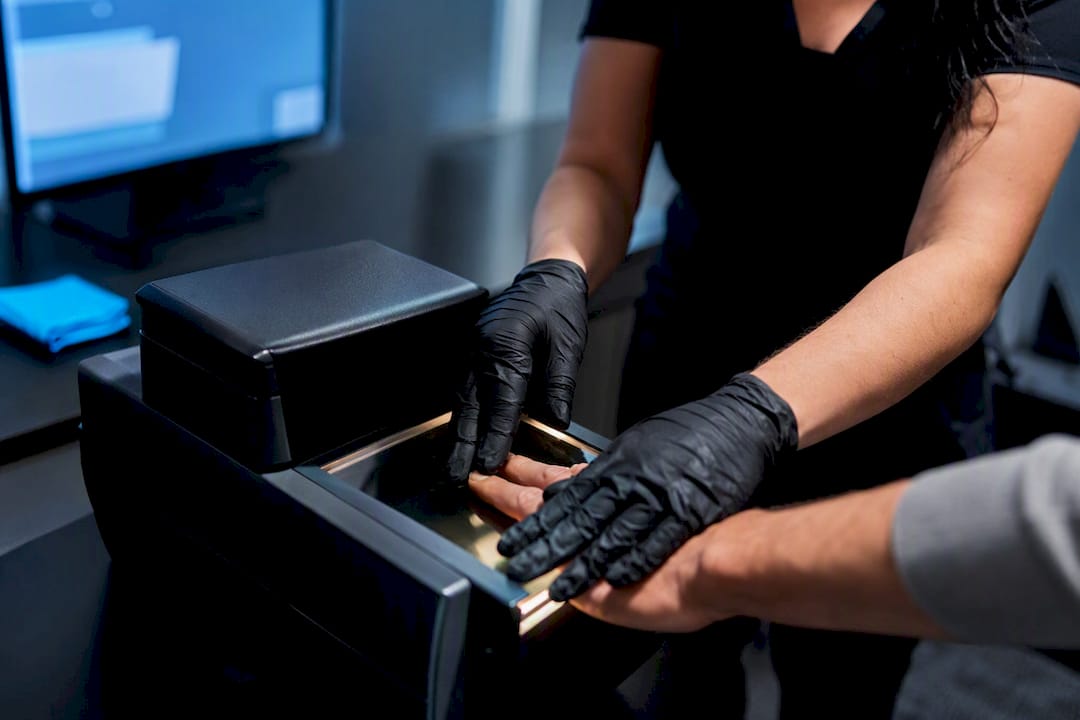
Live Scan is electronic capture. A technician rolls your fingerprints on a glass platen connected to a computer, and the system transmits them digitally to the requesting agency’s designated processing point. This only works when the fingerprinting site is registered as a vendor authorized to submit to the specific state or agency you’re dealing with. Not every Live Scan location can send prints to every state. A fingerprinting business in New York might handle California and Texas submissions but have no relationship with, say, Illinois’ system. That’s why “where to get fingerprinted remotely” isn’t a one-size-fits-all answer. It depends entirely on which agency needs your prints and which vendors that agency recognizes.
FD-258 hard cards are the paper alternative. The FBI designates the FD-258 fingerprint card as the standard applicant format, and it’s captured with ink at a local police department, sheriff’s office, or fingerprinting service. Once inked, the card gets mailed, either directly to the requesting agency or to a designated processing vendor, depending on that agency’s rules.
This is where card-scan conversion comes in. Many states no longer process paper cards manually. Instead, they contract with a vendor who scans the hard card and converts it into an electronic submission compatible with state and FBI systems. Indiana’s State Police, for instance, run exactly this kind of program through IdentoGO’s out-of-state card scan process, which lets someone living in Ohio or Kentucky mail in a card instead of flying to Indianapolis.
What you get back depends on the route:
- Live Scan typically produces an immediate electronic submission and a same-day or next-day confirmation number.
- FD-258 card-scan conversion produces a mailed confirmation or emailed receipt once the vendor processes the card, usually within a few business days of receipt.
- Both routes generate a transaction control number or tracking ID you’ll want to save for your records.
Choosing between them isn’t really a choice at all. It’s dictated by whether your state-specific fingerprinting program has a registered Live Scan vendor near you, or whether it only accepts hard cards through a scanning partner.
Verify the requesting agency: questions that prevent a rejected submission
The single biggest mistake people make with interstate fingerprinting procedures is assuming one state’s process mirrors another’s. It doesn’t. Before you book anything, get the requesting agency on the phone or pull up their applicant instructions page, and confirm these details:
- Which methods do they accept for out-of-state applicants, Live Scan, hard card, or both?
- What’s the exact ORI or service code you need to give the fingerprinting vendor?
- Does a photograph need to accompany the fingerprints? Some clearinghouse-based systems require it, and a plain card-scan conversion can’t satisfy that.
- How long is the receipt or confirmation valid? Some licensing boards have a 60 or 90-day window before your fingerprint clearance expires relative to your application date.
The ORI, or Originating Agency Identifier, tells the FBI and state repository exactly where your results should route. A service code does the same job for private vendors like IdentoGO. Get either one wrong, or leave a required field blank, and the vendor or state will bounce the submission back instead of processing it, according to Indiana’s own card-scan guidance. That means starting over, another appointment, another fee, and a delay that can blow past an application deadline.
Write down who you spoke with, the date, and exactly what they told you. Screenshot the applicant instructions page if it’s online. Licensing boards process thousands of applications and occasionally misplace or mishandle a submission. Your own notes are the fastest way to resolve a dispute without having to re-explain your entire situation from scratch.
Pro Tip: Ask the agency specifically whether they use a “channeler.” The FBI maintains a list of approved channelers like Fieldprint that route fingerprints for background checks, and knowing this up front tells you exactly which vendor network you need to use.
Step-by-step process for completing fingerprints from another state
Here’s the practical sequence, from your first phone call to a confirmed submission.
- Get your ORI or service code directly from the requesting agency, along with confirmation of accepted methods (Live Scan, hard card, or either).
- Register with the vendor. For Live Scan, this usually means an online appointment booking where you enter the service code up front. For hard cards, request a blank FD-258 card if the agency or vendor doesn’t provide one automatically.
- Get captured. Visit a local law enforcement office, a fingerprinting service like Total Tox, or an authorized Live Scan location. The technician rolls all ten fingers, checks for smudging or incomplete ridges, and verifies your personal information matches your ID exactly.
- Submit. Live Scan transmits automatically. For hard cards, mail to the vendor’s processing address, not the licensing board itself, unless the agency specifically instructs otherwise. Texas’s insurance department, for example, explicitly warns applicants not to mail fingerprints to the agency when a card-scan vendor is involved.
- Track it. Save your transaction control number and check the vendor or state portal after a few business days.
- Escalate if needed. If you haven’t heard back within the agency’s stated timeline, call with your tracking number and the notes from your original verification call.
Statistic Callout: Illinois’ fingerprint guide notes that submissions lacking a completed out-of-state identity-verification certifying statement, required for all out-of-state vendor submissions, get rejected outright rather than flagged for correction. Skipping that one form is a common, entirely avoidable delay.
The card-scan model exists precisely to bridge this gap between where you live and where your prints need to end up, but every one of these steps has a failure point if you rush it.
How states handle this differently: Indiana, Florida, Illinois, New York, and Colorado
State-specific fingerprinting rules vary enough that treating any state’s process as the default is a mistake.
- Indiana runs a formal out-of-state card scan program through IdentoGO. You register online, pay a processing fee for the ink card option, and mail your FD-258 to the address the program provides. Indiana State Police and the FBI both process the converted electronic file once it’s scanned.
- Florida accepts both Livescan and hard-card scanning for many out-of-state license fingerprinting cases, but the state’s Clearinghouse program has photo submission requirements that a basic card-scan conversion may not satisfy. Confirm this before choosing the hard-card route for healthcare licensure specifically.
- Illinois requires an identity-verification certifying statement (form OOS-FP) and mandates that out-of-state vendors have genuine “Scan Card” capability to transmit electronically. Manual, unconverted paper submissions are not accepted for many license types.
- New York is the clearest exception to the “you can always do this remotely” rule. The Department of State’s electronic fingerprinting guidance states plainly that certain license applicants must complete capture at a New York site and should not schedule an out-of-state Live Scan appointment for those categories.
- Colorado licensing boards maintain their own approved vendor lists, and instructions differ noticeably from one board to the next, so an applicant renewing a nursing license and one applying for a real estate license may be pointed to entirely different vendors.
The pattern across all five: never assume. Confirm the specific program for the specific license or background check you’re pursuing.
Mailing, security, and documentation for FD-258 cards
A hard card traveling through the mail carries your fingerprints and personal identifiers, so treat it like a sensitive document, not a regular letter.
- Use tracked, insured shipping. A first-class stamp with no tracking number gives you nothing to work with if the card disappears.
- Photocopy or scan the completed card before mailing it, along with any cover sheet or instructions the agency gave you.
- Mail to the exact address given during vendor registration, which is usually the processing vendor, not the licensing board. Sending it to the wrong address is one of the most common causes of delay, according to Texas’s insurance department guidance.
- Include your ORI or service code, full legal name, and a callback phone number directly on or with the card.
Pro Tip: If a card gets returned as undeliverable or rejected for smudging, don’t just re-mail the same one. Call the vendor first, confirm the exact reason, and get a fresh card if there’s any doubt about print quality.
Costs, timelines, and how long your receipt stays valid
Expect two separate charges in most out-of-state background checks: a capture fee (what the fingerprinting site or Live Scan vendor charges to take your prints) and a processing or card-scan conversion fee (what the state or its vendor charges to convert and submit the record). Some agencies also tack on their own processing fee on top of that.
- Live Scan submissions are generally faster, often same-day to 72 hours for a status update, since there’s no physical mail transit involved.
- FD-258 card-scan conversion adds mail time on both ends, plus the vendor’s internal processing window, which commonly runs several business days once the card arrives.
- Receipt validity windows vary by agency. Some licensing boards accept a clearance for 60 to 90 days; others tie it strictly to the date your full application is submitted.
The FBI’s own fingerprint card guidelines stress contacting the requesting agency before submission precisely because generic assumptions about timelines cause the most avoidable delays. Missing a validity window means redoing the entire process, fee included.
What to bring to your fingerprint appointment
Bring a valid, unexpired government-issued photo ID, your ORI or service code written down exactly as the agency provided it, and any agency-specific form (like Illinois’ identity-verification certifying statement) that must accompany the capture.
- The technician fills out the FD-258 with your personal details, then rolls each finger individually plus simultaneous impressions.
- Some out-of-state agencies require a certifying signature from the technician or notary confirming your identity was verified in person.
- Common reprint triggers: smudged ridges, missing a finger impression, mismatched name spelling between the card and your ID, or a missing signature block.
When you can’t do this remotely: PIV badges, NIH, and strict in-state rules
Not every fingerprinting for out-of-state jobs situation allows a remote option. Federal PIV badge programs are a good example. NIH guidance explains that Fieldprint can only be used for prescreening; final badge enrollment still requires an in-person visit to a physical credentialing facility. The remote step doesn’t replace it, it just speeds up what happens before you arrive.
Some state licensing boards, nursing and law enforcement among them, require in-state Live Scan specifically for identity-proofing reasons: they want a state-employed or state-contracted technician physically verifying who sat in the chair. New York’s electronic fingerprinting rules for certain license categories fall into this bucket.
If an agency insists on in-state capture and travel isn’t realistic, ask directly whether any authorized exception or delegated out-of-state vendor exists. Sometimes one does. Often it doesn’t, and rescheduling around a planned trip becomes the only real fix.
Getting fingerprinted locally through Total Tox
If you’re located in or near the Bronx and need fingerprints captured accurately the first time, Total Tox handles walk-in fingerprint capture as part of its broader compliance services lineup. That matters more than it sounds, since a rejected or smudged card means starting the entire mailing and verification cycle over.
- Walk-in fingerprint capture with no long advance booking required.
- Help completing the FD-258 accurately, signatures, certifying fields, and all, before it ever goes in an envelope.
- Expedited handling for people working against a licensing or employment deadline.
- Documentation and audit-ready records for employers who need proof the process was handled correctly.
Applicants juggling immigration paperwork alongside a fingerprinting requirement often find it easier to combine steps in one visit; Total Tox’s guide on the Form I-693 immigration medical exam covers a related process many out-of-state applicants are navigating at the same time.
Choosing a local clinic over a mail-only route cuts out one of the biggest risk points in this entire process: a smudged or incomplete card discovered only after it’s already in the mail.
What the state-by-state patchwork actually reveals highlights important teleradiology state licensing: how coverage works · AstraRad considerations that explain why agencies may require in-state fingerprint capture.
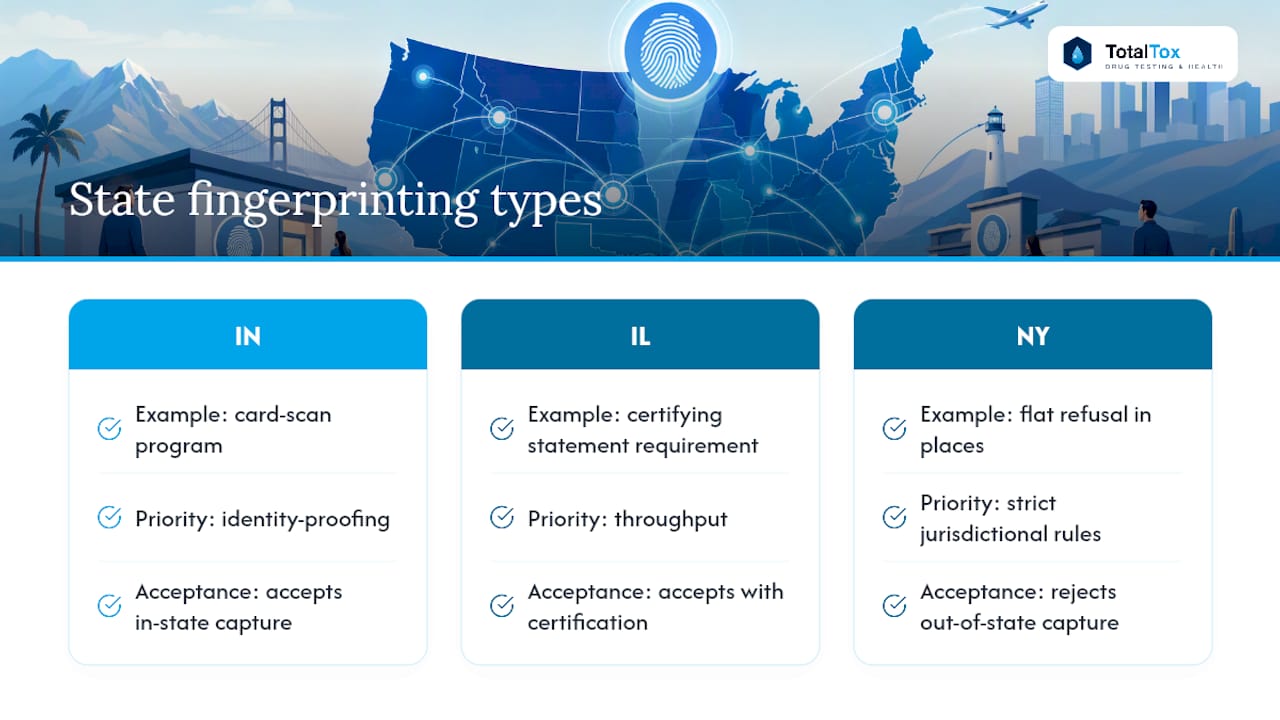
The conventional advice on out-of-state fingerprinting treats it like a single, universal process. It isn’t, and that gap is where most people run into trouble. Indiana’s card-scan program, Illinois’ certifying statement requirement, and New York’s flat refusal to accept out-of-state capture for certain licenses aren’t variations on a theme. They’re genuinely different systems built around different priorities, identity-proofing in one state, throughput in another.
What gets overlooked is that the fingerprint capture itself is rarely the hard part. Getting the right ORI, confirming photo requirements, and mailing to the correct vendor address cause far more delays than any technician’s ink work. That’s a paperwork problem disguised as a logistics problem.
Prioritize the phone call to the requesting agency over everything else. Skipping it to save fifteen minutes is exactly how applicants end up paying twice and missing a licensing deadline they had months to prepare for.
— Total Tox
Schedule fingerprinting and compliance services with Total Tox
Some walk-in services offer an alternative to mailing FD-258 cards and waiting on a card-scan vendor. They provide accurate fingerprint capture done right the first time, with same-day availability and fast turnaround of results.
Whether you’re handling fingerprinting for licensing, employment screening, or pairing it with other compliance needs, some teams are set up to move you through quickly without sacrificing the documentation employers and agencies actually need. These services often come with audit-ready records so there’s no scrambling later if a licensing board or employer asks for proof.
Browse the full list of available compliance services, or go ahead and schedule your appointment directly. Walk-ins are welcome, and most visits take well under an hour from check-in to done.
Sources
- List of FBI‑approved channelers for departmental‑order submissions
- Ordering FBI fingerprint cards and training aids
- Indiana Out of State Card Scan Processing Procedures (IdentoGO fact sheet)
- Background screening out-of-state/international providers — Florida
- Illinois fingerprint background check guide (out-of-state vendor instructions)