
Most standard postnatal paternity tests are reported in about 3 to 5 business days after the lab receives usable samples, according to Cleveland Clinic. Legal and prenatal tests usually take longer because of extra documentation, court scheduling, or slower prenatal lab workflows. Knowing which category your test falls into is the fastest way to set a realistic expectation.
TL;DR:
- Most postnatal paternity tests are completed in 2 to 7 business days after the lab receives usable samples, but legal and prenatal tests often take longer due to additional documentation and procedures.
- The testing turnaround starts when samples are received by the lab, with weekends and holidays potentially adding several days to the process, especially if samples are shipped late in the week.
- Expedited options, such as same-day or 24-48 hour processing, are available for an extra fee and typically require onsite, witnessed collection with proper documentation.
- Shipping samples via tracked overnight courier and collecting early in the week can significantly reduce delays, especially avoiding weekend processing hold-ups.
- Results with nearly 100% inclusion support strong paternity, while ambiguous markers may require additional testing, which can extend the timeline beyond standard processing periods.
Table of Contents
- What a typical paternity test turnaround looks like
- What actually speeds up or delays your results
- How legal, at-home, and prenatal tests differ in timing
- How to shorten the wait without cutting corners
- How to read your report and whether speed affects accuracy
- How an expedited clinic workflow shortens the timeline
- When paying for speed actually makes sense
- Expedited, audit-ready paternity testing when time matters
- Sources
- FAQ
What a typical paternity test turnaround looks like
When a lab says “2 to 7 business days,” that clock starts the moment usable swabs land in the lab, not when you order the kit or mail it out. Weekends and holidays don’t count as business days, so a Friday drop off can quietly add three days to your wait.

Vendors don’t always define the clock the same way. Some quote “analysis only,” which covers just the lab bench work, while others quote “door to report,” which includes intake, processing, and the time it takes to generate and release a written result. When comparing two labs, ask which one they mean. Michigan’s child support guidance notes that many results are completed within approximately two weeks of the lab receiving all required samples, a slightly wider window than the fastest advertised times, according to the Michigan Department of Health and Human Services.
Some labs also offer faster tiers for an added fee or condition:
- Same-day or next-day analysis, usually tied to in-person sample collection rather than a mailed kit.
- 24 to 48 hour expedited processing, often requiring an explicit rush request at intake.
- Standard processing, the default 2 to 7 business day window most people get without paying extra.
What actually speeds up or delays your results
A few practical factors decide whether you land on day two or day ten.
- Shipping speed and timing: a kit mailed on a Thursday or Friday often sits over the weekend before the lab even opens it.
- Sample quality: a weak buccal swab or contaminated collection can force a recollection, which restarts the clock.
- Lab backlog: demand spikes around holidays and back-to-school season can stretch even a well-run lab’s normal window.
- Chain-of-custody paperwork: legal tests require identity verification and signed documentation that non-legal tests skip entirely.
- Follow-up analysis: ambiguous genetic markers sometimes require additional testing before a lab will issue a final report.
Pro Tip: Ship samples with a tracked overnight courier and drop them off early in the week so they clear the lab before any weekend delay stacks up.
How legal, at-home, and prenatal tests differ in timing
Not every paternity test runs on the same schedule, and the difference usually comes down to how the sample was collected and what it needs to prove.
- At-home or non-legal tests: collected by the person being tested, mailed in, and typically resolved within about a week once the lab has the samples.
- Legal or court-usable tests: require witnessed collection, photo ID verification, and signed chain-of-custody forms, which add administrative steps before analysis even begins.
- Prenatal tests: noninvasive cell-free DNA methods and invasive options like CVS or amniocentesis follow separate lab schedules. A cell-free DNA prenatal screen example from UW Medicine lists 8 to 10 business days for that screening test, illustrating how much longer prenatal workflows can run compared to a postnatal cheek swab.
- Court or agency processes: once a lab finishes analysis, court scheduling or agency intake can add more days that have nothing to do with the lab itself.
How to shorten the wait without cutting corners
If you need results fast, a few decisions early on make the biggest difference.
- Book a chain-of-custody appointment right away if there is any chance the results will be used in court or for an employer.
- Ship samples overnight with tracking, and avoid dropping them off on a Friday or before a holiday weekend.
- Ask the lab directly whether their quoted turnaround starts at order placement, sample shipment, or lab receipt.
- Bring valid photo ID and fill out every form completely; a missing signature or mismatched name can trigger an administrative hold.
- Request MRO review and audit-ready documentation up front if an employer, court, or immigration agency will need to accept the result.
Pro Tip: Call ahead and confirm the lab’s exact intake hours for legal collections, since some locations only process witnessed samples during limited windows each day.
How to read your report and whether speed affects accuracy
In practice, results tend to be one or the other with little middle ground.
- Inclusion results near 99.99% mean the tested man is not excluded and the genetic match strongly supports paternity.
- Exclusion results at 0% mean the genetic profile rules the tested man out entirely.
- STR analysis is the standard method behind most of these results, and it remains the predominant technology used across the industry, according to AABB’s 2024 technical report.
- Legal acceptability depends on accreditation and documented chain-of-custody, not on how quickly the result came back.
More than 97% of relationship testing samples submitted industry-wide are collected by buccal swab, according to AABB’s 2024 technical report, according to AABB’s 2024 technical report, which is part of why a clean swab collection matters so much for staying on schedule. When a lab spots an ambiguous marker or a possible mutation, it may run extra loci or alternate technology before issuing a final report, and that step, not the lab’s normal pace, is usually what pushes a result past two weeks.
How an expedited clinic workflow shortens the timeline
Clinics built around walk-in, same-day collection remove several of the delays described above before they ever start. Some clinics have run testing services in the Bronx area for over 10 years, performing thousands of tests annually, with walk-in collections and results typically delivered within 24 hours for expedited workflows.
A practical expedited process usually includes:
- On-site photo ID verification completed at the time of collection.
- Witnessed sample collection that satisfies chain-of-custody requirements from the start.
- Tracked shipping to the lab the same day, cutting out mail delays.
- MRO review of results before they’re released, along with audit-ready paperwork.
Clients working with any provider, expedited or not, should ask to see an accreditation statement, a completed chain-of-custody form, and MRO notes before treating a result as legally usable. Accreditation and quality documentation matter here the same way they do in other regulated testing environments, a point echoed in broader discussions of quality standards in medical testing.
When paying for speed actually makes sense

Expedited collection and reporting earn their cost when a court deadline, immigration filing, or employer requirement is on the line. If the result is only for personal peace of mind, the standard 2 to 7 business day window is almost always enough, and there’s little reason to pay extra.
Before choosing a provider based on the fastest promised turnaround, check that they can actually document chain-of-custody and accreditation. A quick result that a court or agency won’t accept solves nothing.
— Total Tox
Expedited, audit-ready paternity testing when time matters
When a paternity result needs to hold up for an employer, an immigration filing, or an urgent legal matter, waiting the standard window isn’t always an option. Some providers offer walk-in, same-day collections with MRO-reviewed results and audit-ready documentation built for exactly these situations.
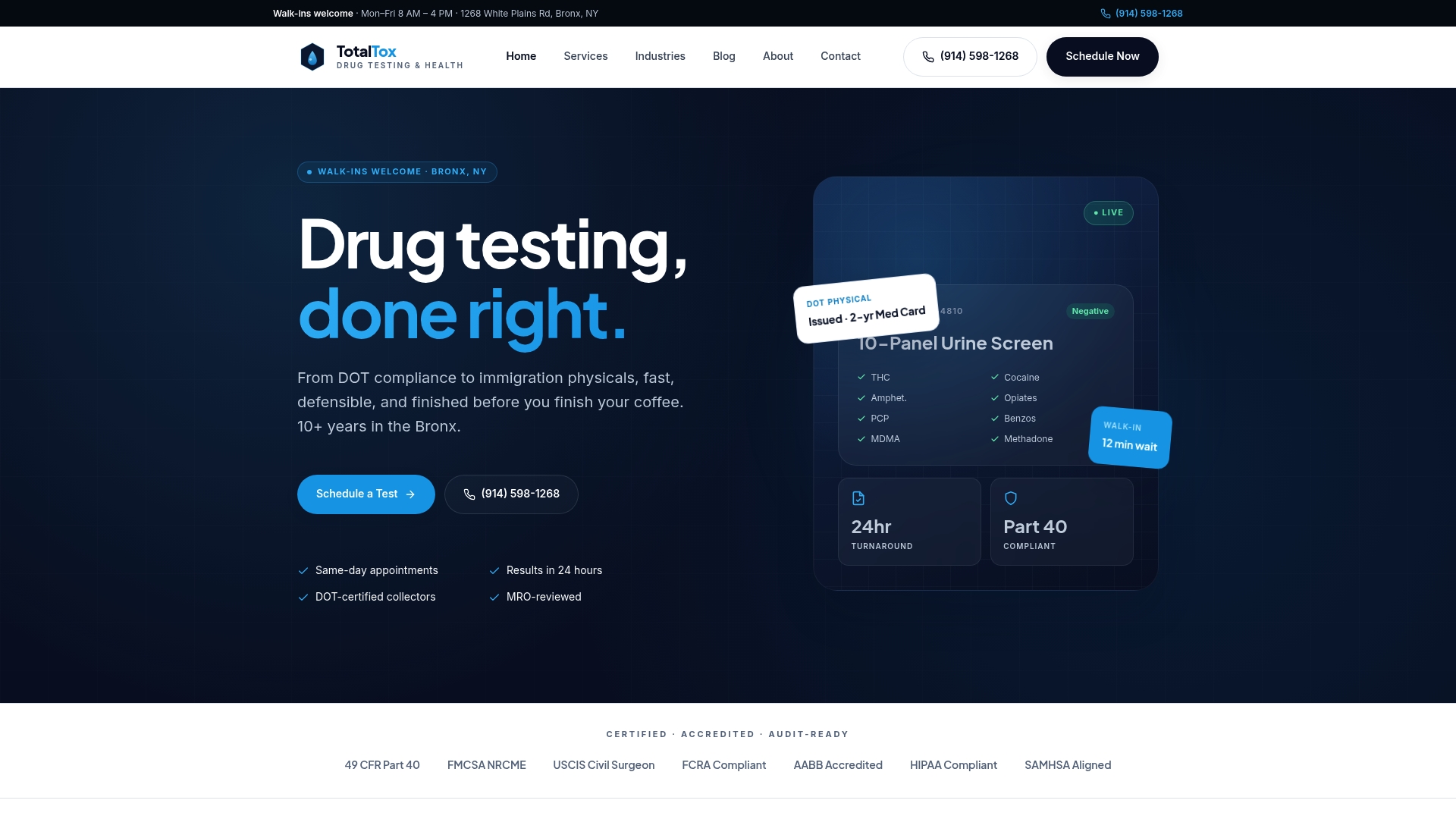
This kind of workflow serves employers verifying dependent status, individuals facing immigration deadlines, and anyone in an active legal matter who needs documentation that will actually be accepted. Visit the Total Tox services page to see current testing options and schedule a walk-in appointment.
Sources
- DNA Paternity Test — Cleveland Clinic
- 2024 technical report summary — AABB
- CellFree DNA Prenatal Screen — UW Medicine
- DNA Paternity Testing — Michigan Department of Health and Human Services
FAQ
How fast do paternity test results come back?
Standard postnatal tests are usually reported in about 2 to 7 business days once the lab has usable samples, according to Cleveland Clinic. Legal tests and prenatal tests typically take longer due to added documentation or slower lab schedules.
What does 97% mean on a paternity test?
If a report shows an unusual middle figure, ask the lab whether additional markers or follow-up testing are needed before drawing a conclusion.
How close is a 3% DNA match?
A figure that low does not indicate paternity in a standard DNA relationship test. Reputable labs report either a strong inclusion, typically near 99.99% probability, or a clear exclusion at 0%, so a very low percentage usually points to an exclusion or an unusual result worth confirming with the lab.
Is a DNA paternity test 100% accurate?
Standard STR-based testing is highly reliable and is the predominant method used across the industry, according to AABB’s technical report. When results are ambiguous, labs run additional markers or alternate methods to confirm the finding before issuing a final report.