
Both QuantiFERON-TB Gold Plus (QFT-Plus) and T-SPOT.TB are FDA-approved interferon-gamma release assays, and both are acceptable first-line choices for TB infection screening. The real decision usually comes down to specimen logistics, patient immune status, and BCG vaccination history rather than one test being categorically better. Neither test can tell you whether infection is latent or active. That distinction still requires a symptom screen, imaging, and microbiologic workup.
TL;DR:
- T-SPOT.TB offers a longer processing window of up to 32 hours with Xtend, making it more suitable for clinics with transport delays over 16 hours.
- Both tests have similar sensitivity for active TB detection, but T-SPOT.TB generally incurs higher costs due to equipment and labor expenses.
- In BCG-vaccinated populations, IGRA tests outperform skin tests by avoiding cross-reactivity, which reduces false positives and unnecessary follow-up procedures.
- The choice between the two depends heavily on specimen logistics and patient immune status, rather than a clear accuracy advantage.
- Neither test can differentiate between latent and active TB without additional clinical and imaging assessment.
Table of Contents
- QuantiFERON vs T-SPOT: A Quick Comparison
- How Do QuantiFERON and T-SPOT Actually Measure TB Infection?
- Which Test Is More Accurate: Sensitivity and Specificity Data
- Operational Differences: Lab Workflow, Turnaround, and Equipment
- How to Choose and Interpret Results in Practice
- What Do QuantiFERON and T-SPOT Cost, and When Is Each Worth It?
- Where QuantiFERON and T-SPOT Both Fall Short
- A Faster Path to Reliable TB Screening Results
- Sources
QuantiFERON vs T-SPOT: A Quick Comparison
Here’s how the two platforms stack up on the variables that actually change clinical decisions:
- Measurement method: QFT-Plus quantifies interferon-gamma (IFN-γ) concentration in whole blood plasma; T-SPOT.TB counts individual IFN-γ producing T cells as visible spots.
- Result categories: QFT-Plus reports positive, negative, or indeterminate; T-SPOT.TB reports positive, negative, borderline, or invalid.
- Processing window: QFT-Plus tubes generally need processing within about 16 hours; T-SPOT.TB can extend to 32 hours with the T-Cell Xtend reagent.
- Best for tight transport windows or high-throughput labs: QFT-Plus, since it skips cell separation.
- Best for remote clinics or longer courier times: T-SPOT.TB, given its wider processing tolerance.
- Best for immunosuppressed patients: Neither is immune to indeterminate results, but the choice often hinges on which platform your lab already validates for that population.
Cost, staffing, and existing lab contracts frequently decide the matter before test performance does.
How Do QuantiFERON and T-SPOT Actually Measure TB Infection?
QFT-Plus is a whole-blood ELISA. Blood gets drawn directly into antigen-coated tubes, including separate TB1 and TB2 tubes that stimulate CD4 and CD8 T cells differently, then the plasma is tested for the total concentration of IFN-γ released. T-SPOT.TB works differently: it isolates peripheral blood mononuclear cells (PBMCs) from the sample, plates a fixed number of those cells, and uses an ELISPOT assay to count how many individual cells secrete IFN-γ, visualized as discrete spots on a membrane.
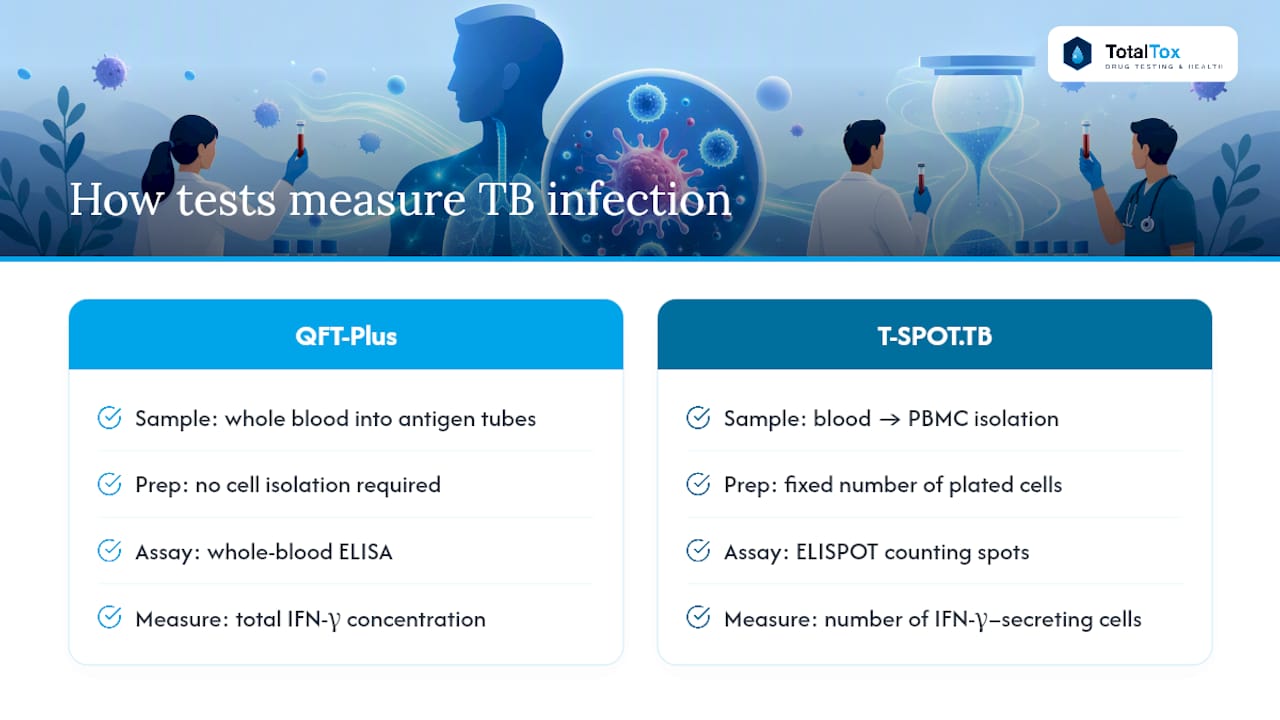
That mechanical difference explains a pattern that confuses a lot of clinicians reviewing paired results: high qualitative agreement, poor numeric correlation. Studies comparing QFT-Plus against other assays found substantial agreement in positive/negative calls but weak correlation between the actual IFN-γ numbers, because one test is measuring bulk cytokine output and the other is counting responding cells. Preanalytical variables (how long the sample sits, how many lymphocytes are in circulation, incubation timing) shift the output of each platform differently, which is exactly why you shouldn’t try to eyeball trend a patient’s raw QFT concentration against a prior T-SPOT spot count.
Which Test Is More Accurate: Sensitivity and Specificity Data
Neither test wins outright on sensitivity. A 2023 systematic review found no statistically significant difference in sensitivity for detecting active TB between QFT-Plus and T-SPOT.TB, and both consistently outperform the tuberculin skin test (PPD/Mantoux) on specificity in populations with prior BCG vaccination, since IGRAs use TB-specific antigens absent from the BCG strain.
Agreement between the two IGRA platforms typically runs at a kappa of roughly 0.7 to 0.9 in large cohort comparisons, notably higher than the concordance either IGRA shows against PPD.
A large U.S. observational cohort testing TST, QFT, and T-SPOT side by side found the two IGRAs agreed with each other more often than either agreed with the skin test, and discordance between TST and the IGRAs rose specifically among non-U.S.-born participants, a group where prior BCG exposure is more common. Indeterminate and invalid rates matter just as much as sensitivity in practice. Some prospective comparisons report T-SPOT.TB producing marginally lower indeterminate rates than QFT-Plus in certain cohorts, though this varies by patient population and lab handling. Patients with lymphopenia or active immunosuppression carry the highest risk of an indeterminate or invalid result on either platform.
Operational Differences: Lab Workflow, Turnaround, and Equipment
The lab realities behind each test often matter more than the head-to-head accuracy data:
- QFT-Plus needs no cell separation. Draw into the tube set, incubate, then run the ELISA. Most labs can process it within their standard walk-in workflow.
- T-SPOT.TB requires PBMC isolation before plating, plus an ELISPOT reader, which raises both the skill requirement and the capital equipment cost.
- The T-Cell Xtend reagent extends T-SPOT.TB’s viable processing window to as long as 32 hours, against roughly 16 hours for QFT-Plus, which matters enormously for clinics shipping specimens to an outside reference lab.
- ELISPOT platforms generally cost more to run per test given the specialized reader and PBMC prep labor, a real factor for high-volume occupational-health programs weighing throughput against budget.
Pro Tip: If your clinic ships specimens more than a few hours away from the processing lab, ask your reference lab directly whether they run T-SPOT with Xtend. That single logistics question often decides the platform choice faster than any accuracy comparison will.
How to Choose and Interpret Results in Practice
- Start with logistics, not preference. If your specimen reaches the lab within 16 hours reliably, either test works. If transport regularly runs longer, T-SPOT.TB with Xtend gives you more margin.
- Weigh BCG history. Either IGRA beats PPD in BCG-vaccinated patients, since neither cross-reacts with the vaccine strain.
- Flag immunosuppressed and lymphopenic patients before testing. These patients carry higher indeterminate risk on QFT-Plus specifically, so some clinicians favor T-SPOT or plan for a repeat draw in advance.
- On an indeterminate or invalid result, repeat the same test first; if it recurs, consider switching platforms or falling back to clinical risk assessment rather than serial retesting indefinitely.
- On any positive IGRA, move to a symptom screen, chest imaging, and microbiologic testing before assuming latent infection. Document the specific result category (not just “positive”) in occupational-health records for audit purposes.
What Do QuantiFERON and T-SPOT Cost, and When Is Each Worth It?
Per-test pricing varies by lab contract, but the specificity advantage IGRAs hold in BCG-vaccinated populations tends to pay for itself. Fewer false positives means fewer unnecessary chest X-rays and fewer patients started on LTBI treatment they don’t need, a tradeoff cost-effectiveness analyses have flagged as meaningful in high-risk and BCG-vaccinated cohorts. For serial occupational screening with low-risk, low-turnover populations, PPD sometimes remains the cheaper default. IGRA programs tend to earn their higher per-test cost once BCG history, immunosuppression prevalence, or return-visit compliance becomes a real logistical headache.
Where QuantiFERON and T-SPOT Both Fall Short
Neither test distinguishes latent infection from active disease. Both are indirect immune-response measures, not direct pathogen detection, so a positive result always needs symptom correlation and imaging before treatment decisions follow. Preanalytical errors including delayed processing, hemolysis, and poor sample handling raise indeterminate and invalid rates on both platforms. Avoid serial retesting on an unvalidated schedule; switching platforms mid-program muddies longitudinal interpretation for occupational-health records.
— Total Tox
A Faster Path to Reliable TB Screening Results
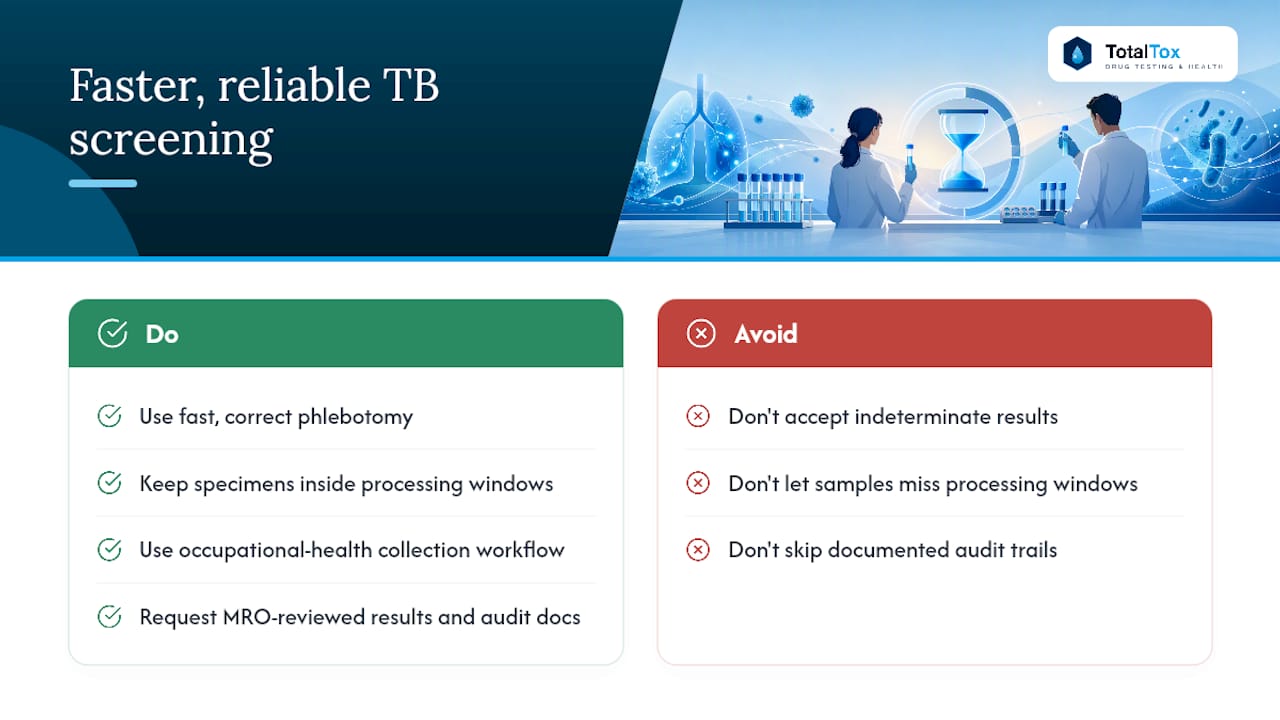
Fast, correctly handled phlebotomy prevents most of the indeterminate results clinicians spend time chasing. Total Tox runs walk-in specimen collection built for occupational-health volume, with MRO-reviewed results and audit-ready documentation that hold up under program review. Tight sample handling keeps both QFT-Plus and T-SPOT.TB specimens inside their processing windows instead of racing the clock. If you’re setting up or refining a TB screening protocol, Total Tox’s occupational health services can help structure the workflow around your patient population.
This article is general information, not a substitute for advice from a qualified doctor. Consult a qualified healthcare professional about your own circumstances before acting on anything here.
Sources
- Interferon Gamma Release Assay | Tuberculosis (TB) — CDC
- Comparing QuantiFERON-TB Gold Plus with Other Tests To Diagnose Mycobacterium tuberculosis Infection — PMC