
Reasonable suspicion drug testing training means arranging a DOT‑compliant, on‑demand drug or alcohol test the moment a trained supervisor documents specific, contemporaneous signs of impairment in a safety‑sensitive employee. The immediate action is simple: pull the worker off duty and get them to a collection site fast. MRO review and audit‑ready paperwork follow once the specimen is collected.
TL;DR:
- Supervisors must document specific, current signs of impairment immediately and ensure the observation is written within 24 hours to maintain compliance.
- Collection of specimens must happen as soon as possible, ideally within 2 hours for alcohol and promptly for drugs, to meet DOT timing rules and avoid invalidation.
- Establishing pre-arranged relationships with testing vendors and having documentation forms ready speeds up response times during active incidents.
- Using walk-in clinics can significantly reduce collection time, but only trained collectors under 49 CFR Part 40 can perform valid DOT specimen collections.
- Employers must keep audit-ready records, including observation forms, chain-of-custody, lab reports, and DER logs, all kept separate from disciplinary files for confidentiality.
Table of Contents
- Reasonable Suspicion Drug Testing: What the Rules Actually Require
- Your Employer Checklist for Arranging a Test Right Now
- Breath, Urine, Saliva, or Hair: Picking the Right Test
- What Happens After Collection: MRO Review and Your Paper Trail
- Walk-In Clinics or Onsite Collection: Which Fits Your Operation?
- Why Speed Is the Real Compliance Risk Most Employers Miss
- Book a Reasonable Suspicion Test With Total Tox Today
- Primary Sources Employers Should Bookmark
- Sources
- FAQ
Reasonable Suspicion Drug Testing: What the Rules Actually Require
Reasonable suspicion drug testing training under federal trucking rules is grounded in one requirement: the observation has to be specific, current, and written down. Under FMCSA’s implementation guidance for 49 CFR Part 382, a supervisor cannot order a test based on a gut feeling or a rumor from another driver. The observation must describe behavior, appearance, speech, or odor that a trained person actually witnessed, at that moment.

Timing rules make this urgent, not optional. For alcohol, employers must attempt an evidential breath test within 2 hours of the observation. If that’s not possible, they document why and keep trying until the 8‑hour mark, at which point attempts stop and the driver goes out of service for 24 hours if no test was completed. For drugs, SAMHSA’s model workplace guidance lists reasonable suspicion alongside random, post‑accident, and return‑to‑duty testing as a standard category every drug‑free workplace policy should cover.
A few things worth locking into your policy language:
- Reasonable suspicion testing applies only to safety‑sensitive functions, never to general workplace conduct concerns.
- Observations must come from someone trained to recognize signs of impairment, not just any manager on shift.
- Documentation has to happen within 24 hours of the observation, or before test results come back, whichever is first.
Your Employer Checklist for Arranging a Test Right Now
Once a supervisor flags a concern, speed and sequence matter. Here’s the order that keeps you compliant and keeps your driver or employee safe.
- Remove the employee from safety‑sensitive duty immediately. Don’t let them drive, operate machinery, or return to the task in question. Secure the area if there’s any immediate safety risk.
- Notify your Designated Employer Representative (DER). The DER is the person authorized to make testing decisions and coordinate with your collection site or clinic.
- Call your testing vendor and specify what you suspect. If alcohol is suspected, prioritize an evidential breath test since the 2 hour and 8 hour clocks are already running. If controlled substances are suspected, arrange urine collection as soon as practicable.
- Transport the employee to collection, not the other way around. Waiting for a mobile collector to arrive burns time you don’t have, especially on the alcohol timeline.
- Confirm chain‑of‑custody procedures with the collector. The specimen has to be sealed, labeled, and logged correctly, or the result becomes indefensible in an audit.
- Write down your observations within 24 hours. Note the date, time, specific behaviors observed, who else witnessed it, and what action you took. Do this before you see any results, not after.
Guides built for trucking compliance repeatedly flag the same two failure points: supervisors wait too long to document, and specimens get collected hours or days after the observation. Both mistakes are avoidable if the checklist above happens the same day, not “when things calm down.”
Breath, Urine, Saliva, or Hair: Picking the Right Test
The specimen type you choose depends on what you suspect and how much time has already passed since the observation.
- Evidential breath test (EBT): required for alcohol confirmation testing and the only method that satisfies the 2 hour/8 hour DOT timing rule. If you wait past the window, the result becomes unusable for DOT purposes.
- Urine: the DOT standard for controlled substances, and detection windows shrink the longer you wait, so collection should happen as soon as practicable after the observation.
- Oral fluid (saliva): faster to collect and harder to adulterate, but not every DOT program accepts it yet for every testing category. Confirm acceptability with your MRO before relying on it for a reasonable suspicion event.
- Hair follicle testing: useful for historical drug use patterns over a 90 day window, but it doesn’t reflect recent or same‑day impairment, so it’s the wrong tool for an active reasonable suspicion incident.
Pro Tip: If you’re not sure whether alcohol or drugs (or both) are involved, don’t wait to decide. Order both tests at the same visit. Most walk‑in clinics can run breath and urine collection back to back in a single appointment.
What Happens After Collection: MRO Review and Your Paper Trail
A Medical Review Officer (MRO) reviews every non‑negative drug test result before it becomes final. The MRO checks the lab report, rules out legitimate medical explanations, and confirms the result before anything gets reported back to you as the employer. This step exists specifically to protect against a false positive derailing someone’s job over a legal prescription.

Turnaround time is where a lot of employers lose ground waiting on results while a driver sits out of service. Expedited walk‑in clinics can often deliver same‑day or 24 hour results for the initial screen, with MRO confirmation following close behind.
Your audit file should hold four things, always:
- The contemporaneous observation form, filled out within 24 hours.
- The chain‑of‑custody form from the collection site.
- The final lab and MRO report.
- A DER log entry recording every decision made and when.
Keep these records separate from disciplinary files. Confidentiality matters, and SAMHSA’s model plan specifically recommends written procedures and clean recordkeeping as part of a defensible drug‑free workplace program.
Walk-In Clinics or Onsite Collection: Which Fits Your Operation?
Walk‑in clinics generally win on speed. You show up, get processed, and are usually out the door in under 15 minutes for the collection itself, with no scheduling lag. Onsite collection has its place for large fleets running frequent tests, since it avoids transporting employees off‑site, but it takes more lead time to arrange and isn’t practical for a one‑off reasonable suspicion event that needs handling today.
Whichever route you choose, only a qualified collector trained under 49 CFR Part 40 can perform a DOT specimen collection. That’s not a formality. An improperly trained collector can invalidate the whole test.
The employers who handle these incidents smoothly are usually the ones who set things up before they need them:
- Establish a standing relationship with a testing clinic or lab before an incident happens, not during one.
- Keep a printed or digital observation form on hand so supervisors aren’t scrambling to remember what details matter.
- When you call the clinic, have the employee’s name, the time of the observation, and a one‑line description of what was seen ready to go. It shortens the call and speeds up the visit.
- Confirm in advance whether your clinic offers both breath and urine collection in one visit, since needing to know that mid‑crisis wastes time you don’t have.
Guides focused on trucking compliance point to this same pattern: companies with a pre‑arranged vendor relationship consistently avoid the delayed testing and documentation gaps that show up most often in audit findings.
Why Speed Is the Real Compliance Risk Most Employers Miss
Most conversations about reasonable suspicion testing focus on the legal definition. What actually gets employers into trouble is the clock. The rule itself is clear enough. What breaks down in practice is the gap between the moment a supervisor notices something and the moment a specimen actually gets collected.
That gap is where audits get lost. A perfectly documented observation is worthless if the alcohol test happens at hour 9. A textbook‑clean urine collection is still a liability if it happened three days after the incident because nobody had a clinic lined up. Total Tox built its walk‑in model around closing that exact gap: collections typically run under 15 minutes, and results move through MRO review with audit‑ready documentation attached, not bolted on afterward.
For transportation companies especially, where a driver sitting out of service costs real money every hour, having a same‑day path to a compliant test isn’t a convenience feature. It’s the difference between a clean file and a compliance headache six months from now when an auditor asks why the timeline doesn’t add up.
— Total Tox
Book a Reasonable Suspicion Test With Total Tox Today
When a supervisor flags a concern, you need a place to send that employee immediately, not a scheduling back and forth. Total Tox handles DOT breath and urine collections for reasonable suspicion incidents with walk‑in appointments, MRO‑reviewed results, and the audit‑ready documentation your file needs if a regulator ever asks questions.
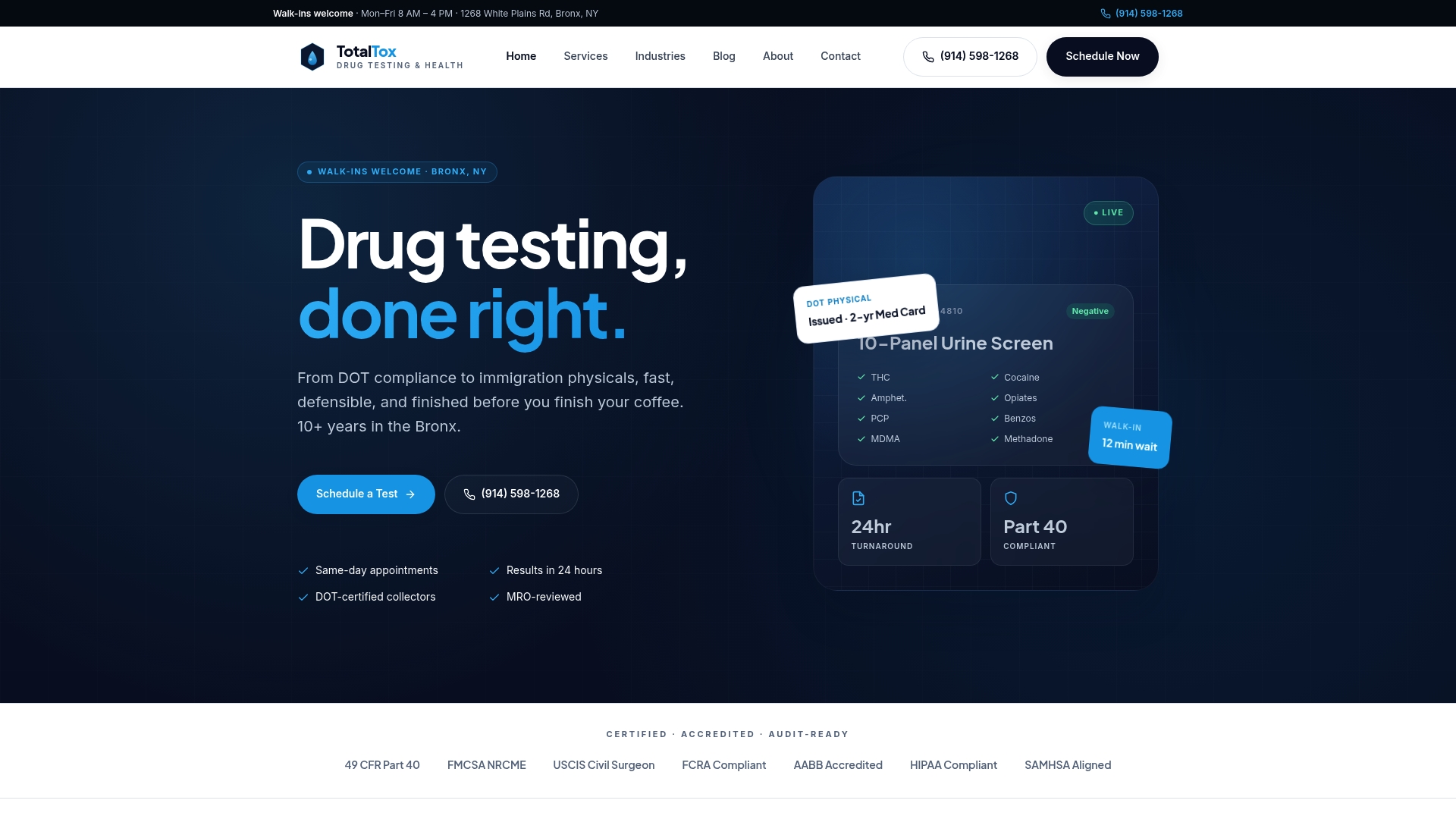
Before you call, have three things ready: the employee’s name, the time of the observation, and a short note on what your supervisor actually saw. That’s enough for our team to get the right collection moving. Some testing services serve transportation, construction, healthcare, and manufacturing employers across the Bronx and nearby areas, and visits are built to get employees tested and paperwork audit‑ready without the wait. Visit the drug testing services page to see what’s available, or go straight to scheduling a same‑day appointment if you’re dealing with an active situation right now.
Primary Sources Employers Should Bookmark
For the exact legal language behind everything above, go straight to the source. FMCSA’s Chapter 5 implementation guidelines cover timing and documentation rules in full. SAMHSA’s model drug‑free workplace plan offers policy language you can adapt directly. For a broader employer‑side breakdown of DOT testing categories, the trucking compliance guide from TruckComplianceHQ is worth a read alongside our own DOT random testing guide.
Sources
- Implementation Guidelines for Alcohol and Drug Regulations - Chapter 5 | FMCSA
- Model Plan for a Drug‑Free Workplace Program | SAMHSA (March 2026)
- DOT Drug Testing Requirements for Trucking Companies — Complete 2026 Guide | TruckComplianceHQ
FAQ
What Triggers Reasonable Suspicion Testing?
A trained supervisor’s specific, current, and documented observation of behavior, appearance, speech, or odor consistent with drug or alcohol use during a safety‑sensitive duty period.
How Fast Must an Alcohol Test Happen?
Employers must attempt the evidential breath test within 2 hours of the observation and stop attempting after 8 hours, placing the driver out of service for 24 hours if no test occurred.
Is There a Time Limit for Drug Testing?
There’s no fixed hour limit like alcohol, but the FMCSA guidance directs employers to collect the specimen as soon as practicable since delays reduce detectability.
Who Reviews the Test Results Before I See Them?
A Medical Review Officer reviews every non‑negative drug result, checking for legitimate medical explanations before confirming the final result to the employer.
Can Total Tox Handle a Same‑Day Reasonable Suspicion Test?
Yes. Total Tox offers walk‑in collections typically completed in under 15 minutes with expedited, MRO‑reviewed results and audit‑ready documentation for employers across the Bronx and nearby counties.