
For US employers, background checks fall into a predictable set of categories: identity verification, criminal-history searches at the county, state, and federal level, motor vehicle records, employment and education verification, credit reports, drug testing, social media screening, license verification, and international or specialty searches. Which combination you run has to be job-related and consistent under the FCRA and EEOC guidance, or you’re exposed to a disparate-impact claim.
TL;DR:
- Using county criminal searches is more thorough but can be slow, with fees varying widely from state to state, such as New York’s $95 fee for statewide checks.
- Employment and education verifications can reveal discrepancies that require candidate clarification, and rehire eligibility offers significant insight into past suitability.
- For roles involving driving, motor vehicle records are essential to confirm license status and violations, often rechecked annually for safety-sensitive positions.
- Drug testing relies on timely sample collection and documentation, with chain-of-custody records crucial for legal defense, especially in regulated industries like transportation.
- Targeted screening based on specific job risks, rather than blanket checks, reduces costs, legal exposure, and improves hiring speed while maintaining compliance.
Table of Contents
- Identity verification and SSN trace: the foundation of every screen
- Criminal history checks: county, state, federal, and registry searches differ a lot
- Employment verification: confirming what the resume claims
- Education and professional license verification
- Reference checks that hold up if challenged later
- Credit reports and financial background checks
- Motor vehicle records for driving roles
- Employment drug testing: sample types, DOT rules, and MRO review
- Social media and online presence checks
- International and specialty checks: fingerprints, foreign records, and watchlists
- Building a legally defensible screening package
- What ten years of running drug tests taught us about paperwork
- Why targeted screening beats screening theatre
- Fast, compliant drug testing without the wait
- Sources
Identity verification and SSN trace: the foundation of every screen
An SSN trace pulls name variants, known aliases, and previous addresses tied to a Social Security number. It’s the starting point almost every screening company uses, because it tells you which counties and states to search next instead of guessing.
- Reduces false matches by narrowing criminal searches to the right jurisdictions
- Flags identity red flags like multiple SSNs or address clusters in unrelated states
- Fingerprints become necessary when a name-based match needs definitive confirmation
Most identity traces turn around in minutes to a few hours; fingerprint-based confirmation takes days longer.
Criminal history checks: county, state, federal, and registry searches differ a lot
County courthouse searches often catch cases that national databases miss entirely, because a large share of court records are only digitized at the county level. Experienced screeners build a county list from the address history an SSN trace surfaces, then search those courts directly rather than trusting one nationwide database alone.
- County searches: most complete for a specific locality, but slow if pulled manually
- Statewide repositories: consistent within a state, but coverage and cost vary by jurisdiction
- Federal searches (PACER) and national databases: catch federal offenses and multistate patterns
- Sex offender registry searches: a separate, targeted search with its own legal use cases
- Fingerprint checks: resolve identity ambiguity when a name-based hit could belong to someone else
Search fees swing widely by state. New York’s Office of Court Administration charges $95 for a statewide criminal-history search, while other states charge a fraction of that for a single-county pull. Automated name matches frequently trigger manual review, and that review can add days to your timeline when a fingerprint submission becomes necessary to confirm the record actually belongs to your candidate.
Employment verification: confirming what the resume claims
Employment verification confirms employer name, job title, dates worked, and eligibility for rehire. Most verifiers reach an HR contact by phone or a verification service, though some employers only release information through a documentary letter.
- Dates and titles that don’t match the resume aren’t automatically disqualifying; ask the candidate to clarify before you act
- Some employers use third-party verification platforms that only confirm dates and title, not performance
- Rehire eligibility, when disclosed, is one of the more revealing data points available
- Turnaround runs one to five business days depending on how responsive the former employer is
A resume-screening tool can flag inconsistencies in claimed dates before you even request verification, which saves a step later.
Education and professional license verification
Education verification confirms enrollment, degree conferred, and dates attended directly with the registrar, not the graduate. Professional license verification works the same way, except you’re checking a state licensing board’s public database instead of a school.
- Degree and enrollment confirmation typically comes straight from the registrar’s office
- License checks confirm active status, expiration date, and any public disciplinary history
- Suspended or revoked licenses should trigger an automatic hold on roles requiring that credential
- Foreign degrees often need a credential evaluation service before you can compare them to a US standard
For regulated roles like nursing, trucking, or skilled trades, license verification isn’t optional. It’s the check that actually determines whether someone can legally do the job.
Reference checks that hold up if challenged later
References carry real legal risk if you rely on hearsay instead of structured questions. A short, consistent script protects you and gets more usable information out of the call.
- Ask the same three or four job-related questions of every referee, every time
- Expect most former employers to confirm only dates, title, and rehire eligibility. Anything more is a bonus
- Treat glowing personal references from friends or family as low signal compared to a former supervisor
- Log the date, name, and exact responses in the candidate’s file immediately after the call
References work best as a tiebreaker between two qualified finalists, not as your only screening layer for a high-risk role.
Credit reports and financial background checks
Credit checks require a stand-alone FCRA disclosure and written authorization, separate from your general background-check consent form. They’re generally appropriate for roles with direct financial or cash-handling responsibility, like accounting, treasury, or roles with signing authority.
- Several states and cities restrict or outright ban credit checks for most positions
- Job-relatedness has to be documented before you request the report, not after
- Any adverse decision based on the report triggers the FCRA two-step notice process
- Consumers can dispute inaccurate items on their credit report through the FTC’s process, so a flagged item isn’t always the full story
Because so many jurisdictions restrict this check, running it on a role where financial responsibility isn’t obvious is one of the fastest ways to invite a complaint.
Motor vehicle records for driving roles
An MVR pulls license class and status, moving violations, suspensions, and DUI history. Insurers and safety-sensitive employers rely on this record because a clean interview means little if the candidate’s license is suspended.
- License class confirms the candidate can legally operate the vehicle your role requires
- Multiple moving violations or a lapsed license often disqualify a candidate for insurance reasons alone
- Safety-sensitive drivers typically get rechecked annually, sometimes more often under a fleet policy
- Access and turnaround vary by state DMV, with some offering same-day electronic pulls and others requiring mailed requests
Employment drug testing: sample types, DOT rules, and MRO review
Urine testing remains the most common panel and covers the widest detection window for recent use. Hair testing extends that window to roughly 90 days, while saliva testing catches only very recent use, useful for post-accident or reasonable-suspicion scenarios where timing matters most.
- DOT-regulated positions require specific panels, chain-of-custody paperwork, and enrollment in a random testing pool
- A Medical Review Officer, or MRO, reviews any non-negative lab result before it becomes final
- “Under review” status means the MRO is verifying a result, often due to a prescription explanation, not necessarily a failed test
- Onsite collection with a same-day lab drop cuts total turnaround dramatically compared to mailing samples
Pro Tip: Build your drug-testing timeline around the MRO step, not just the lab result. A negative result can post in hours, but a result flagged for MRO review can add a day or two even when it ultimately clears.
For a deeper look at detection windows across sample types, the trade-offs between urine and hair testing matter more for some roles than others.
Social media and online presence checks
Public online screening can surface adverse media coverage or posts relevant to job conduct, but it carries real legal exposure. A reviewer who sees a candidate’s religion, age, or disability status while browsing a profile creates a paper trail that looks like discrimination even when the hiring decision had nothing to do with it.
- Limit the review to publicly available, job-related content, not private accounts or protected groups
- Use a documented policy that defines what counts as disqualifying before you start looking
- Assign the review to someone outside the hiring decision, then pass along only relevant findings
- Avoid unverified aggregator reports that compile posts without confirming they belong to your actual candidate
International and specialty checks: fingerprints, foreign records, and watchlists
FBI fingerprint-based checks provide the most definitive identity confirmation available domestically and are standard for federal contracts, licensing boards, and certain caregiving roles. International criminal record searches require a local partner in the candidate’s home country and typically take two to six weeks longer than a domestic pull.
- OFAC and other sanctions watchlist screening matters for finance, export-controlled, and high-risk hires
- Apostille or consular authentication steps are often required before a foreign document is usable in the US
- Costs run higher than domestic searches because of translation, courier, and partner-agency fees
- Certain roles, including foster and kinship caregiving, have federally mandated fingerprint requirements regardless of your standard policy
Building a legally defensible screening package
Start with role risk, not habit. A warehouse picker and a fleet driver with a company vehicle need entirely different check combinations, and running the same blanket package on both wastes money and invites scrutiny you don’t need.
- Identify the specific risk the role creates (driving, cash handling, vulnerable populations, data access)
- Select only the checks that predict or protect against that specific risk
- Get FCRA-compliant, stand-alone authorization before ordering any consumer report
- Adjudicate consistently using a written policy, then issue pre-adverse and final adverse-action notices when a report factors into a negative decision
| Check type | Typical cost range | Typical turnaround |
|---|---|---|
| SSN trace / identity | $1 | Minutes to hours |
| County criminal search | $95 per state, less per county | 1 to 5 business days |
| Statewide criminal search | Fees vary by state (e.g., New York charges $95) | 1 to 5 business days |
| Employment/education verification | $95 per state, less per county | 1 to 5 business days |
| MVR | $95 per state, less per county | Same day to 2 business days |
| Credit report | $95 per state, less per county | Same day |
| Drug test (urine, onsite) | Varies by clinic | Same-day collection, 24-hour lab turnaround |
Pre-offer checks should stay limited to what’s legally allowed before an offer exists in your state; save credit reports, drug tests, and detailed criminal searches for after a conditional offer whenever your state requires that sequencing.
What ten years of running drug tests taught us about paperwork
Fast sample collection only matters if the documentation behind it holds up later. Total Tox built its walk-in model around same-day collection because employers lose money every hour a candidate sits in limbo, but speed without a defensible chain-of-custody record just creates a faster version of the same legal exposure.
- Chain-of-custody forms need to be complete and signed at every handoff, not filled in retroactively
- MRO review adds a short delay for flagged results, but skipping it removes the layer that protects you from a wrongful-termination claim
- Audit-ready files matter most when you least expect to need them: a DOT audit, a workers’ comp dispute, or a lawsuit years later
- Same-day collection with 24-hour lab turnaround in many cases keeps hiring pipelines moving without cutting corners on documentation
For DOT-regulated fleets specifically, the enrollment and rechecking requirements around random testing pools are where most compliance gaps show up.
Why targeted screening beats screening theatre
Buying every available check for every role isn’t diligence, it’s noise. A finance manager candidate probably needs a credit check; a warehouse associate almost never does, and running one anyway just adds cost and legal exposure with zero hiring signal.
The employers who get this right start from documented job risk, not a vendor’s default package. That approach produces fewer false positives, faster time-to-hire, and a much lower chance of a disparate-impact complaint down the line, because every check you run has a defensible reason attached to it.
— Total Tox
Fast, compliant drug testing without the wait
Total Tox is the walk-in alternative to mailing samples off and waiting days for answers. Most tests are collected quickly, with lab results returned promptly in many cases, so a conditional job offer doesn’t sit stalled while paperwork moves through the mail.
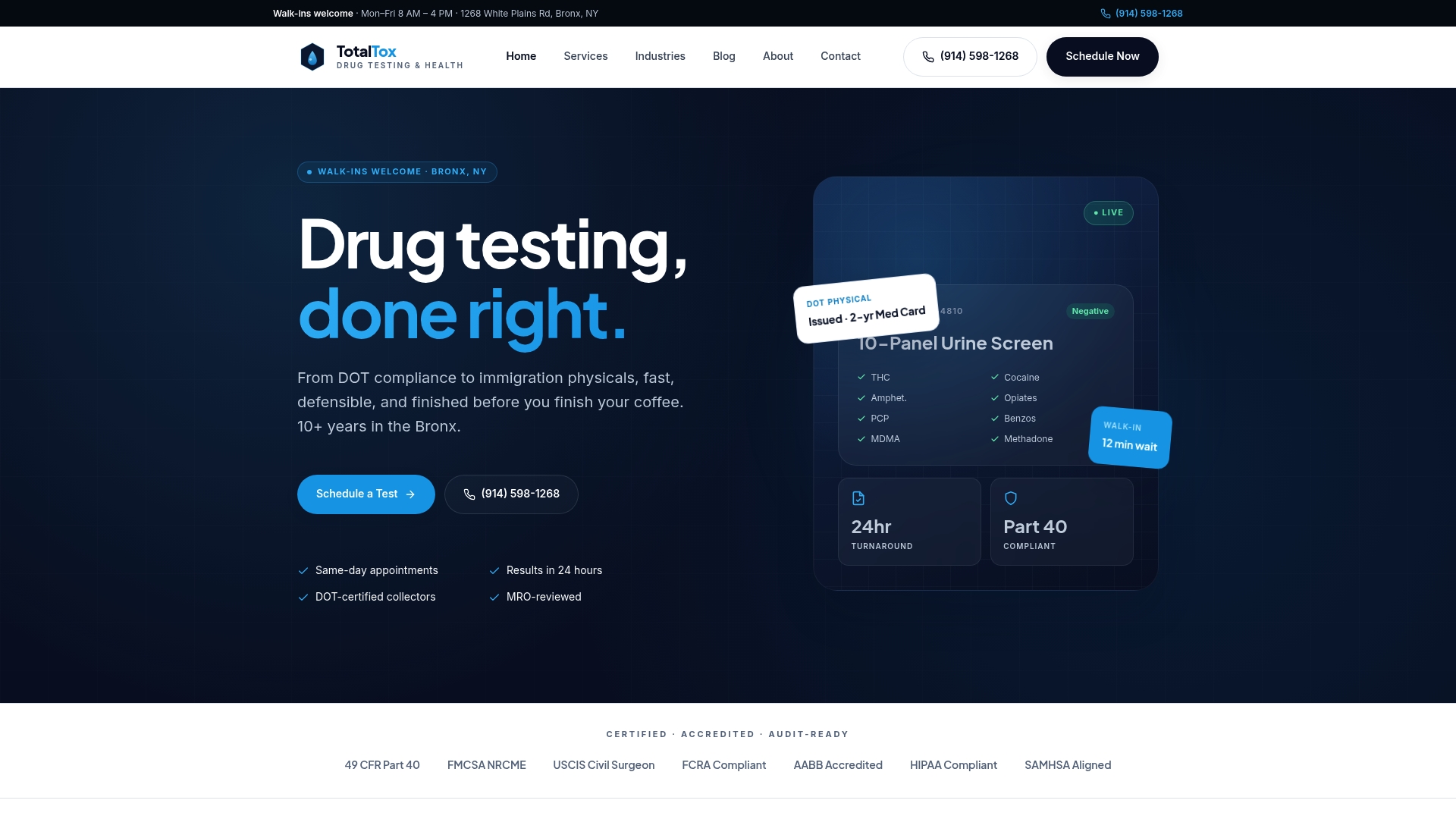
Every result comes with MRO review and audit-ready documentation, which matters the moment a DOT audit or a legal dispute asks you to prove your process held up. Total Tox handles walk-in drug and alcohol testing, DOT physicals, and occupational health services for employers across transportation, construction, healthcare, and manufacturing in the Bronx, Manhattan, Westchester, and Queens. If you need a compliant screening partner that won’t slow down your hiring pipeline, schedule a test today.
Sources
- Background Checks: What Employers Need to Know | U.S. Equal Employment Opportunity Commission
- Criminal history record search | New York State Unified Court System