For adjustment-of-status applicants, the immigration medical exam requires proof of age-appropriate vaccination or immunity against the 15 vaccine-preventable diseases CDC lists in its Technical Instructions. Bring your written vaccine records to the civil surgeon, who documents compliance directly on Form I-693. That form must be submitted alongside Form I-485, so schedule the exam early and gather your paperwork now.
TL;DR:
- Only vaccines explicitly listed in the CDC’s Technical Instructions count toward immigration requirements, which vary based on age and health conditions.
- Proof of immunity can be accepted via lab titers for diseases like measles, mumps, rubella, varicella, and hepatitis B, potentially replacing doses.
- Certain vaccines are marked “not medically appropriate” if the applicant’s age, health, pregnancy status, or timing makes vaccination unsafe or unnecessary.
- Missing doses typically require only one additional shot during the exam, with the rest completed later through your primary healthcare provider.
- Preparation, including bringing original, translated vaccination records and lab results, significantly reduces delays and helps ensure full compliance at the exam.
Table of Contents
- Which Vaccines Are Required for the Immigration Exam?
- Who Sets These Rules: USCIS, CDC, and the Civil Surgeon’s Role
- Age-Based Vaccine Requirements: A Quick Reference
- Can Lab Titers Replace a Vaccine Requirement?
- When Is a Vaccine Marked ‘Not Medically Appropriate’?
- What Happens if You’re Missing Vaccine Doses?
- What to Bring to Your Civil Surgeon Appointment
- What Applicants Actually Experience at a Compliance-Focused Clinic
- A Note From the Clinic Floor on What Actually Slows People Down
- How Total Tox Handles Your Immigration Medical Exam
- Sources
Which Vaccines Are Required for the Immigration Exam?
The CDC doesn’t ask civil surgeons to confirm every shot on the childhood immunization schedule. It asks for proof against a specific, fixed set of diseases, and that distinction trips up a lot of applicants who assume “recommended” and “required” mean the same thing here.
They don’t. The USCIS Policy Manual is explicit that only vaccines named in the CDC’s Technical Instructions count toward the immigration requirement, even though CDC recommends dozens of other vaccines for general public health. If a vaccine isn’t on the list, a civil surgeon has no basis to withhold your I-693 over it.
The 15 vaccine-preventable disease categories applicants must show proof of immunity or vaccination for are:
- Diphtheria, tetanus, and pertussis
- Polio
- Measles
- Mumps
- Rubella
- Rotavirus
- Haemophilus influenzae type b (Hib)
- Hepatitis A
- Hepatitis B
- Meningococcal disease
- Varicella (chickenpox)
- Pneumococcal disease
- Influenza (seasonal)
- Mpox
Not every category applies to every applicant. Rotavirus and Hib, for instance, are relevant almost exclusively to infants and young children because those vaccines are given in a series that finishes well before adulthood. Meningococcal and pneumococcal vaccination, by contrast, carry different rules depending on whether the applicant is a child, a healthy adult, or an adult with certain risk factors.
Here’s where the Advisory Committee on Immunization Practices (ACIP) comes in. ACIP sets the age brackets and dosing schedules that CDC then folds into its immigration Technical Instructions. A civil surgeon doesn’t decide, case by case, whether you need a Hepatitis B booster. They check your age against the ACIP-based schedule embedded in CDC’s table and apply it uniformly.
That’s also why two applicants of different ages can walk out of the same clinic with completely different vaccine requirements marked “met” on their I-693. A 4-year-old and a 45-year-old are not held to the same list, even though both are filing the same form.
One more clarification worth internalizing early: proof of prior disease (having had chickenpox as a kid, for example) is treated differently from proof of vaccination, and civil surgeons have specific rules about what counts as adequate evidence of immunity versus what triggers a fresh dose. That nuance shows up again when we cover lab titers below.
Who Sets These Rules: USCIS, CDC, and the Civil Surgeon’s Role
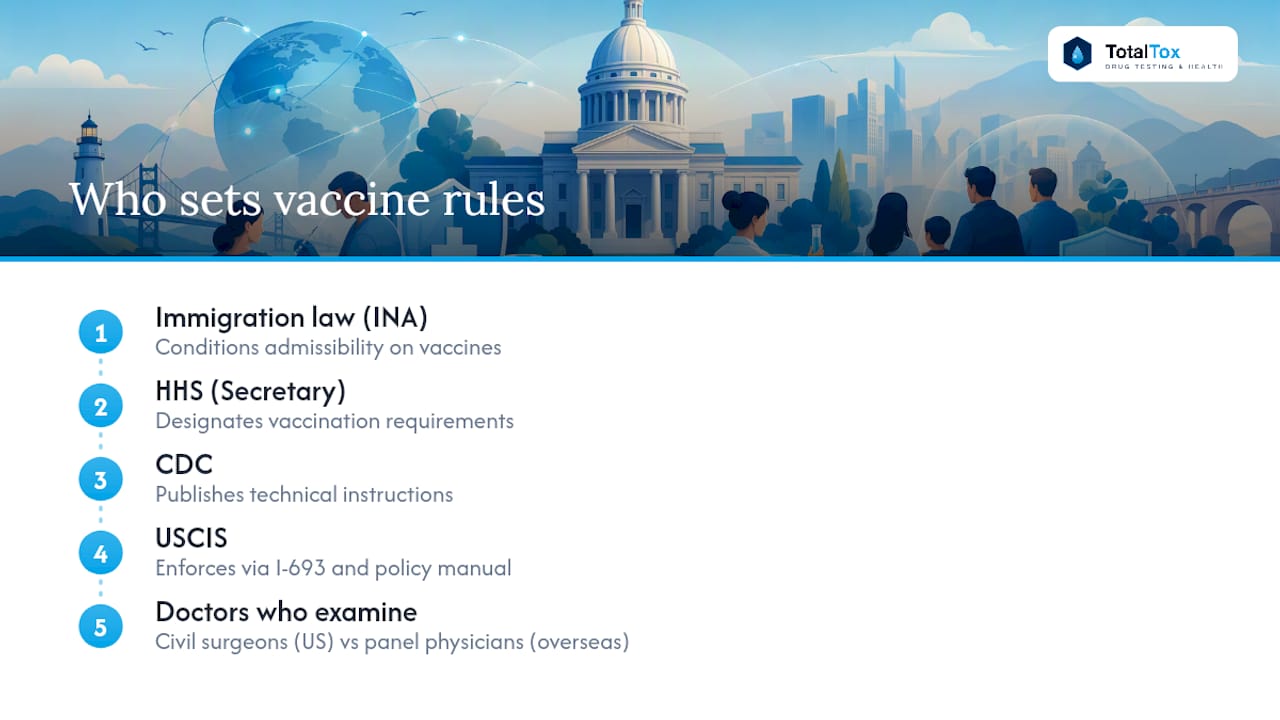
The vaccine requirement isn’t a bureaucratic add-on invented by USCIS. It traces back to the Immigration and Nationality Act, which conditions admissibility on meeting vaccination requirements as determined by the Secretary of Health and Human Services. HHS delegates the technical specifics to CDC, which publishes and periodically updates the Vaccination Technical Instructions for Civil Surgeons. USCIS then enforces compliance through the I-693 and the broader adjudication process described in its Policy Manual.
Some vaccine categories exist on the list because Congress specified vaccination generally as a condition of admissibility; the particular diseases covered come from CDC’s own public-health determination process, which weighs disease burden, vaccine safety data, and ACIP guidance before adding or removing anything. That’s why the list has changed over time (COVID-19 and mpox are recent additions) without any new act of Congress being required.
Civil surgeons and panel physicians are not interchangeable, even though they perform similar exams. A civil surgeon is a USCIS-designated doctor practicing inside the United States who examines applicants already here, typically those filing for adjustment of status under Form I-485. A panel physician performs the equivalent exam overseas, for applicants going through immigrant visa processing at a U.S. consulate. Both follow the same CDC Technical Instructions, but they operate under separate USCIS and Department of State oversight chains, and the paperwork each produces (Form I-693 domestically, DS-3025-linked medical documentation abroad) differs accordingly.
Age-Based Vaccine Requirements: A Quick Reference
Civil surgeons don’t eyeball your age and guess. They apply your age on the exam date directly against CDC’s Table 1, which maps out exactly which vaccines apply to which age bands. Knowing the general pattern before your appointment helps you anticipate what’s coming and gather the right records.
A few age cutoffs matter more than others. Applicants born before 1957 are often presumed immune to measles without needing documented proof, based on the near-universal exposure that generation had to the disease before vaccines existed. Hepatitis B requirements shift depending on birth year and prior risk exposure. Pneumococcal vaccination rules differ sharply between healthy adults and those over 65 or with qualifying health conditions. And influenza, unlike the others, is required only when the exam falls during flu season as defined in USCIS guidance, which typically runs from fall through spring.
| Age group | Vaccines typically required |
|---|---|
| Infants and children (pediatric age) | DTaP, polio, MMR, Hib, hepatitis A and B, rotavirus, varicella, pneumococcal |
| Children and adolescents (child and teenager) | Tdap, polio, MMR, hepatitis A and B, varicella, meningococcal, HPV series as applicable |
| Adults (adult) | Tdap or Td booster, MMR (unless presumed immune), hepatitis B, varicella, seasonal influenza (in season), COVID-19 |
| Adults 65 and older | Tdap or Td booster, pneumococcal vaccination, seasonal influenza (in season), COVID-19 |
Rotavirus and Hib drop off the list entirely once an applicant ages out of the pediatric window, since those series are only given to infants. MMR requirements can also shrink for applicants who qualify for the pre-1957 presumption or who can document prior lab-confirmed immunity, which is where titers become genuinely useful.
Can Lab Titers Replace a Vaccine Requirement?
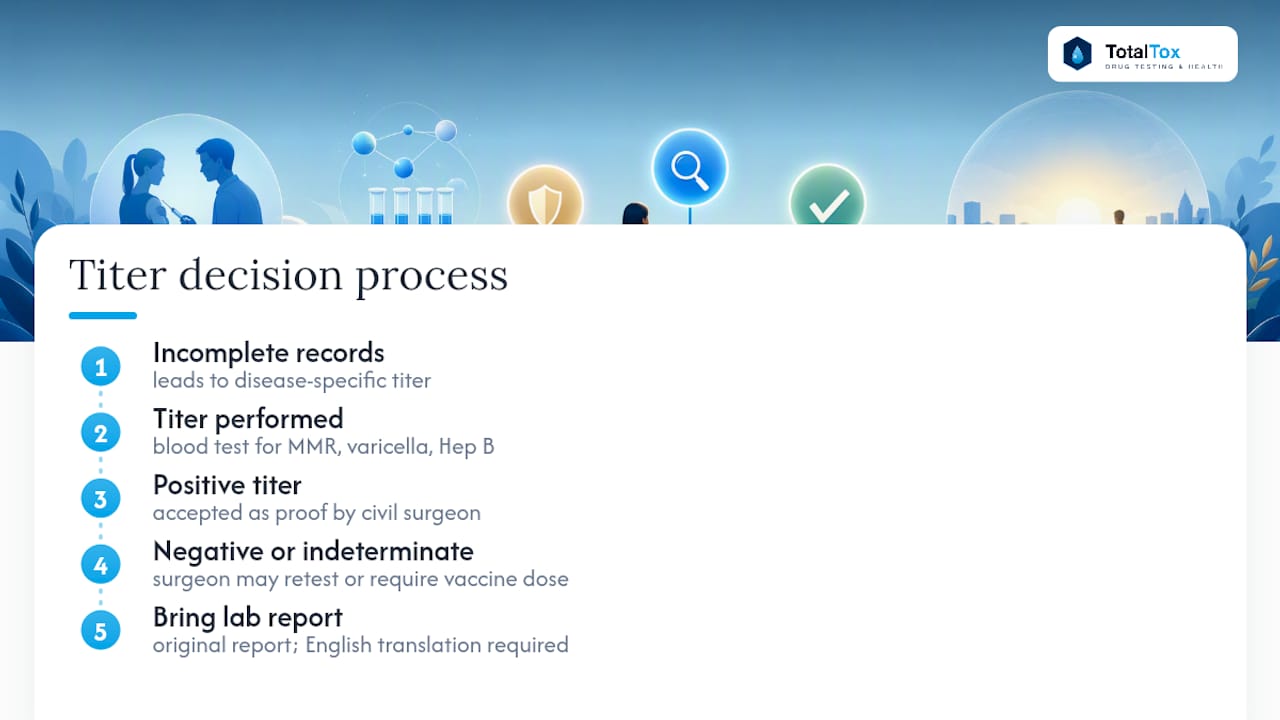
Yes, for several diseases, a blood test showing existing immunity can stand in for the vaccine itself. A titer measures the level of antibodies in your blood against a specific disease. If the result shows you’re already immune, whether from a past infection or from vaccination you can’t fully document, the civil surgeon can accept that as proof and mark the requirement met without giving another dose.
Titers are most commonly used for measles, mumps, rubella (the MMR set), varicella, and hepatitis B. This matters most for applicants who grew up outside the United States, where vaccination records may be incomplete, informally kept, or written in a format the civil surgeon can’t easily verify.
Civil surgeons treat a positive titer as legitimate evidence, but they’re not obligated to accept just any lab slip handed to them. Bring the original laboratory report, not a summary or a photo on your phone, and have it translated into English if it wasn’t issued that way. Some civil surgeons will order a confirmatory titer through their own affiliated lab if the document looks incomplete or the dates don’t line up with your other records. Since USCIS guidance allows titers as acceptable evidence, ask ahead of time whether your civil surgeon’s office can order one on the same day if you show up without prior lab work. That single phone call can save you a second appointment.
When Is a Vaccine Marked ‘Not Medically Appropriate’?
Not every applicant can or should get every vaccine on the list, and CDC built flexibility into the system for exactly that reason. When a vaccine genuinely doesn’t apply, the civil surgeon marks it “not medically appropriate” directly on Form I-693. That notation functions as the waiver. You don’t file a separate application or pay an extra fee for it.
The standard reasons a civil surgeon can use this designation include:
- The applicant’s age falls outside the range where the vaccine is recommended.
- A genuine medical contraindication exists, such as an allergy to a vaccine component or a condition that makes the vaccine unsafe.
- The vaccine isn’t appropriate given the applicant’s pregnancy status.
- Not enough of the vaccine series remains to matter (for example, an applicant who already had three of the four expected doses as a child).
- The exam isn’t occurring during flu season, which makes the influenza vaccine requirement inapplicable at that time.
This is different from a religious or moral objection to vaccination, which follows a separate, formal waiver process filed with USCIS. That route requires demonstrating the objection is based on a sincerely held religious or moral conviction, not just personal preference, and USCIS reviews and can deny those waiver applications. Applicants considering it should understand the risk: a denied waiver can leave the vaccination requirement unresolved and stall the I-485 decision, so it’s not a route to take lightly or as a way to simply avoid a shot you’d rather skip.
What Happens if You’re Missing Vaccine Doses?
Civil surgeons don’t require you to arrive with every series fully completed, which surprises a lot of applicants who assume one missed booster from childhood will derail the whole exam. If your records show you’re missing a dose in a multi-dose series, the civil surgeon typically administers just one dose on the spot, and that single dose is usually enough to mark the requirement as met for immigration purposes.
The rest of the series doesn’t vanish, though. Civil surgeons will note what’s outstanding, and you can finish the remaining doses through your regular primary care provider, a public health clinic, or the same civil surgeon’s office if they offer walk-in vaccination visits.
COVID-19 vaccination offers a good example of how this plays out in practice. An applicant who already completed a full COVID-19 vaccination series before the exam walks in with one less thing to worry about; the civil surgeon simply documents what’s already been done. Someone starting from zero gets an initial dose at the visit and finishes the rest on their own timeline, without holding up the rest of the exam or the I-693 paperwork.
What to Bring to Your Civil Surgeon Appointment
A little preparation before you walk in saves real time and money. Gathering and translating vaccine records before the appointment is consistently the single most effective step applicants can take to avoid redundant vaccination or delays, and it costs nothing but a little advance planning.
- Bring your original vaccination records, including childhood immunization cards, school health records, or a printout from your pediatrician’s or family doctor’s office.
- If any records are in a language other than English, bring a certified or reasonably accurate translation alongside the original.
- If you have a prior Form I-693 or a DS-3025 from a previous immigration medical exam, bring that too, even if it’s expired.
- Bring any lab reports showing titer results for measles, mumps, rubella, varicella, or hepatitis B if you have them.
- Call the clinic ahead of your appointment to confirm they stock the vaccines you’re likely to need and ask whether flu season timing affects your visit.
- Make photocopies of everything before you go, and write down approximate dates for any vaccine you can’t find paperwork for. A rough date is more useful to a civil surgeon than nothing at all.
Pro Tip: If you were vaccinated as a child in another country, request records from that country’s health ministry or your childhood clinic months in advance. International record requests routinely take longer than U.S. ones, and starting the process early avoids scrambling right before your exam date.
What Applicants Actually Experience at a Compliance-Focused Clinic
Most delays in this process come down to one thing: incomplete records showing up at the exam with no backup plan. A clinic that handles a high volume of immigration physicals typically has a standard workflow for that. When an applicant arrives without full documentation, staff assess what’s verifiable, order titers where appropriate, and administer any missing initial doses on the spot rather than sending the applicant away to come back later.
Total Tox has run occupational health and immigration physicals in the Bronx for more than 10 years, with a walk-in model designed around speed. Vaccine administration, documentation review, and Form I-693 completion happen in one visit whenever the applicant’s records support it, with MRO-reviewed documentation practices carried over from the clinic’s broader compliance testing work. That same operational discipline, built for employers who can’t afford delays, applies directly to applicants who need their exam done right the first time.
A Note From the Clinic Floor on What Actually Slows People Down
The single biggest thing we see stall an exam isn’t a medical complication. It’s an applicant showing up with no vaccine paperwork at all, expecting the civil surgeon to somehow reconstruct their childhood immunization history from memory. Bring whatever you have, even partial records, because partial beats nothing every time.
If you’re scheduling anywhere close to flu season or you know you’re missing multiple doses, book earlier than you think you need to. Clinics that offer walk-in vaccinations and handle the sealed I-693 packet correctly the first time save applicants from a second trip and a second bill. That’s the whole game here: showing up prepared, and picking a clinic that treats your paperwork with the same seriousness you do.
— Total Tox
How Total Tox Handles Your Immigration Medical Exam
Total Tox is the practical alternative to bouncing between your primary care doctor, a separate vaccine clinic, and a civil surgeon’s office to piece together one exam. Everything happens in a single walk-in visit: vaccine review, on-site administration of any missing doses, and completion of your sealed Form I-693, with results and documentation turned around fast so your I-485 filing doesn’t stall on paperwork.
That matters most for applicants working against a filing deadline or trying to avoid a second appointment because a titer needed confirming or a dose was missing. Total Tox’s immigration medical exam services are built around the same fast, audit-ready documentation model the clinic uses for its DOT and workplace compliance testing, serving the Bronx, Manhattan, Westchester, and Queens. If you’re preparing for adjustment of status and want your vaccine requirements handled correctly in one visit, schedule your exam and bring whatever vaccine records you have. The staff will take it from there.
Sources
Keep these on hand while you prepare for the exam and file Form I-485:
- Vaccination | Technical Instructions for Civil Surgeons
- Report of Immigration Medical Examination and Vaccination Record | USCIS
If your case involves overseas processing instead, review general visa medical insurance and exam requirements for comparison. The rules for consular panel physician exams differ from domestic civil surgeon procedures.